Making Significant Strides towards a Net Carbon Zero Future
In a rapidly evolving global energy landscape shaped by climate imperatives and energy security concerns, the oil and gas sector is undergoing a fundamental transformation in the areas of cleaner fuels and low-carbon energy. India's rising energy demand and development aspirations place it at the forefront of the global energy transition. Reliance is committed to enabling this shift by deploying large-scale, technology-led decarbonisation solutions that balance growth, affordability and sustainability.
Reliance's climate strategy is anchored in accelerating the transition from fossil fuel-based systems to cleaner energy and materials, while strengthening domestic manufacturing and technological self-reliance. Through sustained investments in renewable energy, bioenergy, green hydrogen, energy storage and circular materials, the Company is building an integrated clean energy ecosystem at global scale. This transformation demands significant investments in skills, advanced manufacturing and deep technology, reinforcing Reliance's long-term commitment to building its New Energy and New Materials businesses while supporting India's vision of a secure, resilient and self-reliant energy economy.
The Reliance Commitment
To achieve its Net Carbon Zero target by 2035, Reliance has committed to:
- Establishing and enabling 100 GW of renewable energy capacity by 2030
- Investing across the clean energy value chain, including future-ready upstream and downstream technologies
- Building giga-scale manufacturing facilities to deliver a fully integrated renewable energy ecosystem
- Transforming its operations towards Net Carbon Zero performance
Net Carbon Zero Strategy
Reliance's Net Carbon Zero ambition represents a strategic transformation that positions it advantageously in evolving energy markets. The Company's approach is guided by three core principles:
Backward Integration
Integrating scientific knowledge, innovation and digitalisation to build and operate truly integrated systems that deliver on cost and performance.
Robust Business Model
Building a model that captures the irreversible upward trend in the demand for green, clean and renewable energy in India and globally, alongside the decreasing cost of production.
Scale
Improving the efficiency, performance and life cycle of its assets and operations to achieve total system optimisation and economics.
These principles guide the transformation of existing energy assets and the development of next-generation clean energy platforms.
Focus on Deep Tech and R&D Capabilities
Through a dual strategy of global collaboration and proprietary R&D, Reliance is cementing its leadership in deep-tech energy solutions. The Company's 'India-first' engineering approach ensures that advanced technologies-ranging from solar PV to hydrogen systems-remain cost-competitive at scale.
The Company's research increasingly treats CO2 as a circular resource rather than a waste product. By integrating waste-plastic pyrolysis and biomass fuels, Reliance is transitioning its portfolio toward sustainable, low-carbon materials. Furthermore, Reliance's carbon fibre operations at Hazira will provide the specialised, lightweight materials essential for the future of aerospace, defence and hydrogen storage applications.
Implemented energy saving schemes of 330 GJ/hr and achieved 2.4 Million GJ energy savings during the year
0 Million GJ
Renewable Energy Consumption
FY 2025-26 Milestone
Successfully produced the first 200 MWp of high-efficiency HJT modules, demonstrating technology validation
Capacity ramp-up underway towards 10 GWp
Battery giga-factory on track to commission in phases in 2026-27
Electrolyser giga-factory progressing as planned
Establish and enable 100 GW renewable energy
Net Carbon Zero target
Clean Energy Transition
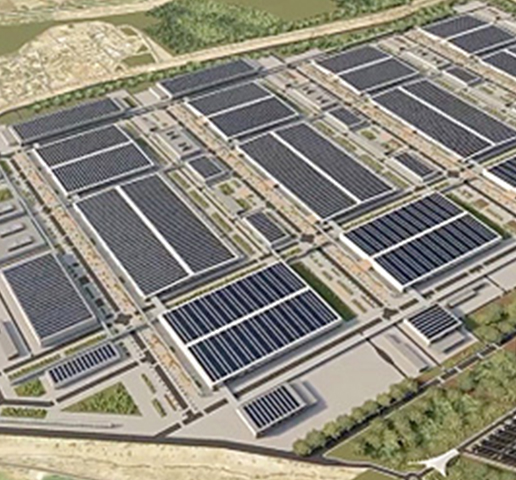
Reliance's clean energy transition is anchored by the Dhirubhai Ambani Giga Energy Complex at Jamnagar, envisioned as the world's largest and most integrated New Energy manufacturing ecosystem outside China. Designed as a 'sand-toelectrons-to-green molecules' platform, the complex integrates solar PV, battery storage, electrolysers and green chemical pathways at unprecedented scale, supported by a strategic focus on renewable energy transition, carbon capture and utilisation, and industrial decarbonisation.
Construction and engineering activities progressed rapidly during FY 2025-26, with focus on cost leadership, future-proof technology, and readiness and reliability. The solar PV module manufacturing became operational, with the first 200 MWp of heterojunction (HJT) modules produced, delivering higher energy yield, improved temperature performance and lower degradation. The facility is being scaled in phases to 10 GWp per annum, with expansion to 20 GWp planned. The Company also plans to develop a 6 GWp solar power project in Andhra Pradesh.
The battery giga-factory, targeted for commissioning from 2026, will initially deliver 40 GWh of annual capacity, scalable to 100 GWh, enabling round-the-clock renewable power and grid-scale storage. In parallel, the electrolyser giga-factory is being developed with capacity scalable up to 3 GW per year, supporting cost-competitive green hydrogen production. Reliance is targeting 3 MMTPA of green hydrogen equivalent capacity by 2032.
In Kutch, Gujarat, Reliance is developing a large-scale solar project across 5,50,000 acres, with potential for peak deployment of 55 MWp per day. Integrated with marine and land infrastructure at Jamnagar and Kandla, it will enable production and export of green hydrogen derivatives, including green ammonia, green methanol and Sustainable Aviation Fuel (SAF).


