

Forward-looking Overview Statement
The report contains forward-looking statements, identified by words like ‘plans’, ‘expects’, ‘will’, ‘anticipates’, ‘believes’, ‘intends’, ‘projects’, ‘estimates’ and so on. All statements that address expectations or projections about the future, but not limited to the Company’s strategy for growth, product development, market position, expenditures and financial results, are forward-looking statements. Since these are based on certain assumptions and expectations of future events, the Company cannot guarantee that these are accurate or will be realised. The Company’s actual results, performance or achievements could thus differ from those projected in any forward-looking statements. The Company assumes no responsibility to publicly amend, modify or revise any such statements on the basis of subsequent developments, information or events. The Company disclaims any obligation to update these forward-looking statements, except as may be required by law.
GLOBAL
Global economic growth remained healthy at 3.6% in CY 2018, as against 3.8% in CY 2017, impacted by weaker performance in the European Union and China. This was driven by a boost in spending due to tax cuts by the United States, which grew at 2.9%, equalling its decade-high growth achieved in 2015. Global trade growth was robust in the first half of 2018, as oil prices rallied due to the impending re-imposition of sanctions on Iran by the United States along with continuing declines in production in Venezuela. Trade tensions and imposition of tariffs saw front loading of imports in 2018.
Global trade weakened towards the end of 2018 partly due to the impact of tariff increases in the United States and China and higher energy prices. The global trade slowdown was led by a sharp deceleration in import demand in emerging markets. Given relatively weaker growth outlook, China is implementing a stimulus package and the United States Fed has indicated a pause in the monetary policy tightening cycle. These policy support measures could potentially help offset growth weakness in the European Union, and be supportive for global demand and commodity prices in the near term.
Higher oil prices had an impact on demand across the hydrocarbon chain, with global oil demand growth slowing to 1.2 mbpd in 2018 from 1.5 mbpd in 2017. Key petrochemical feedstock Ethylene demand growth in 2018 also slowed to 3% y-o-y v/s 5.5% growth in the previous year. Volatility in feedstock prices, muted demand and incremental supply from new capacities led to a challenging environment for businesses in the energy chain.
INDIA
Indian economy remained the fastest growing major economy in the world in CY 2018. In FY 2018-19, the estimated Gross Domestic Product growth rate is 6.8%, driven by strong private consumption growth at 8.1%.
The economy continued to witness an increase in investments, with Gross Fixed Capital Formation growth at a six-year high of 10%. Healthy industrial activity continued, and services indicators sustained positive trends with services credit, air traffic growth, and commercial vehicle sales clocking double digit growth. Services exports growth at 17%, is at a seven-year-high. With continuing policy initiatives, India moved to the 77th rank from 100th, in terms of ease of doing business.
For FY 2018-19, India’s oil demand grew at about 3% y-o-y with consumption-led demand growth in gasoline (+8.1%), gasoil (+3.0%) and jet fuel (+9.1%). The demand was driven by robust growth in commercial vehicle sales and strong air traffic growth during the year. On the rural side, tractor sales and three-wheeler sales declined from the highs of FY 2017-18, but continued to grow in double digits. Domestic demand growth for petrochemical products was healthy with both polymer and polyester demand growing at 7.0% y-o-y.
India continues to embrace the digital life. Reliance Jio has propelled India to become the largest mobile data consuming economy in the world. With ubiquitous and reliable data services, data networks are increasingly being used for media and entertainment, education, market information and for transactions among other use-cases. Adoption of digital transactions witnessed exponential growth. UPI payments grew from 0.7% of GDP in FY 2017-18 to 4.7% in FY 2018-19, while credit card growth averaged a strong 32% y-o-y in FY 2018-19.
Personal consumption trends remain strong with personal credit at a healthy 18% y-o-y, reflective of the strength in India’s consumption cycle. Reliance Retail continues to benefit from strong demand growth across consumer staples and discretionary goods and its ability to deliver a superior customer experience and value proposition.
FY 2018-19 marked the coming of age of Reliance’s consumer businesses. From a mere 2% EBITDA contribution in FY 2015-16, consumer businesses now account for 24.6% of RIL’s consolidated EBITDA. During the year, RIL’s segment EBITDA grew by 23% to `87,640 crore, led by record earnings from petrochemicals, digital services and retail businesses.
Petrochemical business achieved record EBITDA of `37,645 crore, up 45.6% y-o-y. This was led by record production volume This was led by record production volume of 37.7 MMT and a strong polyester chain margin environment. Petrochemical earnings demonstrated the earnings power of the new plants commissioned over the last investment cycle, unmatched integration and feedstock flexibility.
Refining business was impacted by weak light distillate cracks and volatile crude price environment. During the year, all units of the Gasification complex were started safely and are currently under stabilisation.
Reliance Jio continues to add subscribers at a rate unprecedented in the telecom or technology world. With 306.7 million mobile data subscribers, Jio has been the key catalyst in the creation of a broadband data market in India and is now ranked #1 among mobile telecom operators in the country, by Adjusted Gross Revenue (AGR).
Another key pillar of growth during the year was the organised retail business, which crossed the `1,00,000 crore milestone and achieved record EBITDA of `6,201 crore. Reliance Retail continued accelerated expansion of its nation-wide footprint and operationalised 2,829 stores during the year, crossing the 10,000 stores milestone.
REFINING & MARKETING – WEAK
LIGHT DISTILLATE CRACKS LEAD
DOWN MARGINS
During the year, benchmark Brent oil prices
were up 22% due to geo-political tensions,
supply disruptions from Venezuela, Iran
and Libya as well as OPEC+ production
cuts. Demand growth was impacted by the
high pump level prices in the US and other
economies, along with slower growth in
the Chinese economy. Global oil demand
growth slowed down to 1.2 mbpd, leading
to supply-demand mismatch in products
like gasoline resulting in significant margin
erosion.
RIL’s gross refining margins declined to US$9.2/bbl led by weak light distillate cracks, which was only partially offset by resilient middle distillate cracks.
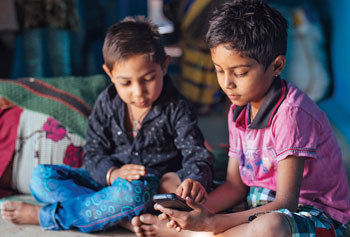
With 306.7 million mobile data subscribers, Reliance Jio has propelled India to become the largest mobile data consuming market in the world.
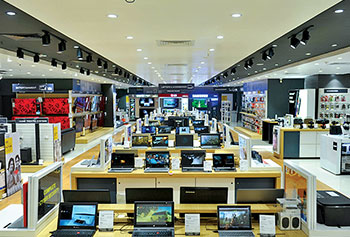
Reliance Retail crossed the milestone of turnover of `1,00,000 crore during FY 2018-19.

LLDPE facility at Refinery Off - Gas Cracker (ROGC) complex, Jamnagar
Operational excellence and flexibility helped Reliance maintain a significant US$4.3/bbl premium over the regional benchmark – Singapore Refining Margins. The resilient performance by Reliance’s refining business was supported by proactive crude sourcing, optimising of product yields and robust risk management in a challenging environment.
PETROCHEMICALS – RESILIENT
BUSINESS MODEL SHINING
THROUGH
Petrochemicals business delivered its
best ever performance, with EBITDA
contribution of `37,645 crore, up 45.6%
y-o-y. Petrochemical production was also at
a record high of 37.7 MMT, up 16% y-o-y.
The strong results were achieved in an environment of declining utilisation rates in key product chains with new supply ramp-up. This demonstrates the resilience of the Reliance business model based on deep inter-linkages between refining and petrochemical chains, feedstock flexibility and the wide product portfolio. While polymer chain margins were impacted by new supplies out of the US Ethane based crackers, polyester chain profitability continued to be robust led by a strong PTA and PX margins.
With the commencement of ethane cracking at Nagothane, all the key components of Reliance’s petrochemical investment cycle are now fully contributing to earnings.
OIL AND GAS EXPLORATION &
PRODUCTION – NEW PROJECTS TO
START CONTRIBUTING FROM THE
NEXT FISCAL YEAR
Reliance is undertaking development
of three ultra-deep / deepwater, High
Pressure High Temperature (HPHT)
R-Cluster, Satellite- Cluster and D55 (MJ)
fields. First gas from R-Cluster is expected
by mid-2020 followed by Satellite Cluster
and MJ fields over the next two years. The
new development will leverage Reliance’s
partnership with BP, existing infrastructure
in the Krishna-Godavari Basin and
downturn in the capital equipment and
service provider market.
RELIANCE RETAIL –
GROWTH ACROSS ALL KEY
CONSUMPTION BASKETS
Reliance Retail achieved record turnover of
`1,30,566 crore, up 88.7% y-o-y. Turnover
growth was driven by rapid store expansion
and robust growth in same-store-sales.
Reliance Retail achieved its highest ever EBITDA of `6,201 crore, up 145% y-o-y. The strong operating performance was driven by 100 bps improvement in EBITDA margin to 4.7%.
Continuing strong growth momentum, Reliance Retail has achieved revenue CAGR of 55% and EBITDA CAGR of 76% over the last 5 years
Reliance Retail operated 10,415 retail stores in over 6,600 towns and cities covering an area of 22.0 million sq. ft. as of March 2019. A record footfall of over 500 million was received during the year, a growth of 44% y-o-y. Reliance Retail is now working on plans to launch a differentiated New Commerce platform, which will enable millions of small merchants across the country to compete in a digital age.
DIGITAL SERVICES – STRONG
TRACTION IN SUBSCRIBER
ADDITION AND USER ENGAGEMENT
Jio continued its robust growth momentum
during FY 2018-19. Digital Services business
revenue grew by 94.5% to `46,506 crore
and EBIT grew by 176.7% to `8,784 crore.
This was driven by strong adoption of Jio
services, reflected in strong subscriber
addition and usage metrics on data and
voice. Reliance Jio added 120.1 million
subscribers during the year, taking total
subscriber base to 306.7 million.
Jio is now India’s largest mobile telecom operator ranked by Adjusted Gross Revenue (AGR). Jio leads the Industry in terms of Average Revenue Per User (ARPU) (`126.2/ month), with healthy average voice consumption (823 minutes per user per month) and average data consumption (10.9 GB per user per month). Total data consumption on a monthly basis exceeds 3 Exabytes in March 2019. Jio has built a video-ready all IP-network as evidenced by video data consumption on the network of over 500 crore hours per month.
Jio is aiming to provide global standard wireline infrastructure and services in India through its FTTH and Enterprise offerings. To accelerate this rollout, RIL has made strategic investments in Hathway Cable and Datacom Limited and DEN Networks Limited.
Jio also continues to execute on its plans of building a digital ecosystem spanning across media and entertainment, commerce, education, healthcare and agriculture.
MEDIA – STRENGTHENING
OFFERING AHEAD OF EVOLVING
MARKET TRENDS
Reliance is committed to offering
differentiated and relevant media
content for the Indian market as part of
its digital services bouquet. As part of
this commitment, Reliance is investing in
creation of original content relevant for
the evolving trends in media consumption,
to be delivered in a pipe-and-platformagnostic
manner to India’s diverse
populace. Through owned content-engines
and symbiotic partnerships, Reliance
is building an extensive media content
library which will cater to all segments of
the audience, and dovetail with its wide
delivery platforms.
Reliance’s flagship media company Network18 continued on its growth trajectory, and invested in key areas to fill whitespaces or fortify its competitive position. Impetus on identified growth areas of vernacular content and digital delivery continued during the year, and the strength and reach of multiple powerful brands was extended across regions and mediums. Growing ad-spends in regional channels (news, led by regional elections and continued rise of viewership share; and entertainment, driven by rising consumption and value-perception) was a consistent theme for the TV channel portfolio as well as Digital properties.
CORPORATE STEWARDSHIP
Reliance is committed towards promoting
a balanced economic growth and
establishing an inclusive and sustainable
growth for all.
During FY 2018-19, Reliance contributed `1,16,251 crore to the national exchequer and `904 crore towards various community development initiatives focused in the areas of rural transformation, health, education, sports for development, disaster response, arts, culture and heritage and urban renewal. Reliance Foundation has touched the lives of 26 million Indians since inception.
The management at RIL follows an integrated thinking approach which leads up to six capital approach and helps in ensuring a sustainable future. Different businesses in Reliance foster physical, digital and biological innovations, thus, exhibiting readiness for future megatrends and empowering the fourth industrial revolution.
DIGITAL PLATFORMS
During the year, Reliance initiated platform
driven organisation processes
to tap significant potential for its
businesses to improve efficiency and
facilitate informed and agile decision
making process.
REAL ESTATE DEVELOPMENTS
NMSEZ PROJECT
RIL entered into a Memorandum of
Understanding (MoU) with the Government
of Maharashtra to develop a Global
Economic Digital & Services Hub with
global partnerships. RIL through its wholly
owned subsidiary has entered into an MoU
with NMSEZ to sub-lease land of about
4,000 acres along with the associated
development rights. The Project will usher
the Industry 4.0 Revolution in Maharashtra
and will induce significant Industrial
growth, not only by offering world class
Infrastructure but also by partnering with
the best of global technology companies
in the areas of Innovation and Learning,
Research & Development, Technological Advancement and building efficient
Manufacturing and Service capabilities.
INDIAN FILM COMBINE
RIL through its wholly-owned subsidiary
has acquired majority stake in Indian Film
Combine, which is building a Drive-in
Theatre, Hotel, Retail Mall and Clubhouse at
Bandra Kurla Complex (BKC) in Mumbai.
JIO WORLD CENTRE
The Company is also constructing a state of-
the-art, world-class Convention Centre,
Performing art Theatre, Retail Mall, Office
space and Clubhouse at Bandra Kurla
Complex (BKC), Mumbai.
Both these projects are aimed at making BKC the most attractive Retail, Entertainment and Cultural destination of Mumbai city along with a much needed world-class Convention Centre.
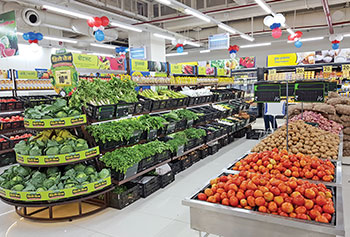
Reliance Retail has achieved revenue CAGR of 55% and EBITDA CAGR of 76% over the last 5 years.

The resilient performance by Reliance’s refining business was supported by proactive crude sourcing, optimising of product yields and robust risk management in a challenging environment.

Jio leads the Industry in terms of ARPU (`126.2/month), average voice consumption (823 minutes per user per month) and average data consumption (10.9 GB per user per month).
Alok Agarwal
Srikanth Venkatachari
The year was characterised by volatile macro-economic environment. Adding to uncertainty were higher oil prices in the first half of the year and increasing geo-political tensions through the year. Reliance achieved its best ever performance in this environment with record contribution from petrochemicals, retail and digital services businesses.
Robust operating performance for the year underscored the strength of the petrochemicals business that we have reinforced over the last investment cycle. Furthermore, our consumer businesses continue to scale new heights with industry leading metrics. The scalability of retail and digital services business platforms has created unprecedented value for all stakeholders.
At Reliance, we continue to maintain strong balance sheet with investment grade ratings. Our scale of energy business operations and growth catalyst in consumer businesses will help deliver superior and reliable returns over the long term.
FINANCIAL INFORMATION – CONSOLIDATED AND STANDALONE
REVENUE
Reliance achieved consolidated revenue
of `6,22,809 crore (US$90.1 billion),
an increase of 44.6%, as compared to
`4,30,731 crore in the previous year.
Increase in revenue was primarily
on account of volume increase with
stabilisation of petrochemicals projects
and oil price related increase in realisations
in the refining and petrochemical products.
The higher volumes in petrochemicals
business are on account of first full year of
operations of new petrochemical facilities.
Reliance’s consolidated revenue was also
boosted by robust growth in retail and
digital services business, which recorded
an increase of 88.7% and 94.5% in revenue,
respectively as compared to the
previous year.
PROFIT
Volume growth in petrochemicals and
rapidly increasing contribution from
consumer businesses led to significant
rise in operating profit for the year.
Operating Profit before other income and
depreciation increased by 30.8% on a y-o-y
basis to `83,918 crore (US$12.1 billion) as
compared to `64,176 crore in the previous
year. Profit after tax before exceptional
item was higher by 13.1% at `39,588 crore
(US$5.7 billion) as against `34,988 crore in
the previous year. Relatively lower growth
in profit after tax is mainly due to higher
interest charges and depreciation due to
stabilisation of projects.
SEGMENT REVIEW
- Refining and Marketing – Revenue (including inter segment transfers) increased by 28.7% y-o-y to `3,93,988 crore (US$57 billion) primarily on account of higher crude prices during the year. Segment EBIT decreased by 19.8% to `19,868 crore (US$2.9 billion), impacted by significantly higher crude prices, weak product cracks, lower light-heavy differential and unplanned shutdown of Fluid Catalytic Cracking (FCC) Unit. GRM for FY 2018-19 stood at US$9.2/bbl, outperforming Singapore complex margins by US$4.3/bbl.
- Petrochemicals – Revenue (including inter segment transfers) increased by 37.3% y-o-y to `1,72,065 crore (US$24.9 billion), primarily due to higher prices and volumes, which reflected full benefits of ROGC and Paraxylene capacity expansion projects. Petrochemicals segment EBIT increased sharply by 51.9% to its highest ever level of `32,173 crore (US$4.7 billion).
- Oil and Gas – Revenues decreased by 3.8% y-o-y to `5,005 crore. Volumes from domestic upstream fields and US shale were lower on account of natural decline and slowdown in development activity. Segment EBIT was at `(1,379) crore as against `(1,536) crore in the previous year. For the year, domestic production (RIL share) was at 58.9 Bcfe, down 25.4% y-o-y and in US Shale (RIL share) business was 94.5 Bcfe, down 32.4% y-o-y basis.
- Organised Retail – Revenues grew by 88.7% y-o-y to ` 1,30,566 crore. Business PBDIT for FY 2018-19 grew by 145.2% y-o-y to ` 6,201 crore. EBITDA margins improved 100 bps to 4.7% boosting operating profitability. Reliance Retail further consolidated its leadership position and is India’s largest, most profitable and fastest growing retailer.
- Digital Services – The business recorded revenues of `46,506 crore, with year-end subscribers base at 306.7 million. Reliance Jio reported strong financial performance for the year. Segment EBIT was at `8,784 crore for the year, with EBIT margin of 18.9% as against 13.3% in previous year.
OTHER FINANCIAL HIGHLIGHTS
Other Income before exceptional item
was lower at `8,635 crore (US$1.2 billion)
as against `8,862 crore in the previous
year, primarily on account of adverse yield
movement.
Finance Cost was at `16,495 crore (US$2.4 billion) as against `8,052 crore in the previous year. The increase was primarily on account of commencement of digital services business, petrochemical projects at Jamnagar and higher loan balances.
Depreciation (including depletion and amortisation) was higher by 25.3% to `20,934 crore (US$3.0 billion) as compared to `16,706 crore in the previous year, primarily on account of commencement of wireless service business in Reliance Jio. Higher depreciation also reflected the capitalisation of new projects in the petrochemicals business.
Basic Earnings Per Share (EPS) for the year ended March 31, 2019 was at `66.8 as against `60.9 in previous year.
The Board of Directors of the Company has recommended dividend of `6.5/- per fully paid up equity share of `10/- each, aggregating `4,641 crore (US$671 million), including dividend distribution tax.
Reliance’s fixed assets (excluding goodwill) stood at `5,65,840 crore (US$81.8 billion) as on March 31, 2019. This includes RIL Standalone's fixed assets of `3,14,745 crore and balance of `2,51,095 crore in its subsidiaries mainly Reliance Jio, Reliance Holding USA and Reliance Retail.
Capital Expenditure for the year ended March 31, 2019 was `1,32,445 crore (US$19.2 billion), including exchange rate difference. Capital expenditure was principally on account of the digital services business, projects in the petrochemicals and refining business and in the organised retail business.
Reliance’s Gross Debt was at `2,87,505 crore (US$41.6 billion). This includes standalone gross debt of `1,61,720 crore and balance in key subsidiaries, including Reliance Jio (`67,018 crore), Reliance Holding USA (`34,848 crore), Reliance Retail Group (`12,832 crore), Independent Media Trust Group (`3,045 crore), Hathway Cable and Datacom Limited (`1,973 crore), Reliance Gas Pipelines Limited (`1,379 crore) and Recron Malaysia (`1,170 crore).
Cash and Marketable Securities were at `1,33,027 crore (US$19.2 billion) resulting in net debt at `1,54,478 crore (US$22.3 billion).
RIL’s standalone Revenue from Operations for FY 2018-19 was `4,00,986 crore (US$58 billion), an increase of 27.2% on y-o-y basis. Profit after tax was at `35,163 crore (US$5.1 billion) an increase of 4.6% against `33,612 crore in the previous year. Basic EPS on standalone basis for the year was `55.5 as against `53.1 in the previous year.
Reliance achieved a consolidated revenue of `6,22,809 crore, growth of 44.6% from previous year.
Standalone revenue from operations at `4,00,986 crore, growth of 27.2% y-o-y.
Hital R. Meswani
C Borar
Srinivas Tuttagunta
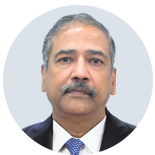
P. Raghavendran
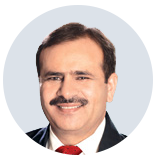
Harish Mehta
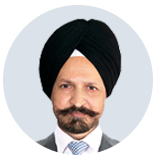
Surinder Saini
RIL continued to outperform Singapore complex margins with a premium of US$4.3/bbl, significantly above its 5-year average. It reflects the robust operational performance, superior configuration and consistent high utilisation of refineries at Jamnagar.
Refining EBIT for the year was down 19.8% y-o-y at ₹19,868 crore led by lower GRM of US$9.2/bbl. The segment performance was impacted by volatile crude prices and multi-year low light distillate product cracks.
Petrochemicals intensity index further improved with enhanced integration post commissioning of paraxylene and ROGC facilities at Jamnagar. RIL also started up all units of the Petcoke Gasification project. On stabilisation, the gasification complex will reduce supplemental energy cost significantly. Petcoke gasification project, is transforming Jamnagar refinery into a unique 'bottom-less' refinery by converting refinery residue into syngas.
RIL expanded its domestic fuel retailing footprint to 1,372 outlets and maintained industry leading throughput per outlet.
Aromatics Complex at Jamnagar
STRATEGIC ADVANTAGES AND COMPETITIVE STRENGTH

BEST-IN-CLASS PORTFOLIO
- Jamnagar site has complexity index of 21.1
- Ability to run a wide basket of crudes and among the lowest cost producers globally
- Strong operational performance with flexible product slate, selling to highest value markets

INCREASING THE ADVANTAGE
- On stabilisation, Petcoke Gasification complex will reduce supplemental energy cost significantly while ensuring value addition to captive Petcoke
- Debottlenecking of Diesel Hydro De-Sulphurisation (DHDS) unit to higher capacity
- Ramp-up of domestic retail network to 1,372 outlets
LOGISTICS AND SUPPLY-CHAIN
- State-of-the-art logistics infrastructure to support the largest refining hub at Jamnagar
- Optimises freight costs through opportunistic use of time charters
- Global outreach with trading offices and tankages at key locations

CRUDE SELECTION AND SOURCING
- Refinery configuration allows crude portfolio optimisation with changing market dynamics
- Eleven new crude grades processed, including new North American light grades and opportunity crude grades from Latin America
MARKET ENVIRONMENT
ROBUST OIL DEMAND GROWTH
ENABLING MARKET RE-BALANCING AND
SUPPORTING PRICES
Global oil demand growth at 1.2 mb/d in
CY 2018 was around the 10-year average
despite higher oil prices. Brent crude oil
price at US$71/bbl in CY 2018 was higher by
30.9% y-o-y. US, China and India accounted
for almost all of the global growth at
1.1 mb/d. Oil demand growth in the US
was the highest at 0.5 mb/d aided by the
commissioning of large ethane crackers,
higher shale production as well as firm
economic growth. Growth in China at
0.4 mb/d and in India at 0.2 mb/d was
largely structural and broad based.
Global oil demand growth was led by ethane, LPG and middle distillates. Demand growth for gasoil was supported by improved economic activity. Gasoline demand growth slowed in 2018 impacted by increase in oil prices.
Chinese oil demand growth was largely stable at 0.4 mb/d led by a growth in petrochemical feedstock and jet fuel. In China, gasoline demand was largely flat y-o-y due to lower car sales. Diesel demand declined in China for 2018 owing to slowing economic growth as well as rising share of natural gas in the energy mix.

NON-OPEC GAINS MARKET SHARE
Global oil supply grew by 2.6 mb/d in
CY 2018. Non-OPEC supply grew by 2.7
mb/d led by the strong supply growth in
North America (2.2 mb/d in the US and 0.4
mb/d in Canada). Supply from Russia was
higher by 0.2 mb/d y-o-y while supplies
from Mexico declined by 0.2 mb/d y-o-y.
OPEC supply contracted by 0.1 mb/d y-o-y in CY 2018 as a result of sharp production declines in Venezuela and adherence to the supply restraint deal between OPEC and non-OPEC producers. Supply from Saudi Arabia was higher by 0.4 mb/d y-o-y as Saudi Arabia took a larger than mandated cut in 2017. Supply from Venezuela fell further by 0.6 mb/d in 2018. Supply from Iran for the full year 2018 was lower only by 0.2 mb/d with US sanctions enforced towards the end of the year.
SUPPLY DISRUPTION LED BY
GEO-POLITICAL DISTURBANCE
SUPPORTED OIL PRICES
Brent crude oil prices averaged
US$70.1/bbl in FY 2018-19, higher by
22% y-o-y. Oil prices increased despite
significantly higher production from non-
OPEC suppliers. Heightened geopolitical
tensions in the Middle East, sanctions on
Iran, sharp production decline in Venezuela
and armed conflict in Libya added to the
uncertainty in oil supply.
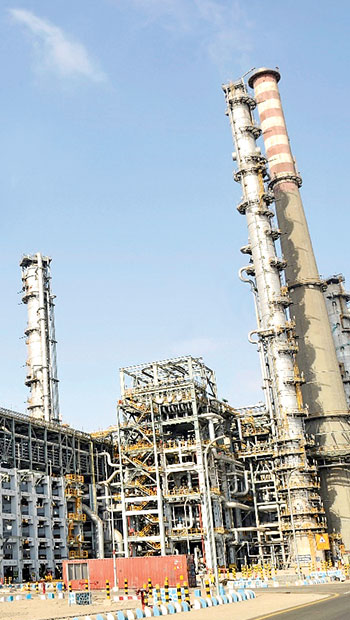
Acid Gas Removal at Gasification Complex at Jamnagar
OIL PRICES (US$/bbl)

FIRM MIDDLE DISTILLATE CRACKS
SUPPORTED REFINING MARGINS
Singapore and North West European
refining margins were lower y-o-y as sharp
decline in light distillate cracks weighed on
stronger middle distillate cracks. Refining
margins in the US Gulf Coast were higher
due to the access to deeply discounted
crude supply from the US as well as from
Canada primarily owing to logistical
constraints for evacuation of crude oil.
Middle distillate cracks gained from firm
economic growth and low inventories
across trading hubs. Refinery utilisation
edged up in CY 2018 to 82.9% compared to
the 5 year average of 81.3% as net refinery
capacity addition lagged oil demand
growth.
Light Distillates
Light distillate cracks were lower in
FY 2018-19 due to moderation in gasoline
demand growth across key markets as well
as higher inventory especially in the US.
Rising oil prices seemed to have an impact
on demand in the US, the largest gasoline
market in the world, where demand was
largely flat y-o-y. Growth in China slowed
after new car sales declined by 3% in
CY 2018. Gasoline demand growth in India
in FY 2018-19 was strong at 8.1% y-o-y
despite higher retail prices.
Middle Distillates
Middle distillate cracks strengthened in
FY 2018-19 over the previous year on firm
global demand growth. Middle distillate
demand growth accounted for close to
two-thirds of the oil product demand
growth globally. Gasoil demand was
exceptionally strong in the US aided by
good economic growth as well as higher
shale oil production. Gasoil demand in
China however, fell by 4% in CY 2018 as
the share of natural gas in the energy mix
continues to increase. Gasoil demand in
India was resilient at 3% despite higher
retail prices. Gasoil demand growth
generally remained firm in other parts of
the world through CY 2018.
Jet fuel demand growth remained strong with Aviation Turbine Fuel (ATF) demand growing 3.0% y-o-y aided by robust 6% y-o-y global international passenger traffic growth and 7% growth in global domestic air travel. Jet fuel demand in India grew by 9.1% led by 18.6% growth in air traffic in CY 2018.
FUEL OIL
Fuel oil demand declined in CY 2018 due to
substitution from other fuels. Fuel oil demand
from the power sector continued to be
impacted by natural gas substitution in the
Middle East and West Asia. Declining heavy
crude oil production (mainly in Venezuela and
Mexico) and lower Latin American refinery
utilisation reduced the availability of fuel oil.
Further, OPEC oil output cut targeted mainly
towards medium and heavy crude grades and
continuing refinery upgrades tightened fuel
oil supply and boosted fuel oil cracks.
STABLE DEMAND OUTLOOK, IMO 2020
IMPLEMENTATION TO SUPPORT REFINING
ENVIRONMENT
Global oil demand is expected to grow by
1.3 mb/d in CY 2019 supported by moderating
oil prices and start-up of petrochemical
projects in US and China. US crude production
is expected to grow sharply in 2019 as well.
Gasoil demand growth is expected to gain from the implementation of stricter marine fuel sulphur specifications starting January 2020. Gasoline demand growth is expected to recover on moderating oil prices as well as rising incomes in emerging markets. Global refinery utilisation is expected to ease with the addition of large green-field refinery capacities towards the second half of CY 2019.
RIL PREMIUM OVER REGIONAL BENCHMARKS ABOVE 5-YEAR AVERAGE
At US$9.2/bbl, RIL refining margin remained relatively strong even in a volatile market.
RIL maintained a significant premium of US$4.3/bbl over the benchmark Singapore
Complex margins. RIL achieved superior refining margins due to optimal secondary unit
utilisation, maximisation of middle distillate yield, dynamic crude sourcing and responsive
product placement.
RIL processed 11 new crude grades this year, including new grades from North America and opportunity crudes from Latin America. During the year, 64 different crude grades were processed.

FINANCIAL AND OPERATIONAL PERFORMANCE
FINANCIAL PERFORMANCE*
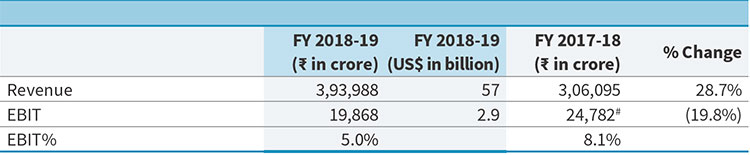
*consolidated
# excludes exceptional item of `1,087 crore representing profit from divestment of stake in Gulf Africa Petroleum
Corporation (GAPCO) during FY 2017-18.
FY 2018-19 revenue from the R&M segment increased by 28.7% y-o-y to ₹3,93,988 crore (US$57 billion), primarily on account of higher average oil prices during the year. Refining EBIT decreased by 19.8% y-o-y to ₹19,868 crore impacted by volatile crude prices, multiyear low gasoline and naphtha cracks. Crude throughput for the year was at 68.3 MMT.
DOMESTIC MARKETING
Market Environment
In FY 2018-19, the petroleum product consumption increased to 212 MMT, growth of 2.7% y-o-y. The industry growth continues to be led by transportation fuels with improving accessibility due to increased network penetration, higher automobile sales and rising disposable income.
On account of their share, the transportation fuels are driving the strong oil demand growth. Gasoline demand grew by 8.1% to 28 MMT and Diesel demand grew by 3.0% to 84 MMT. Growth in demand was facilitated by expansion of retail network and road infrastructure. The total number of retail outlets in India has increased to over 64,624 as both state owned oil marketing companies and private players continue to expand their network presence.
With the implementation of the ambitious Bharatmala and Sagarmala Pariyojana, there is significantly higher government spend on infrastructure development ongoing in the country. These projects are creating new avenues for network expansion and will support demand growth of petroleum products in India over medium-term.
REFINERY SALES (In MMT)

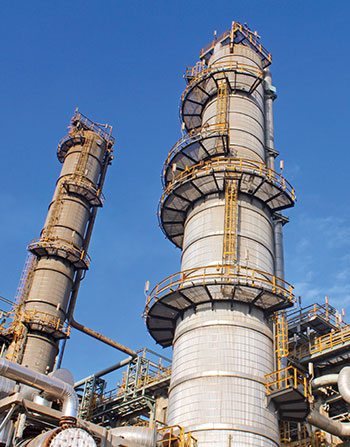
DTA Refinery at Jamnagar
Petroleum Retail Business
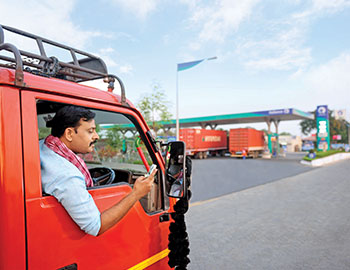
With a countrywide operational network of
1,372 fuel outlets, RIL is covering
all the key highways in the country.
At 0.2 Million, customer count enrolled
in RIL’s marquee fleet programme –
Transconnect, grew by 12.5% during FY
2018-19. RIL registered industry leading
throughput with innovative loyalty
customer programmes and strong
customer value proposition.
RIL registered y-o-y growth of 9.1% in retail Diesel and 21.8% in retail gasoline volume compared to 2.6% and 8.1% for industry, respectively. Share of fleet (trans-connect) sales in the retail volumes is significantly higher than competitors. RIL’s emphasis on quality and quantity (Q&Q) of Fuels, superior service and technology enabled value added offerings at the retail outlets have resulted in industry leading throughput. 'Desh ka Sacha Pump' campaign built around showcasing RIL’s Q&Q proposition continues to resonate with the customers.
- A) Operating Strategy
- RIL serves its family of satisfied
customers with a unique Q&Q fuelling
experience through the entire supply
chain to the Retail Outlets. RIL’s refinery
is technically equipped to produce BS VI fuels and has already started supplies of
the same in the National Capital Territory
(NCT) and adjoining districts.
After being the first Oil Manufacturing Company (OMC) to rollout dynamic pricing regime, RIL has now also become the first OMC to implement Vapor Recovery System (VRS) at retail outlets at all the locations in the mandated geographies within stipulated timelines.
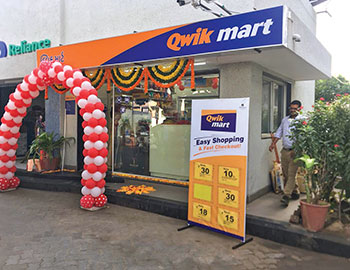
RIL has reinforced its customer value proposition by leveraging the unique synergy of RIL’s group companies – Reliance Retail and Reliance Jio. An array of co-located convenience stores have already been launched in the retail network and company is working on plans to augment the setup. Jio connects each of RIL’s outlet through high end fiber providing best-in-class connectivity which would form the backbone of RIL’s pioneering proactive customer service.
To take the fuel delivery to customer’s door-step, RIL is working on next generation business models. Over 260 sites are serving diesel in packaged containers to non-transport sector in general and telecom sector in particular. RIL has all the requisite regulatory permits for launching diesel in High Density Polyethylene (HDPE) packs.
Mixing its customer-first approach with industry-leading practices, RIL will continue setting higher benchmarks of customer fueling experience in the country.
- B) Digitisation Strategy
- RIL continues leveraging technology to
exceed service expectations of all RIL's
internal and external stakeholders.
As a part of RIL's digital transformation,
both RIL's Customer Service and
Technology are rapidly evolving.
For enabling the same, RIL is working
on the opportunities in the Industry 4.0
landscape. Next generation technologies
such as Artificial Intelligence, Blockchain
and Internet of Things (IoT) are the
epicentre of RIL's business improvement
and enhancement initiatives.
To augment seamless implementation of these services in the field, RIL has already initiated the rollout of state-of-art new age fuel dispensers across the network.
Empowering customers to monitor their fleet on the go, offering flexibility of 24X7 fund transfer for loading their fleet account and introduction of virtual card for enabling quicker transactions continue to resonate well with RIL's key customer segment.
Through its social media channel, RIL endeavours to work closely with the last mile customer for getting service feedback and upgrading the offerings to meet their expectations.
Petroleum B2B Business
- A) HSD – Direct
- Bulk Diesel registered a y-o-y growth
of 5.1% in spite of the concerns around
growing electrification. During the year,
RIL registered a y-o-y volume growth
of 21.7% increasing market share to
8.5% despite difficult market conditions
and competition led margin pressure.
Non-railway business registered an
impressive 34% y-o-y growth.
Alongside strengthening railway business, RIL has also created a strong foothold in the second largest sector in the direct HSD segment through the foray in State Transport Undertaking (STU). Mines, infrastructure and fisheries have all showed promising growth on the back of focused sector specific operating strategy.
Growth in HSD – Direct sales volume would be driven by getting higher volume share in STUs, designing unique operating models for fisheries and mines along with strengthening presence in the Southern markets.

Reliance petro retail outlet
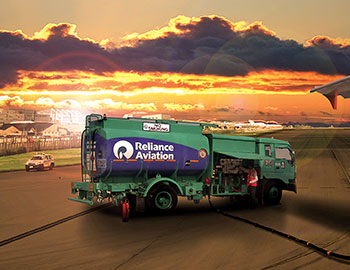
- B) Aviation Turbine Fuel (ATF)
- With a double digit growth for over 50
consecutive months, at a growth rate
of 18.6% in 2018, India is the fastest
growing domestic aviation market in
the world for the 4th consecutive year.
Demand for aviation fuel grew at 9.1%
y-o-y in FY 2018-19. RIL achieved y-o-y
Volume growth of 9.3% to its airline
partners.
In addition to the best in class service standards and end-to-end automation, RIL continues to be the only OMC offering unique turnkey solutions to its airline partners for cost reduction across its network. Having the highest market share at 20% of the operating airports reinforces customer’s trust in Reliance Aviation.
To leverage the soaring Indian aviation market, RIL has enhanced its network of Aviation Fuel Stations to 30 in FY 2018-19 and working on adding another 10 locations in the near term.
- C) Facilitating Nation’s Energy Security
- More than three quarters of RIL’s
production of transportation fuels was
absorbed in the Indian market during
FY 2018-19. In addition to selling through
own retail network and HSD – Direct
segment, the absorption was achieved
by bridging the product deficit of all
the major Public Sector Oil Marketing
Companies in India.
RIL is also partnering with Government in meeting their vision of abolishing indoor pollution to improve the health of rural women. Significant share of the household cooking LPG demand of the Public Sector OMCs is met by RIL.
JAMNAGAR SUPERSITE HAS
COMPLEXITY INDEX OF 21.1
Complexity index (CI) designates the
capabilities of a refinery to upgrade
lowest quality crude to the highest quality
refinery products, including fuels and
petrochemicals. Complexity index of
Jamnagar supersite, as per KBC, a global
refinery consultant, has increased from
earlier 12.7 to 21.1 or a 66.1% boost
with the start-up of Jamnagar expansion
projects, including ROGC and downstream
units, Paraxylene complex and Petcoke
Gasification complex. RIL’s Jamnagar
supersite ranks 1st in the world in
complexity barrels, aided by best-in-class
Refinery and Petrochemicals integration.
OIL TO CHEMICAL
Reliance has developed a future-ready
Oil-to-Chemical strategic vision to,
progressively, transform the Jamnagar
refinery from a leading producer of fuels to
chemicals.
The fundamentals of the Jamnagar oil-tochemical strategy, are to employ advanced molecule management to upgrade the refinery intermediate streams, by value. The Jamnagar oil-to-chemical objectives are to preserve as well as upgrade existing refinery margins, while maximising asset utilisation, for a sustainable competitive cost of chemicals.
RIL has developed a disruptive technology innovation, a Multizone Catalytic Cracking (MCC) process, which converts a wide range of feedstock to high value propylene and ethylene in a single riser. This technology, protected by Reliance’s IP, shall underpin Jamnagar’s oil-to-chemical mission. The oil-to-chemical programme is a roadmap implemented over a long time horizon, based on market outlook and price triggers for refinery fuel products. The ultimate goal is to achieve greater than 70% conversion of crude refined in Jamnagar, to competitive chemical building blocks of olefins and aromatics.
The Jamnagar refinery product slate, at the culmination of oil-to-chemical transition, shall be only jet fuels and petrochemicals. All refined products priced below crude shall be eliminated for chemicals at initial stage. Final fuel de-risking shall target elimination of gasoline, alkylate and diesel, synchronised to the global evolution of E-mobility and transport fuel demand decline.
In summary, the Jamnagar supersite shall continue to maintain a pre-eminence in Reliance’s revenues and earnings, with the oil-to-chemical growth plan.
Market outlook
With expectations of global petrochemicals
demand growing at a faster rate as
compared to transportation fuels in longer
term, some companies are investing to
integrate refinery to petchem to maximise
yields of petrochemicals from every barrel
of oil processed. This can possibly lead to
significant cost savings through economies
of scale and improve competitiveness of
companies undertaking such projects.
New complexes in Asia and the Middle East
have announced projects with 25-40%
crude to chemical conversion. A Leading
Middle Eastern NOC in collaboration with
technology providers has undertaken
research to maximise oil to chemical
conversion to 70%.
R&M PLATFORM
The R&M business has already embarked
on Journey of Platform Based Ways
of Working. Also single unified source
(Datalake) for all the organisation data,
is established. Advanced analytical
models along with visualisation, are being
developed and delivered to business users
in phase wise manner. These initiatives are
helping business users with insights for
informed decision making.
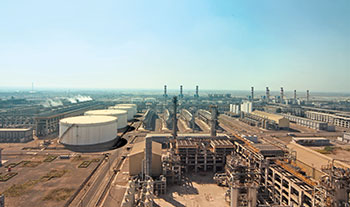
Jamnagar supersite ranks 1st in the world, in complexity-barrels.
ILLUSTRATION: IMPACTING CUSTOMERS WITH A DIFFERENCE

PROJECT UPDATE
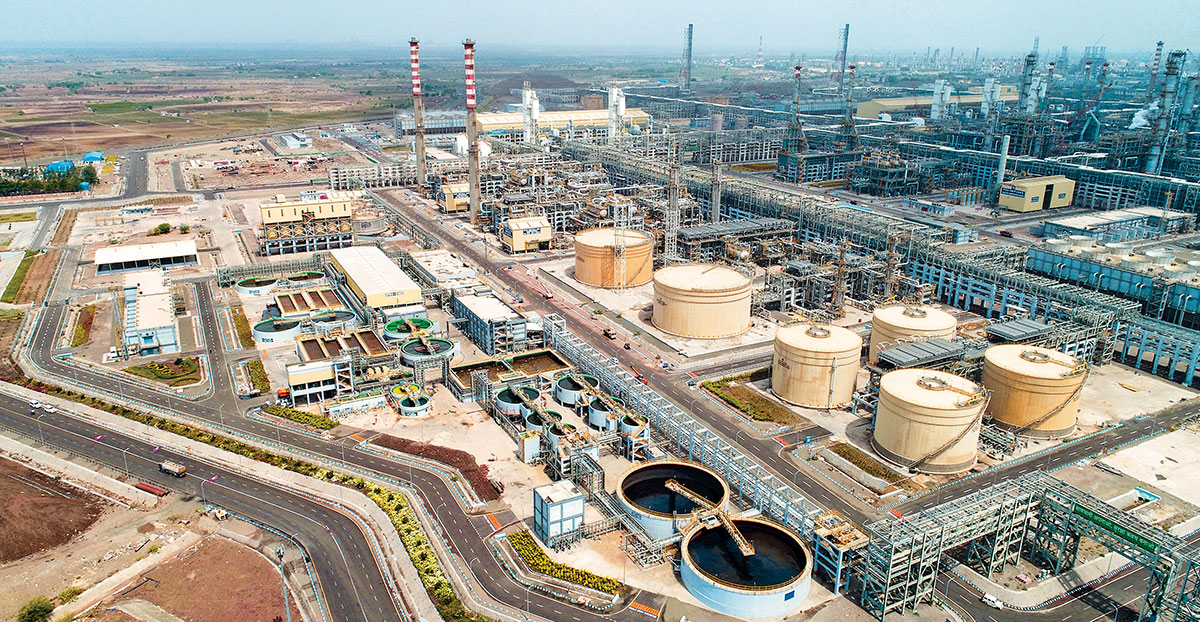
PETCOKE GASIFICATION
All units of the Gasification complex
including air separation units, material
handling systems, gasifier islands, syngas
shift and processing facilities, sulfur
recovery units, and associated utilities
and offsites have been started safely.
Currently, the gasification complex is under
stabilisation.
The pet-coke gasification project shall transform Jamnagar into a unique 'bottom-less' refinery by upgrading low value refinery residue, pet-coke, into clean syngas. This will help in reducing the impact of LNG price volatility by substituting high cost LNG imports. It is one of the largest ‘Clean Fuel’ projects in the world. Syngas shall leverage LNG and petcoke price arbitrage to minimise the utility cost of the Jamnagar complex.
BUSINESS STEWARDSHIP The Jamnagar supersite is designed to achieve zero freshwater withdrawal by implementing design efficiency. It is also capable of producing Euro VI fuel.
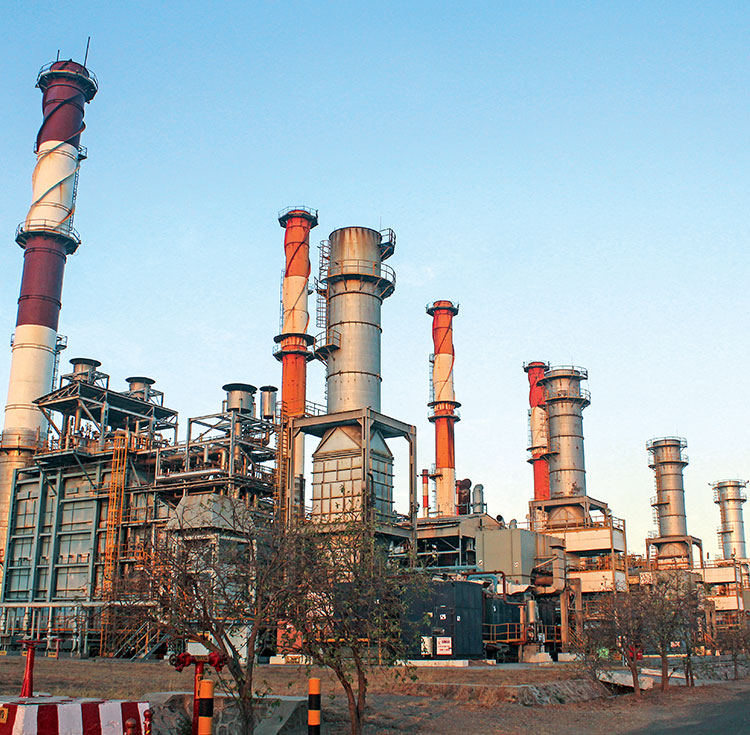
Jamanagar petcoke gasification – one of the largest ‘Clean Fuel’ projects in world
Petcoke Gasification Unit at Jamnagar
Nikhil R. Meswani
Vipul Shah
Par Singh
RIL achieved record EBIT of `32,173 crore (up 51.9% y-o-y) and production of 37.7 MMT in the petrochemicals segment for the year, reflecting value accretion and growth acceleration through scaled up capacities. RIL’s integrated operations, feedstock flexibility and enhanced customer focused approach, delivered a sustainable bottom line for the Petrochemicals business amidst a challenging global environment. Completion of last mile connectivity of the ethane pipeline and commencement of ethane cracking at Nagothane division underpinned RIL’s global cost competitiveness.
Building on its 'Chemistry for Smiles' theme, RIL continues to broaden its product portfolio, through innovation and customer centric initiatives, like R|ELan fabrics and Recron Certified products. RIL launched the 'Fashion For Earth' and the eco-sustainability porgramme, to promote circularity within the fashion industry.
Reliance is also strengthening its newly ventured Advanced Materials and Composites businesses by leveraging the capabilities in polymer formulations, materials engineering and product design, 3D printing and application development to deliver innovative products and solution offerings to the industry.
Jamnagar supersite
STRATEGY
ROBUST ASSET
PROFILE
- One of the most integrated petrochemicals producers globally
- Leading market position across product categories
- World class production facilities
- Industry leading operating rates across products
- Commissioning of High Purity Iso- Butylene (HPIB) unit for C4 value addition
SUSTAINING VALUE
CREATION
- Refinery off gas cracker, a unique project and expansion of downstream capacity to cater to expected demand growth
- Ethane imports enable a cost advantage and feedstock security
- Strong brand initiatives enabling Reliance’s shift in focus towards consumers
COMPETITIVE
STRENGTHS
- Fully integrated operations providing cost competitiveness
- Captive and cost effective feedstock supplies provide feedstock security
- Benefits of economies of scale
- High domestic market share across most products
- Proximity to key consuming markets and diversified consumer base
INTRODUCTION
HARNESSING THE POWER OF CHEMISTRY
Name
Olefin
Polymers
Polyesters
Aromatics and Fibre Intermediates
Elastomers
DESCRIPTION
Unsaturated open chain hydrocarbon
Large molecule with repeating subunits
Synthetic Fibres
Raw Material for polyester and textile industries, Industrial Chemicals
Polymers with rubber like elasticity
RIL PORTFOLIO
Ethylene, Propylene, Butadiene
Polyethylene(PE), Polypropylene(PP), Polyvinyl chloride (PVC)
Polyester Filament Yarns (PFY), Polyester Staple Fibres (PSF), Polyethylene Terephthalate (PET)
Purified Terephthalic Acid (PTA), Monoethylene Glycol (MEG), Paraxylene (PX), Benzene (BZ)
Poly-Butadiene Rubber (PBR), Styrene Butadiene Rubber (SBR), Butyl Rubber
APPLICATIONS/ASSOCIATED INDUSTRIES
Industrial Chemicals and Polymers
Construction, Agriculture, Automobile, Consumer Goods
Textile / Apparel industries and Beverages
Polyester and textile industries, Industrial Chemicals
Tyres and Automobile
CAPACITIES/ GLOBAL MARKET POSITION
Feedstock for petrochemical products Ethlyene: 3.6 MMTA
PE: 2.3 MMTA/ 11th
PP: 2.9 MMTA/ 5th
PVC: 0.7 MMTA/ 16th
PFY and PSF: 2.1 MMTA PET: 1.1 MMTA/ 8th
PTA: 4.9 MMTA/ 4th
MEG: 1.5 MMTA/ 6th
PX: 4.8 MMTA/ 1th
PBR: 120 KTA
SBR: 150 KTA
MARKET ENVIRONMENT
FY 2018-19 witnessed a firm energy price environment which, reflected in petrochemical
feedstock and product prices. However, the strength in product prices were relatively
modest as compared to feedstock prices, resulting in mixed petrochemicals margins.
OLEFINS AND POLYMERS
Global demand for ethylene increased by 3% y-o-y to 158 MMT in 2018. Global ethylene
operating rates have declined to about 88% from about 89.5% in previous year. New
capacities of 6 MMTA was added during the year, resulting in capacity addition outpacing
demand growth.
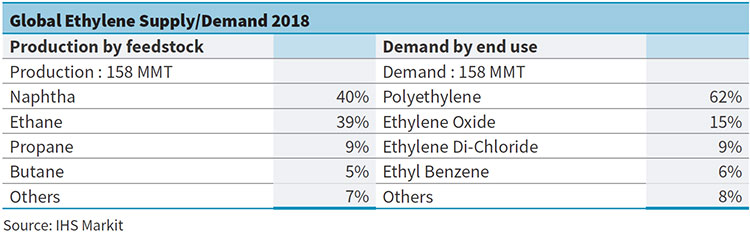
USA has started 3.5 MMTA new ethane based crackers capacity in 2018. The other major capacity additions were in China, Iran and South Korea. In the USA, another 4.3 MMTA crackers capacity is expected to come online in 2019. These additional capacities are based on low cost ethane from shale gas production, continuing to pressurise ethylene market fundamentals. In Asia, 2.3 MMTA capacity is expected to come online in China in 2019 besides 1.3 MMTA capacity in Malaysia.
Global propylene demand increased by 6% y-o-y to 112 MMTA in 2018. The higher incremental demand compared to supply (5% y-o-y) resulted in operating rate increasing to 80% from 78.5% in 2017. The addition of 2.8 MMTA capacities in 2018 is expected to keep markets well supplied in the near-term. Economics of Coal to Olefins (CTO) capacities improved during the year with softening of coal prices; however, environmental risk persists. On-purpose Coal to Olefins (CTO), Methanol to Olefins (MTO) and Propane Dehydrogenation (PDH) units remained the marginal supplier of Olefins to global markets.
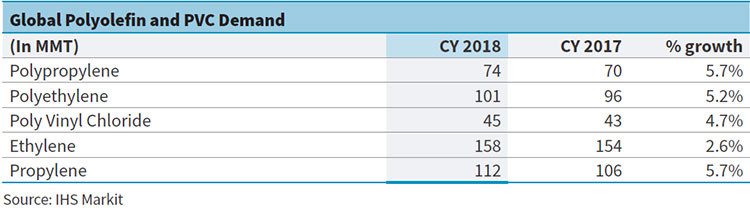
Global polymer demand (PE, PP and PVC) in 2018 was estimated at 220 MMT. Polyethylene (PE) accounted for 46%, Polypropylene (PP) 34% and Polyvinyl Chloride (PVC) 20% of the market. Demand for polymers remained resilient amid uncertain global economic growth and grew by a healthy 4.8% during the year, above the 5-year CAGR (4.6%). The global demand for polymers is expected to grow at a healthy pace in near term, driven by India, China and other emerging economies. Trade conflicts between the US and China re-routed global trade flow. Incremental supplies from the US have been diverted to the South East Asian market, while China increased its imports from the Middle East. China’s ban on import of recycled polymers w.e.f. January 1, 2018 resulted in increased demand for virgin resin in the region.
Polymer chain
Crude oil prices saw high volatility during the year. The prices touched near 4-year high amid geo-political concerns and production cut by OPEC. In the later part of the year, prices moderated due to global economic concerns, crude stock build-up in the US and weaker energy demand growth projection. Average naphtha prices in Asia were up by 16% y-o-y in FY 2018-19 amidst strong crude price and sustained petrochemical demand. Ethylene prices in Asia marginally softened by 3% due to lower downstream PE prices amid new capacity additions in the US. Propylene prices in Asia strengthened by 12% with healthy downstream PP demand growth and seasonal turnaround of crackers in North East Asia.
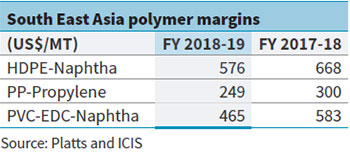
PP and PVC prices remained well above 5-year average during FY 2018-19 with healthy demand supply scenario. However, polymer margins weakened due to high feedstock prices. On y-o-y basis, PP, PE and PVC margins corrected by 17%, 14% and 20%, respectively. PE prices weakened amid increased supplies as first wave of new ethane-based capacities came online in the US. PVC margins weakened due to high Ethylene Dichloride (EDC) prices led by a weak caustic price environment.
Polyester and Fibre Intermediates
The polyester market remained volatile
during FY 2018-19 with overall weakness
due to sluggish downstream demand.
Initial strength was followed by gradual
weakness in polyester sales, which further
weakened as demand remained lacklustre
even after Chinese National holidays.
Overall, polyester prices during the period were higher but margins declined due to firm feed-stock prices. Globally, polyester demand growth was resilient at 3% during 2018, driven by demand in Asia’s emerging economies, which cover 85% of the global market. The Indian polyester market witnessed healthy demand growth of 7%.
Global PET prices for the year surged by 18% y-o-y as demand remained healthy amidst tight supplies with delays in the restart of the PET units in USA, Europe and China. PET margins surged by 32% y-o-y owing to firm demand from beverage segment, tight supplies and curtailed output. During CY 2018, global PET demand was estimated at 24 MMT, compared to global PET capacity of 31 MMT. Asia / Far East region account for 42% of global PET demand with China’s PET demand estimated at 5.5 MMT (23% of global PET demand).

During FY 2018-19, polyester chain margins remained healthy, indicating strong market sentiments. Operating rates across polyester chain remained healthy favouring integrated polyester producers during the year.
During the year, PX prices gained 25% y-o-y driven by firm feedstock prices and healthy PTA demand. During CY 2018, global PX capacity grew by 4% y-o-y, compared to 9% y-o-y demand growth. However, start-up issues in new PX units and subsequent planned turnarounds kept PX markets tight, supporting prices and margins.
PTA markets remained buoyant amidst healthy operational efficiencies, supported by strong downstream demand and tight supplies. PTA margins improved 38% y-o-y with firm demand from markets outside China. During 2018, Global PTA capacity grew by 7% y-o-y compared to 8% y-o-y demand growth. China continues to be the largest consumer of PTA, accounting for 58% of the global consumption. China demand is expected to grow by 3% CAGR till 2022. India demand is around 10% of the global consumption (68 MMTA).
Monoethylene Glycol (MEG) markets witnessed weakness as margins declined by 23% y-o-y during the period. MEG markets had a strong start to the year but faltered due to rising port inventories and slower offtake from polyester sector. Global capacity grew by 6% y-o-y during 2018, compared to 8% y-o-y demand growth. China introduced trading in MEG at Dalian Futures Exchange to streamline investment into MEG and curb speculative trading.
International cotton prices improved 5% y-o-y during FY 2018-19. Cotton to polyester price differential narrowed marginally and stayed above 5-year average, favouring polyester consumption. Global cotton production in 2018-19 (August-July) is expected to decline 4% y-o-y to 26 MMT against increased consumption of 1% y-o-y at 27 MMT. Slower than expected arrivals in Indian markets have bolstered domestic cotton prices. India’s cotton supply is estimated to drop 1% y-o-y to 7.19 MMT during cotton season 2018-19. Total cotton consumption is estimated to be stable at 6.49 MMT, resulting in 13% y-o-y lower closing stock at 0.70 MMT, conducive to polyester substitution
Elastomers
During 2018, global Natural rubber
production was at 13.9 MMT, up 2.5% y-o-y
while demand growth was up about 4.9%
y-o-y to 13.87 MMT. Slowdown in economic
activities driven by the US-China trade
conflict weighed on downstream operation
and rubber consumption.
Global capacity of Butadiene continues to remain stable at 15.2 MMTA with average operating rate of around 78% in CY 2018. With more light feed crackers coming up, mainly in the US, the availability of Butadiene is expected to be limited.
The global capacity of PBR is 4.5 MMTA in 2018 with average utilisation rate of 78%, while the global capacity of SBR is 6.7 MMTA in 2018 with average utilisation rate of 68%. PBR and SBR demand are directly linked to growth in automobile and tyre sectors. During CY 2018, global passenger car assembly grew at 2.3% while commercial vehicles production grew by 5.3% y-o-y. The operating rates of both PBR and SBR are expected to improve in near future with growing demand and limited capacity addition.
DOMESTIC SCENARIO AND
OPERATIONAL PERFORMANCE
Polymers
The Indian polymer market registered a
healthy growth of about 7% in FY 2018-19
y-o-y. PE demand growth was healthy at 4%
y-o-y (led by LLDPE growth of 11% y-o-y)
driven by increasing disposable income and
growth in e-commerce sector. PP demand
growth was at 7% y-o-y driven by boost in
infrastructure and cement industry. PVC
demand growth has been fuelled by pipe
demand, both in the construction and
agriculture sectors. Enhanced focus on R&D
in automobile and appliance sector led to
sustainable growth in the PP co-polymer
segment in India. Increasing awareness
and policies against single usage plastic
resulted in lower demand growth in tubular
quench (TQ) and thermoforming sectors of
PP and PE.
India is the world’s fastest growing polymer market with a 5-year CAGR (2014-18) demand growth of 9.1%. It is the second largest demand hub for polymer in Asia after China.
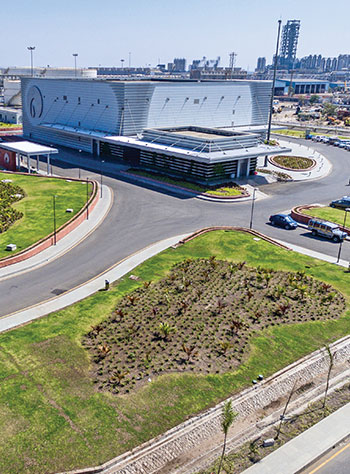
Cracker Control Centre
FINANCIAL AND OPERATIONAL PERFORMANCE
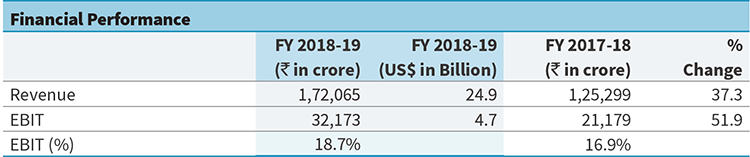
FY 2018-19 revenue from the Petrochemicals segment increased by 37.3% y-o-y to `1,72,065 crore (US$24.9 billion), primarily due to higher volumes and prices, which reflected full benefits of ROGC and Paraxylene capacity expansion projects. Petrochemicals segment EBIT increased sharply by 51.9% to its highest ever level of `32,173 crore (US$4.7 billion). Strong integrated polyester chain margins offset weakness across the polymer chain, which was impacted by incremental supplies from new US crackers. Petrochemical segment recorded strong EBIT margin of 18.7%, aided by strength in PX margins.
Polymer Production
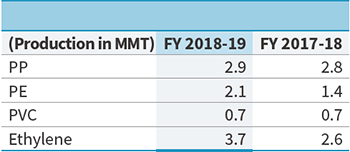
RIL is a leading global manufacturer of polymers with 6 state-of-the-art manufacturing facilities. RIL maintained its leadership position in Indian polymer market with domestic industry market share of 33%.
RIL is the world’s fifth largest producer of PP. During FY 2018-19, the Company recorded its highest ever production of PP at 2.9 MMT and maintained 45% domestic market share. Post start-up of ROGC and downstream plants, RIL became world’s 7th and 11th largest producer of LLDPE and LDPE respectively. RIL produced 2.1 MMT of PE, which helped grow the domestic PE market share to 28% and LDPE market share from 35% (before start-up of ROGC) to 62%. RIL’s PVC production was at 0.7 MMT with 23% domestic market share.
RIL’s continuous efforts towards strengthening of supply chain network, enabled the Company to place polymers in more than 70 countries globally during the year.
Polyester and Intermediates Production
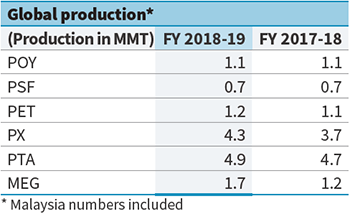
During the period, Indian polyester filaments market grew by 10% y-o-y while PET market grew by 9%. PFY markets were buoyant in the early part of the year as downstream units diversified with new applications, expansion and re-stocking due to firm prices. PSF markets weakened due to liquidity crunch, increased recycled PSF availability and weak international price environment. PET demand firmed amidst improved downstream buying, supported by Government’s decision to exclude PET from ban on single-use plastics.
Domestic Elastomer Production
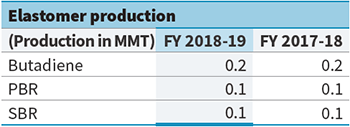
Indian elastomers sector witnessed stable demand environment during the year, led by commercial vehicle demand growth (17.6%). Passenger vehicle demand growth was muted during the year at 2.7%. Automobile demand in the latter part of the year was impacted by poor festive demand, revised axle norms and high fuel prices.
Butadiene witnessed demand growth of 15% y-o-y to 360 KT during the year as against an installed capacity of 550 KTPA. PBR and SBR demand in India is estimated to be 194 KT and 330 KT respectively in FY 2018-19 and is expected to grow at 5-7% annually in the medium-term.
NEW PRODUCT DEVELOPMENTS
Polymers
- PE Net for paddy stubble bales: Broadening Plasticulture applications.
- Special PE sleeves for saplings: Protection from wildfires in Maharashtra
- Cast film PP for food packaging: Increase shelf-life of perishables and products containing high fatty acid
- PE bubble film for greenhouses: Better technical performance and higher shelflife of nearly 10 years, reducing farmers’ recurring expenses
- High melt flow index PE: For applications of stretch films
- 100% recyclable PE pouch: For consumer packaging application
PROJECT UPDATE
Record production during the year was
achieved with full utilisation of the ROGC
and PX projects which were commissioned
in the previous year. RIL also completed the
last leg of ethane pipeline between Dahej
and Nagothane during the year. Ethane
cracking at Dahej, Hazira and Nagothane
has been streamlined and all the plants
achieved highest ever ethylene production.
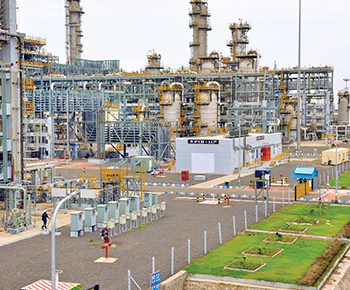
Refinery Off Gas Cracker at Jamnagar
INTEGRATED BUSINESS MODEL
TRANSFORMING RIL PETROCHEMICAL BUSINESS, BUILDING A CUSTOMER CENTRIC ORGANISATION

CONSUMER FACING BUSINESS
R|ELAN – NEXT GENERATION FABRIC
R|ElanTM is a portfolio of innovative fabrics that has been developed to offer more to end consumers, across apparel segments like activewear, denim, ethnic and western wear, both formals and casuals. Fabrics from R|ElanTM are made from specially engineered fibres that combine functionality and fashion with a focus on sustainability.

Flagship products
R|ElanTM Kooltex used in making
activewear apparels
R|ElanTM FreeFlow used in manufacturing sarees and dress material, western and ethnic wears
R|ElanTM SuperSoft used in shirting
R|ElanTM GreenGold, the textile made out of the greenest fibres in the world, manufactured by recycling used PET bottles that finds its way in trousers and denim
R|ElanTM SuperBlack used in suiting
Widespread
acceptance
In line with RIL’s B2B2C focus, R|ElanTM
directly connects with brands and retailers
who know their target consumers. R|ElanTM
has been gaining overwhelming acceptance
from domestic and global brands across all
apparel segments.
Committed to a larger purpose
R|ElanTM is committed to a circular
economy in fashion industry and is one
of the world’s 'greenest' recycler of PET
bottles into fabric, thereby helping reduce
pollution and carbon footprint.
In order to support circularity in fashion and catalyse waste reduction in the fashion industry, R|ElanTM has launched the ‘Circular Design Challenge’ through its ‘Fashion for Earth’ initiative together with the UN Environment in India and Lakme Fashion Week of IMG-Reliance.
RECRON® CERTIFIED
Developing a unique consumer brand
Fifteen years ago, Reliance identified
the under-served ‘sleep and dream’
product category as an opportunity
area and developed Recron® Certified, a
unique consumer brand franchise-based
business. Since then, Recron® Certified has
consolidated its position as a true-value,
high-quality home-comforts product brand
and has become the largest selling pillow
brand in the country. Owing to the depth
of its merchandise and wide-spread reach,
Recron® Certified is a brand appealing to
both the value-seeking mass segment and
the premium class-seeking segment.
Focus areas
- Strengthen its portfolio further by penetrating deeper into the home comfort segment
- Extend consumer trust from pillows to mattresses, leveraging brand strength, category expertise and quality emphasis. It aims to enhance customer comfort during sleep and become a leading mattress brand in the chosen segment
One in 10 families in India has experienced the comfort of sleeping on a Recron® Certified pillow.
BRAND PROPOSITION:
THE SLEEP EXPERTS
The brand consists of a wide range
of products in the Sleep Comfort
category – pillows, cushions, bolsters,
comforters and quilts. With the recent
addition of a number of products
variants in the high-growth mattress
segment, Recron® Certified is now
truly a one-stop shop for all sleep and
dream products.
In each of its product categories,
significant investments in R&D
have ensured that the brand offers
superior attributes, including
aesthetics, ergonomics, durablity and
value in use.

RECRON® CERTIFIED – HELPING MILLIONS SLEEP BETTER
Pan-India presence through an extensive channel network comprising Authorised
Licensee manufacturers, Distributors and Retailers (both traditional as well as modern
retail formats)
100% quality control – Committed to offering products with highest quality standards as per the existing RIL standards, and consistent across all the markets, using the ‘Zero Defect Principle’
75% products made using ‘green fibres’, thereby making them environmentally friendly, generating societal value and promoting a circular economy
ADVANCE MATERIAL
Reliance is developing a new business
vertical in the Advance Material domain.
Material properties and material
engineering coupled with design, provides
a development platform that will add
value to Reliance’s current and new
product offerings and enable Reliance to
deliver compelling solutions to customers.
RelWoodTM is one such advance material,
replacing wood across categories.
Reliance has already ventured into Fibre-Reinforced Composites as part of its Advance Material strategy, which helps in light weighting and rendering superior properties. It has the potential to reduce steel usage in infrastructure projects.
Reliance is also working on two dimensional nanomaterials such as graphene, which when added to the existing polymer portfolio, would deliver new formulated materials that will provide exceptional value to the customers.
RELWOODTM – ONE MATERIAL, ENDLESS
POSSIBILITIES
The consumption of wood in India has risen
with the growth of construction industry
at about 10% y-o-y. However, for nearly a
century, there has been no path-breaking
innovation in the wood material industry
in India, except for the advent of plywood.
Reliance identified an opportunity in this
space and innovated RelWoodTM, a natural
fibre polymer composite. RelWoodTM is
the result of a disruptive technology that
combines the aesthetics and warmth of
wood with a focus on sustainability.
Made with patented German technology, RelWoodTM is 100% waterproof, termite-proof, UV-resistant and fire-resistant, but is virtually indistinguishable from wood by look or touch. It can also be thermoformed to create unique shapes and designs.
RELXTM COMPOSITES AND
CARBON FIBRE
RIL acquired the assets of Kemrock
Industries in FY 2017-18, which is now
launched as Reliance Composite Solutions
(RCS) under the trademark RELXTM. RCS
has a state-of-the-art manufacturing
facility spread across 198 acres, having
composites processing units consisting of
3 feedstock and 7 finished goods plants.
RCS will provide solutions to markets like
mass transport and railways, renewable
energy, infrastructure, automotive, defence and aerospace. RCS leverages in-house
designing and development capabilities
to deliver new applications and solutions,
tailor made as per customer requirements.

RelWood furniture
INNOVATIVE PRODUCT DEVELOPMENT
FTTX POLE FOR TELECOMMUNICATION
These are composite poles used for transmitting gigabytes of data and are produced by pultrusion process. Poles are designed as per TIA-222 G2 (US telecom standard). These poles are lightweight and cost competitive, compared with existing metal or concrete ones. The design is flexible to attach additional fixtures and can be used as a utility pole or as a next generation smart pole. Reliance is also engaged in developing new innovative composite material for a smart light pole for 5G infrastructure.

UNDERGROUND FUEL STORAGE TANK (UST)
These are underground FRP storage tank prototypes for storing petroleum products. It is designed according to the latest standard EN13121-3 and tested for UL-1316. The use of composite has benefitted the tank with non-corrosive property, less manufacturing time and improved product life.

TRAIN COACH TOILETS
Reliance materials – right from thermoplastics to composites – are used in the production of prototype of toilet modules with a new radical design considering aesthetic, functional and passenger comfort requirement.

TRAIN INTERIORS FOR COACH
Reliance’s composites are being used in prototypes of new passenger locomotive interiors with new features such as inclined stair arrangement for easy ingress and egress of passengers and foldable ladder for giving passengers easy access to berths.

CARBON FIBRE WRAP
Using carbon fibre wrap, Reliance Composites has the capability to design and implement solutions aimed at restoring building, pipeline, road and bridges infrastructure.

Reliance Composites is building an application development centre to showcase capabilities and to help customers understand the applications. It will be equipped with state-of-the-art characterisation and testing facility to foster innovation and new product development.
RIL is also investing in India’s first and largest carbon fibre production line with homegrown technology–to cater to India’s aerospace and defence needs and other specialty industrial applications.

ReleXTM Applications
3D PRINTING TECHNOLOGY
Additive Manufacturing, commonly known
as 3D printing, is gaining acceptance
rapidly with increase in number of
proven applications in end-use parts in
various industries. RIL has developed
capabilities to design and print prototypes
as well as end-use parts for Oil and
Gas, Medical, Electronics and Industrial
Tooling industries. RIL is also working on
developing 3D-printable materials out of
RIL’s downstream products such as PP
and PE.
DIGITAL INITIATIVES AND PLATFORM
DIGITAL CUSTOMER EXPERIENCE
- Enhancing user experience and enabling Sales and Collection transactions on smart devices
- E2E tracking of Order Fulfilment is enabled on mobility Platform
- Machine Learning enabled Chatbot for customers, agents and transporters
- Delivery tracking through IOT enabled Vehicle Tracking System is implemented for dedicated fleet
- Collaborative planning through CRM platform to effectively manage customer demand
- Mobility apps like approvals, account management, customer visits to empower Sales Force for better customer service
- Predictive analytics on demand forecast integrated for accurate planning to serve customers better
- Customer interface for fabric certification and brand management for R|Elan brand was built on open source, microservices based platform architecture
PROCESS AUTOMATION AND ENHANCED DECISION MAKING
- Robotic Process Automation (BOT) for automating repetitive processes like E-way bill, e-BRC, B2B order processing etc.
- No touch sales order processing based on auto allocation through system
- Block chain platform integrated with electronic Bill of Lading (eBL) to issue and manage eBL. Blockchain enabled LC transaction through a consortium led by HSBC
- “Business Command Center” system of role based dashboards that leverages information for collaborative operations and enhanced decision making
- Data Science and Predictive Analytics deployed for Price forecasting, Customer Credit risk management and freight cost analysis
DIGITAL SUPPLY CHAIN
- Warehouse Management (EWM) operated on smart devices simplifies complex logistics, optimises inventory tracking, distribution operations, multi-channel fulfilment, and more, all real time
- Ensure distribution safety through 'Emergency Response Center' on IoT enabled Vehicle Tracking System integrated with biometrics and voice box
- Automation through EDI (Electronic Data Interface) with major ports and shipping lines
- ePOD mobile app for drivers to capture electronic proof of delivery and auto service certification for transporters
- Integrated Business Planning and Optimisation implemented with objective to maximise contribution rate
- Cloud based systems for digital settlement of commercial contracts, eBL and road freight management
RELIANCE’S APPROACH TO CIRCULAR
ECONOMY
Plastics play a major role in improving the
quality of life and help in tackling number
of societal challenges. Plastics directly aid
in achieving the UN’s SDGs by reducing
food waste (increasing shelf life of food),
helping reduce resource consumption
(current alternatives use more energy and
water in production) and providing raw
materials for life saving medical instruments.
Through innovative solutions/ applications,
plastic products help in improving process
efficiency, thereby reducing overall GHG
emissions particularly in automotive and
construction industries.
Unfortunately, due to unchecked littering, plastics as a whole get maligned. The benefits of plastics need to be acknowledged by encouraging proper collection, segregation and education. This will ensure our smooth transition, as a society, towards a circular economy.
For Reliance, ‘Sustainability’ is not just a buzz word, it is about how Reliance operates. RIL strives to promote Circular Economy and deliver Societal Value. Reliance’s approach is to innovate, collaborate and educate communities to help end plastic waste in the environment:

- Innovate through circular business models: Reliance continues to be one of the largest recyclers of the post- consumer PET waste and converting it into value added, branded products like R|Elan™ and Recron® Certified. During FY 2018-19, RIL recycled about 2 billion waste PET bottles, converting it to products like Recron® GreenGold – one of the lowest carbon foot-print globally.
- Educate (Communication and Awareness): Reliance continues to engage with internal and external stakeholders to educate and improve consumer awareness. During FY 2018-19, the Company carried out awareness sessions across the manufacturing sites and also carried out awareness at major schools in Mumbai.
- Collaborate: Reliance engages and collaborates with governments, businesses and consumers to drive effective solutions. For instance, RIL led participation of Indian Industry at UNEA-4 Nairobi
INITIATIVES HIGHLIGHTS
- Reliance has 3 plastic-to-roads projects underway on pilot basis. These initiatives have helped create solution for disposal of non-recyclable postconsumer plastic waste. As a first pilot, 1.2 tonnes of plastic waste has already been used for construction of 2,600m2 of road in Reliance Corporate Park. Further, about 50 tonnes of plastic waste will be used at Nagothane Manuacturing Division for construction of 40 km of road
BEFORE

AFTER
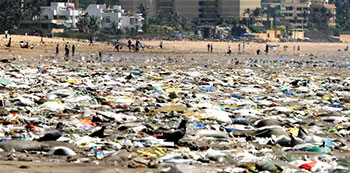
RIL worked with Afroz Shah’s team to clean up the Versova beach in Mumbai. RIL sponsored the BobCat to expedite retrieval of solid waste off the beaches and from the oceans. This one-of a kind solution has replaced the need for manual clean-up drives by volunteers. It has resulted in a more efficient and systematic cleanup recovering about 1.5 Million Kgs. of solid waste in 180 days – that much less waste in the oceans
ILLUSTRATION
Reliance’s Fashion For Earth launched the ‘Circular Design Challenge’ at Lakme Fashion Week with the UN Environment
Need to reduce waste and implement circular economy concepts in the fashion value chain

Action
To incentivise waste reduction and catalyse adoption of circular economy in the Indian textile industry, Reliance, UN Environment and Lakme Fashion Week, successfully launched and concluded the first edition of the ‘Circular Design Challenge’. The ‘Circular Design Challenge’ is an annual competition where fashion and product designers submit a proof of concept of creating a fashion collection that encompasses key principles of circularity, sustainability, aesthetics and scalability. First edition of the challenge was won by Stefano Funari and Poornima Pande for their brand ‘I was a Sari’.
Scale of Impact
First edition of the Circular Design Challenge saw over 900 registrations from over 30 cities across the country.
Outcome
Through such initiatives Reliance has helped raise awareness on textile waste generation and promote the use of sustainable materials and offer solutions that are helpful in reducing environmental impact caused by waste in the fashion, textile industry

Circular Design Challenge
BUSINESS STEWARDSHIP
In keeping with the motto of ‘Chemistry
for Smiles’, Reliance continues to produce
eco-friendly products such as GreenGold
(made from recycled PET bottles using
renewable energy, with one of the lowest
carbon footprints globally), R|Elan™
(a fabric with increased breathability,
anti-odour benefits, and excellent drape)
among others. Additionally, the Company
continues to be one of the largest recyclers
of PET bottles in India.
P.M.S. Prasad
Naresh Narang

Sanjay B. Roy
FY 2018-19 marked progress on plans to monetise discovered resources in deepwaters.
RIL has commenced development work for R-Cluster and Satellite Cluster fields in the KG D6 Block. Field Development Plans for MJ have been approved by Government. These fields are expected to come onstream from mid-2020 onwards.
There has been steady production from the Coal Bed Methane (CBM) fields in Sohagpur. Development activities are underway to further enhance the production.
Reliance continues to focus on value preservation in the Shale Gas business. In this regard, Reliance is restructuring its Shale Gas assets through cross-border merger of RHUSA with RIL.
CBM Group Gathering Station
STRATEGIC ADVANTAGES AND COMPETITIVE STRENGTH
Reliance’s upstream business encompasses the complete chain of activities from acquisition to exploration, development and production of hydrocarbons in both conventional and unconventional areas. Reliance has an advantageous position in offshore deepwater capabilities, coupled with the knowledge of operations in unconventional areas such as CBM.

PROJECT
EXECUTION
KG D6 – India’s first and till date only
greenfield deepwater project
CBM – India’s largest surface footprint
hydrocarbon project in remote tribal areas
with no prior infrastructure

SAFETY
Over 11 years of safe operation, with safety record among the best in the world since commencement of production in deepwater block KG D6 and in Coal Bed Methane

SIGNIFICANT
INFRASTRUCTURE
ON THE EAST COAST
RIL has commenced development of discovered resources in the KG D6 Block leveraging the existing infrastructure on the East Coast.

PARTNERSHIPS
Partnerships with global majors in conventional as well as unconventional hydrocarbon plays. The partnerships combine Reliance’s project execution skills with global expertise
MARKET ENVIRONMENT
In 2018, global oil demand slowed down
to 1.2 mb/d. Demand growth was largely
driven by growth in USA, China and India.
Oil demand was led by ethane, LPG and
middle distillates while gasoline demand
slowed down. Demand growth was
impacted due to high pump level prices in
USA and other economies. Brent oil prices
strengthened 22% during the year due to
geo-political tensions, supply disruptions
from Venezuela, Iran and Libya as well as
OPEC+ production cuts.
US Henry Hub (HH) gas prices averaged above US$3/mmbtu and peaked as high as US$4.8/mmbtu in the second half of the year. Asia LNG prices strengthened, averaging around US$9/mmbtu; however, the prices they remained volatile throughout the year.
Upstream capital expenditure showed a rising trend with increased drilling activity especially in North America.
New exploration is also on the rising trend although it is yet to return to levels prior to the price collapse. Global upstream investment is set to rise for the third consecutive year and is expected to increase by 4% in 2019 following higher than expected spending last year.
INDIAN REGULATORY ENVIRONMENT
During the year, there have been many
initiatives by the Government of India to
promote the Indian Oil and Gas industry.
Open Acreage Licensing Policy (OALP) was implemented, which provides options for operators to select exploration areas on their own. Under OALP Bid Round-I, 55 Blocks were awarded and subsequently, the Government has launched OALP Bid Round-II offering Blocks under Petroleum Operation Contract for International Competitive Bidding.
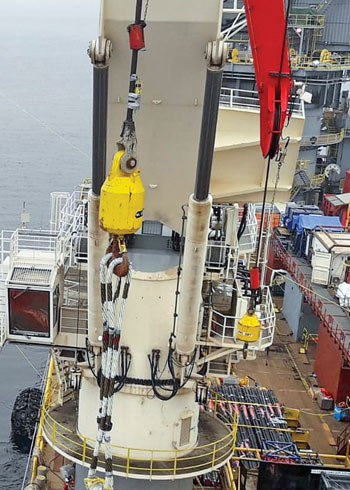
Subsea Structure Foundation Installation in Deepwater (about 2,000 m WD)
OIL AND GAS PORTFOLIO
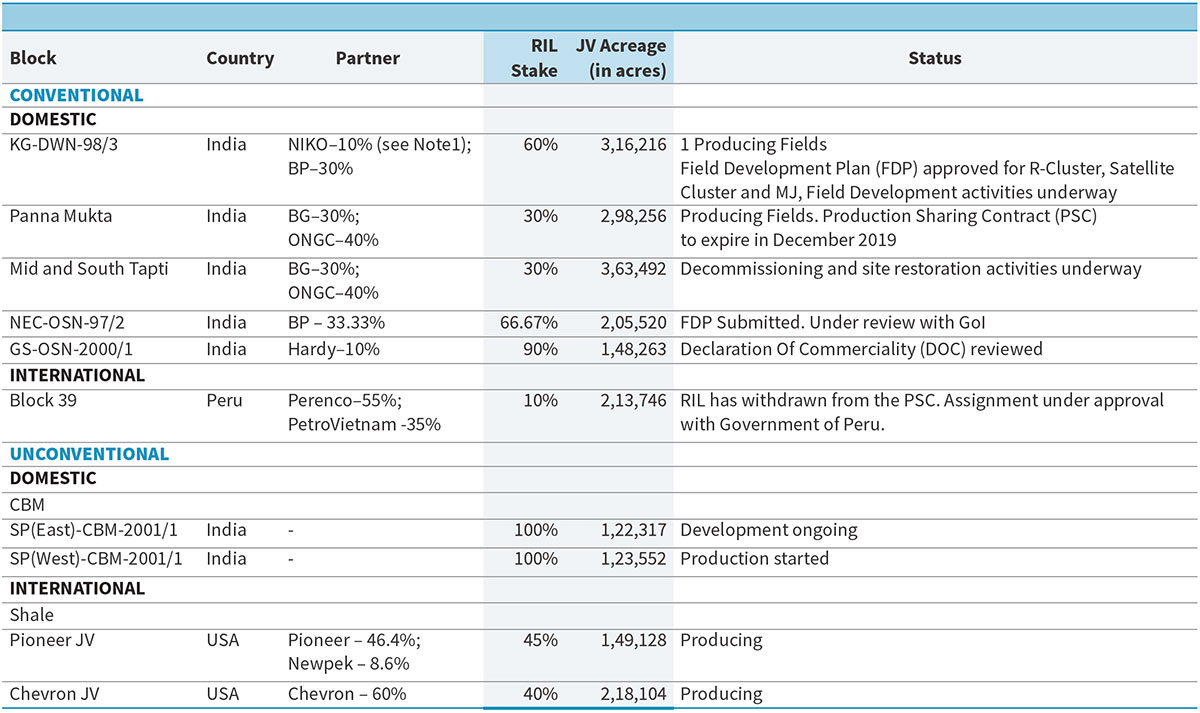
Notes
1: Post default of Cash Call, RIL-BP issued Default notice to NIKO on October 16, 2018. Since the dues are not cured by NIKO, RIL-BP has issued notice to NIKO to withdraw from
Joint Operating Agreement (JOA) and PSC and assign their Participating Interest (PI) to RIL-BP. NIKO has served a notice of arbitration in response to the withdrawal notice.
The arbitration tribunal has been constituted and proceedings to commence.
2: Reliance and BP sold their stake in onland Block CB10 to Sun Petro.
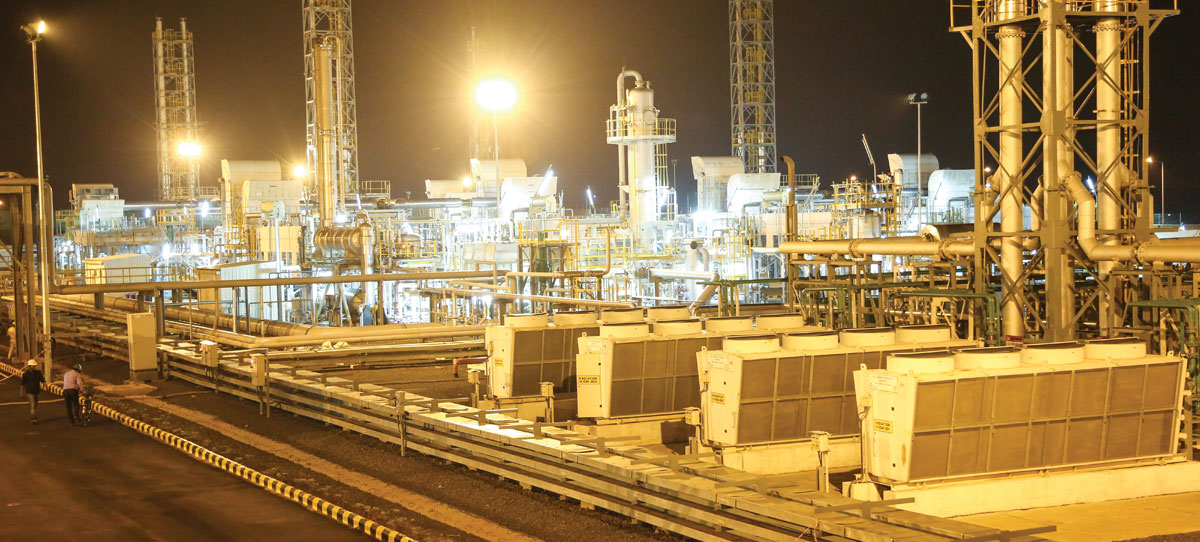
Coal Bed Methane Station
FINANCIAL AND OPERATIONAL PERFORMANCE*

*Consolidated basis
FY 2018-19 revenues for the Oil and Gas segment decreased by 3.8% y-o-y to `5,005 crore. Volumes from domestic upstream fields and US shale were lower because of natural decline and slowdown in development activity. Segment EBIT was at `(1,379) crore as against `(1,536) crore in the previous year. For the year, domestic production (RIL share) was at 58.9 Bcfe, down 25.4% y-o-y and in US Shale (RIL share), business was 94.5 Bcfe, down 32% y-o-y basis.
OPERATIONAL PERFORMANCE – DOMESTIC
Production Performance
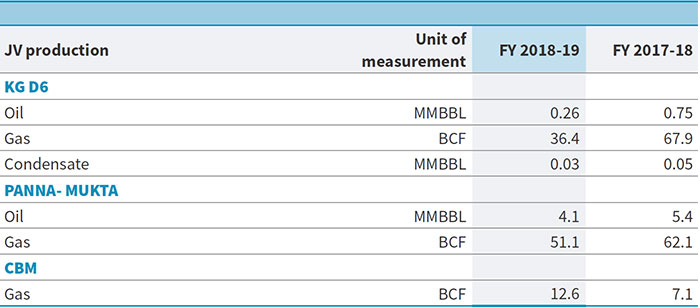
KG D6
KG D6 gas production declined by 46%
for the year to 36.4 BCF due to natural
decline of D1D3 field and cessation of MA
Field in September 2018. KG D6 operations
continue to achieve field uptime of 100%,
which continues to be the global standard
for deepwater facilities. Despite challenges
associated with substantial reservoir
depletion and sand and water influx, the
focus remains on sustaining production
until future projects are commissioned.
Panna-Mukta-Tapti
Panna-Mukta field produced 4.1 million
barrels of crude, a reduction of 24% on
y-o-y basis and 51.1 BCF of natural gas,
a reduction of 18% on y-o-y basis.
The fall in production is due to natural
decline and increasing water cut in the
field, shut in of wells due to integrity
issues and unplanned field shutdown due
to tilting of single buoy mooring facility
by water ingress in July 2018. Loss in
production was partially offset by better
production optimisation and successful
revival of a few wells, which were shut in
due to integrity issues.
The Production Sharing Contract (PSC) for Panna-Mukta Block is expiring on December 21, 2019 and necessary preparations are in progress for handover of the assets to the Government (i.e. GoI nominee) on expiry of the PSC.
The ‘Decommissioning Plan for Tapti Part B Facilities’ is approved by GoI and the contract for Engineering Preparation Removal and Disposal (EPRD) has been awarded. The decommissioning activities are scheduled to be completed by end 2021.
CBM (Sohagpur East and Sohagpur West)
RIL commenced production from its Coal
Bed Methane (CBM) block SP (West)–in
March 2017. More than 200 wells are on
production, with production averaging 1 mmscmd this year. As CBM Reservoirs
are initially 100% saturated with water,
the wells go through ‘Dewatering Phase’
during initial years of production. In the
dewatering phase of CBM production,
water is pumped out continuously to
increase the gas saturation in the reservoir,
resulting in ramp up of gas production
from these wells. Dewatering process
in RIL’s fields is underway for achieving
further production ramp-up.
Reliance Gas Pipeline Limited, a subsidiary of RIL, operates the 302 km Shahdol-Phulpur Pipeline from Shahdol (MP) to Phulpur (UP). This pipeline connects the CBM Gas fields with the Indian Gas Grid.
NORTH AMERICAN SHALE GAS
OPERATIONS
Production Performance
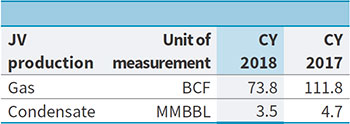
Business Performance
Reliance is restructuring its Shale Gas
assets through cross-border merger of
RHUSA with RIL, integrating the US gas
resources with the Indian market, as done
with ethane for petrochemicals. This will
allow shale gas assets to benefit from the
expected upcycle in commodities.
The Company continued to focus on value maximisation of remaining two JVs through production stabilisation, well design improvements reflecting latest completion designs and improving well inventory through development plan optimisation and acreage consolidation.
As part of this strategy, the sale of certain Eagle Ford assets in the Western Eagle Ford area to Sundance Energy Inc., was closed during the first half of 2018.
Reliance’s aggregate capital investments across JVs dropped considerably and was US$159 million during CY 2018.
For 2019, the thrust remains on preserving long-term value through high-grading of land and development portfolio, retaining optionality, improving execution efficiency and cost structure.
Operational Performance
At Pioneer JV, drilling and completion
activities commenced at the end of third
quarter of CY 2018 with the objective of
testing wells in a new area. At Chevron
JV, drilling and completion activity
commenced in the second half of
2018 in the JV operated areas, while
activity continued to ramp up, in the
non-operated areas. The joint ventures
drilled 28 wells and put 11 wells on
production.
Gross JV production was about 0.62 BCFe/d for the 2 JVs, down 30% y-o-y. Reliance’s share of production and sales were at 94.5 BCFe and 84.0 BCFe, respectively, in CY 2018, compared to 139.7 BCFe and 121.4 BCFe in CY 2017.
Pioneer JV
At Eagle Ford, development activities
commenced drilling of one pad with 3 wells
to explore a new area in the agreement.
JV drilled only 1 well and did not frack any
well during the year while the production
has been rolled over to 2019. With zero
activity and natural decline of the
existing wells, year average gross JV
production was 21% down at 93 BCFe
compared to 118 BCFe in CY 2017, while
Reliance share of net sales volume was at
38.7 BCFe compared to 47.5 BCFe in
CY 2017. The share of liquids slightly
declined from 67.0% to 66.5% in CY 2018.
Chevron JV
While 2018 was characterised by optimised
cost structure (well costs and Lease
Operating Expenses (LOE)), there was little
progress on JV operated areas, considering
low gas prices that prevailed in early 2018.
With upward trend that prevailed in gas
prices during the second half of 2018,
development activity in JV operated areas
restarted from 3Q CY 2018. There was 1 rig
operating in the JV operated area. There
was also significant progress in nonoperated
areas (with very small working
interest) in terms of drilling and wells put
on production.
Year average gross JV production declined by 17% to 131 BCFe from 159 BCFe in CY 2017, reflecting slowdown in JV operated activity despite improved operational efficiency and strong well performance. Reliance share of net sales volume stood at 45.2 BCFe, compared to 55.0 BCFe in CY 2017.
EXPLORATION OUTLOOK
RIL is in leadership position in exploring
and producing hydrocarbons from
deepwaters off India’s East Coast,
specifically in KG basin through resources
established, produced and variable plays
targeted. RIL has the necessary basin and
play know-how for assessing the petroleum
systems in the area. RIL's strategy aims
to explore prospects that may eventually
leverage existing infrastructure.
Application of new technology played a pivotal role, extending the data and interpretation to its technical limits. BroadSeis and BroadBand technology application aided to image scanning deeper targets with improved geological understanding. Enhancing the data for fluid contact analysis through optical stacking has de-risked prospects. Application of robust pore pressure integrated wellbore stability models helped in drilling safe and economic wells.
TECHNOLOGY AND INNOVATIONS
E&P PLATFORM
Aligned with Reliance Enterprise Digital Vision of 'Reimagining the business model by adopting platform way of working to scale-up stakeholders' experience and value 'E&P's digital vision is anchored on the following focus areas, judiciously blending open source technologies and Original Equipment Manufacturers (OEM) technologies:
- Cross Domain Collaboration using Geo-Technical Platform
- Collaborative Well Planning and Drilling Analytics using Drilling Platform
- Smart Capital Project execution using Project Management Platform
- Safe Reliable Operations using Operations Platform – providing real-time insights into well performance, production optimisation by monitoring and modelling physical constraints across the production systems
BIO-CBM
To increase recovery from CBM fields,
Reliance is engaged in R&D efforts in
addition to the established methods.
Current focus of this research is Bio-CBM.
In CBM, methane gas which is adsorbed and trapped naturally in coal seams is produced. Bio-CBM technology uses microbe injection to produce in-situ methane where either the coals are devoid of methane or conventional CBM extraction is uneconomical.
Currently, this technology is in the nascent stage and the initial lab tests have shown encouraging results with respect to methane production potential. Future work is planned to establish the ability of this technology to scale up to a commercial operation.
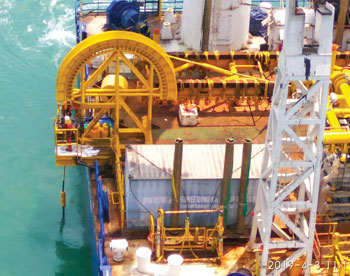
Umbilical Installation at Live Platform (CRP)

Deepwater Pipeline Installation Pipes being welded at welding stations
Several microbial consortia were isolated from various locations within India, screened for methane production potential and the best consortium is being optimised.
RIL is leveraging its infrastructure (advance laboratories), requisite diverse inter-disciplinary technical skills, CBM production expertise, CBM fields and knowledge of regulatory requirements to give impetus to the Bio-CBM research.
ILLUSTRATION
Flare stack inspection with drones at KG D6 onshore terminal
Flare stack inspections are carried out to check the healthiness of the system at regular intervals. The inspection involves major shutdown of processes, flare downtime, use of heavy weight winches, scaffolding erection and the associated risks.

Action Taken
Safe, reliable and quick inspection of flare system with minimum human intervention using drones
Scale of Impact
Elimination of shutdown times, minimisation of manual intervention, data accuracy and time and cost reduction
Outcome
Enabled access to otherwise inaccessible structures and details, and actionable information during shutdown period
UPDATE ON ARBITRATION AND
OTHER LEGAL ISSUES
KG D6 COST RECOVERY ARBITRATION
Arbitration claim commenced by the Company in November 2011 seeking declaration that it is entitled to recover 100% of its contract costs under the Production Sharing Contract for the KG D6 Block (KG D6 PSC). Parties have filed their respective pleadings before the Arbitral Tribunal and are in the process of completing the arbitration proceedings.
PUBLIC INTEREST LITIGATIONS
Three Public Interest Litigations (PILs)
were filed before the Supreme Court
against the Company in relation to the KG
D6 PSC, seeking reliefs in the nature of
disallowance of cost recovery, quashing
GOI’s decision to approve certain gas
price formula and termination of PSC.
The Company has submitted that the
underlying issues in the PILs are already
subject matter of ongoing arbitrations
relating to the KG D6 Block. Matter is still
pending in the Supreme Court.
PMT ARBITRATION
Arbitration was initiated by BG Exploration
and Production India Limited and RIL
(together the Claimants) against the
Government on December 16, 2010 under
PSCs for Panna – Mukta and Tapti blocks
due to difference in interpretation of
certain PSC provisions between Claimants
and Government. The Arbitral Tribunal by
majority issued a final partial award (FPA),
and separately, two dissenting opinions in
the matter on October 12, 2016. Claimants
challenged certain parts of the FPA before
the English Courts, which delivered its
judgment on April 16, 2018 and remitted
one of the challenged issues back to the
Arbitral Tribunal for reconsideration. The
Arbitral Tribunal decided in favour of the
Claimants in large part vide its final partial
award dated October 1, 2018 (‘2018 FPA’).
The Government has filed an appeal before
the English commercial court against this
2018 FPA. The Claimants have also filed
an appeal against the 2018 FPA on limited
aspects of the 2018 FPA, which were not decided in favour of the Claimants. Arbitral
Tribunal is yet to schedule recomputation
of accounts and the quantification phase of
the arbitration, which will take place post
determination of Claimants’ request for
increase in cost recovery limit under the
PSCs. The Government has also filed an
execution petition before the Hon’ble Delhi
High Court under sections 47 and 49 of the
Arbitration and Conciliation Act, 1996 and
Section 151 of the Civil Procedure Code,
1908 seeking enforcement and execution
of the FPA.
DISPUTE WITH NTPC
NTPC filed suit for specific performance
of contract for supply of natural gas of 132
trillion BTU annually for a period of 17
years. This suit is still pending adjudication
in the Bombay High Court and the
Company’s fact witnesses in the suit are to
be cross examined by NTPC.
ARBITRATION RELATING TO ALLEGED
MIGRATION OF GAS
GOI sent a notice to the KG D6 Contractor
on November 4, 2016 asking the Contractor
to deposit approximately US$1.55 billion
on account of alleged gas migration from
ONGC’s blocks. RIL, as Operator, for and on
behalf of all constituents of the Contractor,
initiated arbitration proceedings against
the GOI. The Arbitral Tribunal vide its
Final Award dated July 24, 2018 upheld
Contractor’s claims.
GOI filed an appeal on November 15, 2018 before the Hon’ble Delhi High Court, under section 34 of the Arbitration Act, against the Final Award of the Arbitral Tribunal and the appeal is currently pending adjudication before the Hon’ble Delhi High Court.
WRIT PETITION FILED AGAINST FIR IN
ANTI-CORRUPTION BUREAU
In 2014, four individuals filed a complaint to
the then Chief Minister of the Government
of National Capital Territory of Delhi
alleging collusion between the then
Ministers of the Central Government and
the Company in relation to increasing the
price of gas produced by the Company from
the KG D6 Block. The then Chief Minister of
Delhi had ordered the ACB to register the
FIR and investigate the matter.
The Company has filed a Writ Petition before the Hon’ble Delhi High Court questioning the jurisdiction of the ACB in registering the FIR against the Company. The Company has contended that the ACB lacks jurisdiction to file the FIR. The matter is currently pending before the Hon’ble Delhi High Court.
LCIA ARBITRATION FILED BY NIKO
(NECO) LIMITED (NIKO)
Due to Niko’s failure to pay the cash
calls issued by RIL as Operator of KG D6
Block pursuant to the terms of the Joint
Operating Agreement (JOA), RIL and BP
issued a Notice of Withdrawal to Niko
in terms of the JOA requiring Niko to
withdraw from the KG D6 PSC and JOA.
Thereafter, Niko has initiated arbitration
proceedings against RIL and BP on
December 19, 2018 and the arbitration
tribunal has been constituted.
PROJECT UPDATE
KG D6
Reliance commenced the development of three deepwater fields, R-Cluster, Satellite Cluster and D55 (MJ) fields. First gas from R-Cluster is expected by mid-2020 followed by Satellite Cluster and MJ fields over the next two years. These projects are estimated to contribute upto 20% of India’s domestic production, which will reduce India’s energy import dependence.
Reliance has rich project execution experience, including knowledge in deepwater oil and gas projects. Additionally, it expects to leverage its partnership with BP, existing infrastructure in the Krishna-Godavari Basin and current downturn in the capital equipment and service provider market.
For R-Cluster development, all contracts have been awarded and engineering and fabrication activities are ongoing. Drilling and completion activity for six development wells commenced during the year. Majority of materials / equipment have been delivered and first offshore installation campaign has been completed successfully.
For Satellite Cluster development, contracts have been awarded. Detailed engineering and manufacturing of Subsea Production System (SPS) is in progress. Well planning and preparation for drilling campaign is underway, which is expected to commence in FY 2019-20.
For MJ field development, contracting of long lead items is underway. Well planning and preparation for drilling campaign is underway which is expected to commence in FY 2019-20.
To accrete hydrocarbon resources, infrastructure led exploration efforts are being pursued in the proven petroleum play fairways. These pursuits would benefit from the existing world class deepwater infrastructure.
CBM
To sustain plateau production, further
CBM development is being undertaken.
Development activities of block SP
(West)–CBM–2001/1 Phase II and SP
(East)–CBM–2001/1 block is currently
underway. Phase II includes drilling and
completion of more than 100 wells along
with an additional gas gathering station
and associated water gathering stations for
collection and processing of CBM Gas and
water respectively. Phase II development
activities are in advanced stage and is
expected to come online in the second half
of FY 2019-20.
BUSINESS STEWARDSHIP
Employee volunteering and community
participation are encouraged within the
Company. Acting as a responsible business,
the Company also ensures productive
employment for members of the local
community.
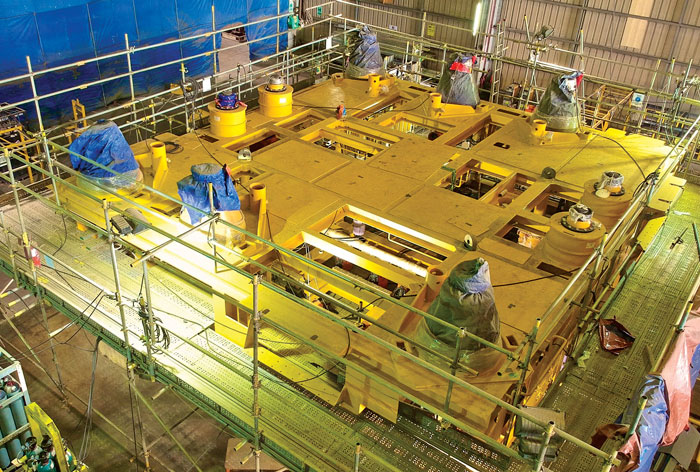
Fabrication of Subsea Structure
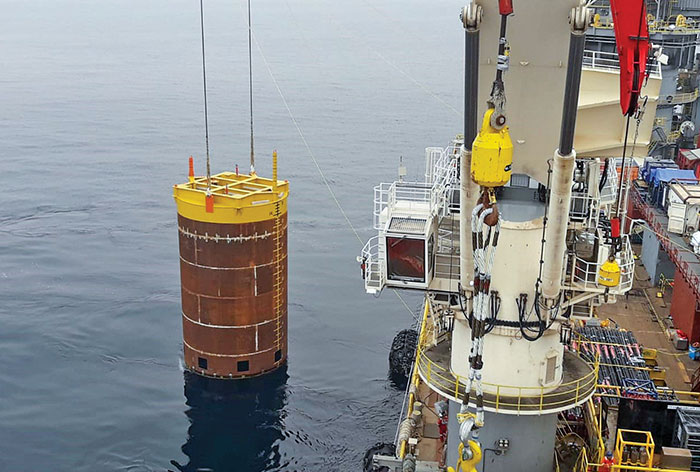
Subsea Structure Foundation Installation
ILLUSTRATION
Green Cover
Medical camp
Women Empowerment
Promoting education in rural areas
Improved child health

Action Taken
1,500 coconut trees planted at Gadimoga panchayat and Bhairavapalem, Theerdalamondi and Dariyalatippa villages on the occasion of Gandhi Jayanti and women members were mobilised to safeguard the trees after plantation at identified households as a part of community ownership.
Comprehensive health check-up camp was organised and prescribed medicines distributed to reduce incidence of communicable and seasonal diseases by a 20 member–specialist doctors’ team.
Enhanced livelihood opportunities for 100 widows at Pedavalasala village by promoting and creating awareness about backyard poultry.
Commemorating birth anniversary of Reliance’s Founder Chairman Shri Dhirubhai H Ambani, district Level quiz competition is being organised by RIL covering all schools across the East Godavari District, Andhra Pradesh since 2010 with participation from over 2,200 students from 550 schools.
As a part of community connect, two anganwadi centres Katkona and Lalpur have been adopted by teams of RIL employees and their spouses. The teams work towards the basic health and nutritional supplements to children with provisions of sport materials at the centres, and promoting awareness on health and hygiene.
Scale of Impact
Generating employment opportunities for communities and ensuring healthy employee-community engagement
Outcome
Employee Social Responsibility has resulted in communities extending their co-operation and assistance for the project

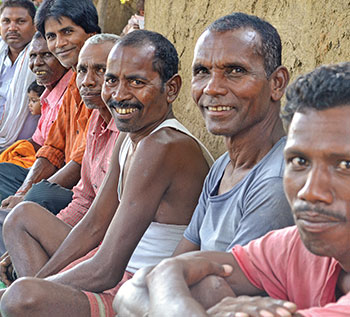
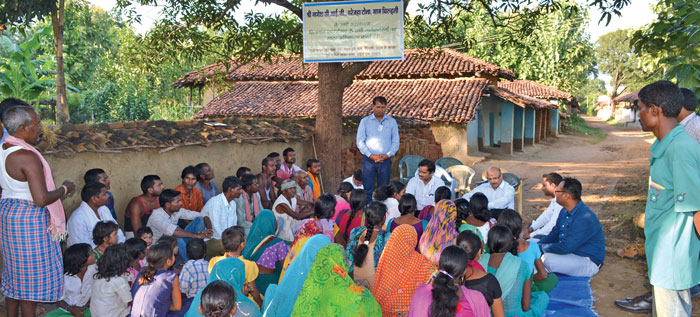
Subramaniam V.

Brian Bade
Damodar Mall
Akhilesh Prasad

Shawn Gray
Darshan Mehta
Sunil Nayak
Kaushal Nevrekar
Ashwin Khasgiwala
Reliance Retail has effectuated a consumption boom in the country, taking organised retail to the smallest of towns and making it accessible to middle class customers in India.
Reliance Retail continues to deliver remarkable results as it nearly doubled its revenues and tripled its profits in FY 2018-19. Reliance Retail’s inclusion in the list of top 100 global retailers* is a testimony of its growth and depicts the trust of consumers. With 10,415 retail stores, presence in 6,600 plus towns and cities and 22 million sq. ft. retail space, Reliance Retail is the largest retailer in India.
Reliance Retail is committed to its ethos of shared prosperity–making a difference to the life of every Indian. Reliance Retail continues its journey of making shopping enjoyable for the entire family.
* Global Powers of Retailing 2019, Deloitte
Menswear focused apparel store
STRATEGIC ADVANTAGES AND COMPETITIVE STRENGTH

DIVERSIFIED PORTFOLIO OF STORES ACROSS VARIOUS CONSUMPTION BASKETS
Reliance Retail has developed and strategically positioned a wide array of stores with a mindset to serve customers and achieve leadership within its category. The strategy has worked well as Reliance Retail has achieved leadership in key consumption baskets and has emerged as India’s largest retailer.

SERVING THE UNDERSERVED MARKETS
Reliance Retail has been expanding at the rate of 4 stores every day for the last 5 years, penetrating into markets unserved and underserved by organised retail. It enjoys a first mover advantage in many cities.

PARTNER OF CHOICE
Reliance Retail has emerged as the partner of choice for international brands and has established exclusive partnerships with many revered international brands. It operates the largest portfolio of international retail brands in India.

ADAPTIVE / RESPONSIVE
Reliance Retail operates on a framework that fosters rapid adaptation to the ever changing external environment whether it pertains to technology evolution, consumer experience or the way shopping habits are changing. This has helped Reliance Retail in maintaining its market leadership by anticipating and responding quickly to the ever evolving customer and market dynamics.

CUSTOMER FOCUSSED ROBUST ECOSYSTEM
Reliance Retail has created an ecosystem consisting of farmers, manufacturers, suppliers, supply chain and logistics partners, distribution partners with a scalable and integrated network of infrastructure. This enables it to provide unlimited choice, superior value proposition, quality and unmatched experience across all retail stores.

MULTI-CHANNEL STRATEGY
Reliance Retail has adopted a multi-channel strategy and has integrated ‘offline-online’ models to truly differentiate the customer experience.
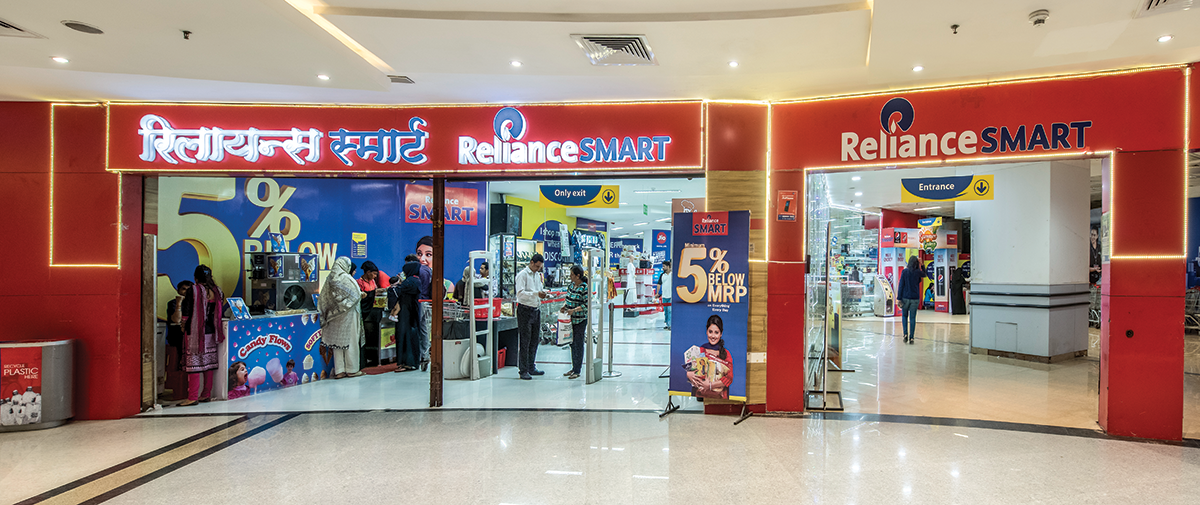
Destination Supermarket
RELIANCE RETAIL OPERATING MODEL
BUYING
VENDOR ECOSYSTEM
Comprehensive network of vendors
from farmers to large enterprises
MOVING
- Efficient and seamless supply: Direct delivery to stores from chain network, fleet of vehicles and logistic partners
- Direct delivery to stores from suppliers in select cases
SELLING
CHANNEL ECOSYSTEM
Providing anytime, anywhere, shopping
experience through stores, e-com, connected
kiosks and catalogue sales; after sales service
through ResQ and dedicated customer care
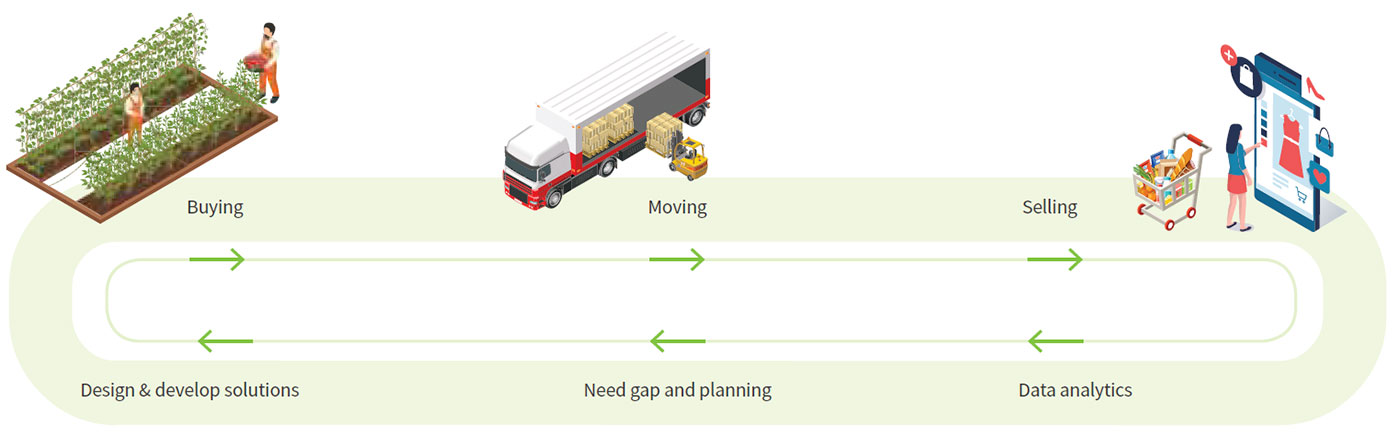
DESIGN & DEVELOP
SOLUTIONS
DESIGN ECOSYSTEM
Combination of
inhouse and
external design support for
product development

NEED GAP AND PLANNING
DATA ANALYTICS
CUSTOMERS
Serving individuals, kiranas,
hotels, restaurants, caterers and
B2B customers; engagement
through loyalty porgramme,
enriching shopping experience
through consumer insights

- Leveraging technology backbone across entire value chain and integrated IT systems
- Inhouse engineering, procurement and construction team supporting rapid expansion
- People — microservices organisation with defined roles and responsibilities
MARKET OVERVIEW
India’s retail market is estimated at around
US$700 billion in 2017 and is expected to
grow at a CAGR of approximately 12% over
the next 4 years to reach around US$1,100
billion by 2021. The penetration of organised
retail market is estimated at 9% in 2017
and is expected to grow to 13% by 2021.
The organised retail market is estimated at
around US$67 billion in 2017 and is expected
to grow at a CAGR of approximately 21%
over the next 4 years to reach around
US$145 billion by 2021.
Food and grocery, apparel and accessories, jewellery and consumer electronics together contribute 88.8% of organised retail market in 2017. Reliance Retail has established large presence across these categories to serve market opportunity and transform the retail landscape in India.
The strategy and business model of Reliance Retail has consistently helped it outpace the growth of organised retail and it is fully geared up to be able to continue this growth momentum in future.
BUSINESS OVERVIEW
Reliance Retail is engaged in the business
of retailing products and services across
five key consumption baskets: a) Fashion
and Lifestyle, b) Consumer Electronics, c) Grocery, d) Petro Retail and e)
Connectivity. Under each consumption
basket, Reliance Retail operates multiple
customer centric store concepts that
provide superior customer experience,
focused assortment, attractive price value
proposition and best quality products.
Reliance Retail operates one of the most
extensive retail store networks in the world
backed by committed and well trained
manpower, robust infrastructure backbone
and an integrated value chain. Reliance
Retail has created an ecosystem that
connects producers and manufacturers to
consumers seamlessly in over 6,600 towns
and cities of India through its 10,415 stores.
FASHION AND LIFESTYLE
The organised apparel, accessories and
footwear market is estimated at around
US$16 billion in 2017 and is expected to
more than double to around US$35 billion
by 2021. Organised retail penetration
in apparel and accessories category is
estimated at approximately 24% and
in footwear category, it is estimated at
approximately 27%. This is expected to
grow to in the range of 37% and 31%,
respectively by 2021.
Reliance Retail is the largest fashion retailer in India with 1,769 stores across 350 cities. Reliance Retail operates multiple speciality store concepts, which cater to all income segments ranging from value to mid segment and premium to luxury.
Trends is Reliance Retail’s flagship fashion concept positioned in the value segment and built on the principle of democratising fashion for aspiring Indian consumers. It is India’s largest apparel destination with over 670 stores across 350 cities. Trends stores are spread across malls, high streets and city centres connecting with customers in best settings. Trends is a multi-brand store concept offering national and international brands. Trends has developed a strong portfolio of in-store brands such as Avaasa, DNMX, Netplay, Performax, Teamspirit, etc. to cater to the diverse tastes and preferences of customers. Many of these brands have shown tremendous acceptance with customers and have grown up to match in size and scale equivalent to established national brands. In-store brands contribute over 70% to Trends revenues.
RELIANCE RETAIL FASHION LANDSCAPE
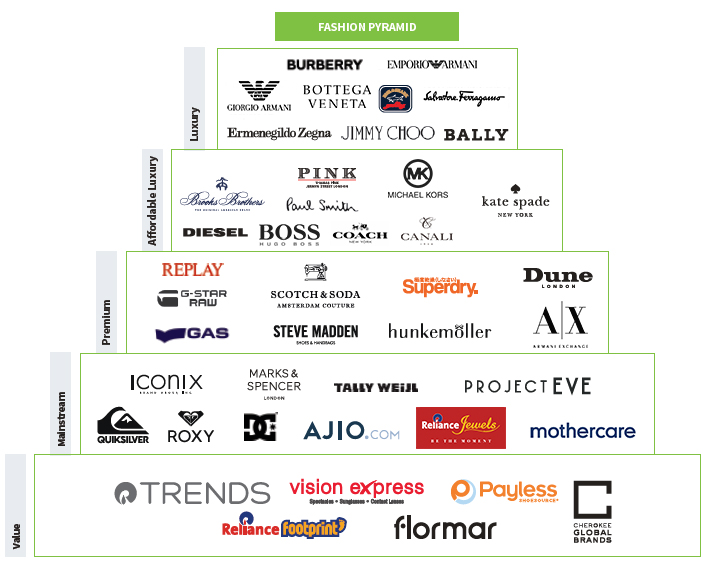
The ability of Trends stores to cater to an ever increasing number of customers comes from its vertically integrated operating model which, allows it to control the entire fashion value chain. Trends has set up in-house design studios, which, supplemented with international design houses, generates new designs on a regular basis. Trends sources its own fabric and gets the designs manufactured through hundreds of vendor partners across India and international markets. This translates into fresh fashion across stores on a regular basis.
Reliance Footprint is a leading multi-brand footwear chain offering over 50 prominent international, domestic and in-store brands. The store provides offers wide collection of products across footwear, luggage, handbags and accessories. The stores offers high quality products at attractive value proposition, making it a destination for all footwear and travel needs.
‘Project Eve’, is a unique and first of its kind experiential store concept that caters to the entire fashion and lifestyle needs of women. Positioned in the mid to premium segment, the store offers apparel, beauty and cosmetics, accessories, footwear, in-store salon and a café, all under one roof to address entire fashion needs of a woman. Since its launch in July 2017, Project Eve has now scaled to 20 stores across major cities.
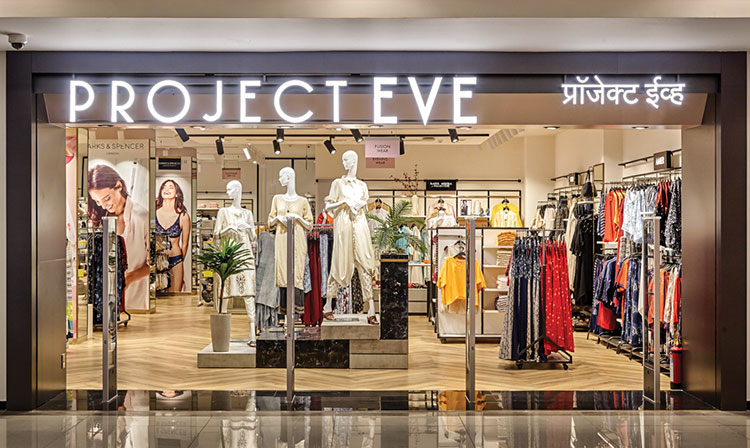
Curated Fashion and lifestyle
Reliance Jewels is a leading premium jewellery chain, offering a wide range of fine jewellery. It offers exquisitely crafted gold, diamond, bridal jewellery, ornaments for special occasions as well as daily wear with a profuse mix of traditional and contemporary designs. The stores provide a delightful customer experience guaranteed by a promise of 100% purity in quality and transparency in prices. Reliance Jewels has an inhouse design team and a dedicated production facility enabling it to exercise complete control over superior crafted jewellery sold through its stores.
Reliance Brands works with international brands in the premium to luxury segment with a focus on apparel, footwear and lifestyle categories. With a portfolio of over 40 revered international brands, Reliance Brands operates the largest portfolio of premium and luxury brands in India. Over the years, Reliance Brands has emerged as a partner of choice for best international brands. Reliance Brands operates the largest store network of international retail brands in India with over 400 stores.
AJIO is a curated fashion platform offering the trendiest and most unique styles from across India and the world. It features over 500 national and international brands alongside an in-store brand collection under the name ‘AJIO’. AJIO operates a digital ecosystem and democratises fashion for consumers across India. AJIO operates on an omni-channel model by providing anytime anywhere shopping to consumers. It leverages many of its partner brands’ network of stores to serve consumers through kiosks, fulfil orders, facilitate returns, replacement and refund. AJIO delivers products across 17,800 PIN codes.
CONSUMER ELECTRONICS
The organised consumer electronics
market is estimated at US$11 billion in
2017 and is expected to more than double
to US$26 billion by 2021. Organised retail
penetration in the consumer electronics
category is estimated at 27% and is
expected to grow to in the range of 35% by
2021.
Reliance Digital–Personalising Technology
Reliance Retail operates Reliance Digital, the largest consumer electronics speciality retail chain in India with 357 stores across 166 cities. Reliance Digital offers a wide range of technology products and consumer electronics from mobiles, laptops, cameras to large appliances such as UHD TVs, Air Conditioners, Washing Machines and much more. Reliance Digital stores are located on high streets and malls, serving technology needs of all age groups, including millennials to Generation Z and income strata across households.
Personalising technology for every Indian, Reliance Digital is transforming the way India shops for technology products and consumer electronics by providing product experience zones, wide range of assortment across 200 national and international brands, quality service through ResQ, supported by trained and knowledgeable staff and much more.
Reliance Digital has a wide portfolio of in-store brand products under 'Reconnect', 'JioPhone' and 'LYF' brands. The brands are built on the premise of product innovation, unmatched user experience, superior quality and give customers a wider choice of products that serve their needs.
ResQ is Reliance Digital’s service arm and India’s only ISO 9001 certified electronics service brand. ResQ provides multi-brand, multi-product service, including installation, repairs, maintenance and comprehensive ResQ care plans to consumers, thereby providing a one stop solution to consumers.
Jio Store is a small store concept offering range of mobility, connectivity and smaller sized tech products such as mobiles, laptops, cameras, memory cards, etc. It acts as an interface for providing Jio’s connection, recharge services and resolving customer concerns. These stores are located in high traffic areas such as high streets, commercial complexes, etc. across 6,600 plus towns and cities in India. Jio Stores leverage this deep-rooted reach by depicting, demonstrating and selling Reliance Digital’s catalogue of consumer electronics and technology products to consumers. Nearly 10% of Jio Stores’ revenues come through catalogue sales. Thus, it fills the much needed demand-supply gap for consumers based in remote pockets of India, thereby enabling the ease of living for every Indian.
GROCERY
The organised food and grocery market
is estimated at US$16 billion in 2017
and is expected to more than double to
US$41 billion by 2021. Organised retail
penetration in the food and grocery
category is estimated at 3% and is
expected to grow to in the range of 6%
by 2021.
Reliance Fresh is India’s leading chain of neighbourhood stores with 378 stores across 57 cities. Rated as India's Most Trusted Grocery Brand by Brand Trust Report 2018, Reliance Fresh offers fresh fruits and vegetables, staples, cereals, and items of daily needs to consumers at attractive prices with a focus on providing quality produce.
Reliance Fresh stores are placed in residential neighbourhood catchments, which gives it the ability to reach out to a set of customers and serve them for their daily needs.
Reliance SMART is the destination supermarket store, dealing in fresh foods, staples, items of daily needs, home and personal care items, apparel and general merchandise with attractive price-value proposition. Reliance SMART operates 154 stores across 96 cities.
Reliance SMART stores are operated across key cities in high traffic areas such as residential catchments, city centres, malls, etc. with a focus to serve every household’s recurring food and non-food consumption. The stores operate on an everyday low-price strategy and promises 365 day savings with a minimum 5% discount on maximum retail price (MRP) of the products, attractive promotions and a wide variety of products to choose from.
Reliance Market is the largest chain of cash and carry stores serving thousands of kirana, hotel, restaurants and catering (HORECA), small and medium institutional partners and households across fresh foods, FMCG products, staples, non-food and general merchandise items. It operates 46 stores across 42 cities.
The core business model of Reliance Market is to serve all kinds of small / large market participants across the trading value chain through efficient sourcing and distribution, including last mile distribution to member partners.
With a focus to provide quality produce to consumers at affordable prices, Reliance Retail has developed in-store brands, which provide a wide range of offerings across various categories such as staples, food, FMCG, home and personal care and general merchandise. Best Farms, Good Life, Masti Oye, Kaffe, Enzo, Mopz, Expelz, Home One, Graphite, RelGlow, etc. are some of the brands that have developed a strong liking by consumers. These brands are available across Reliance Fresh, Reliance SMART and Reliance Market stores.
Reliance Retail operates on a farm-to-fork grocery value chain. It directly partners with a large number of farmers and small vendors, which ensures and enhances quality of produce through ground level support, reduction in wastages and quicker movement of produce to consumers, thereby benefiting all.
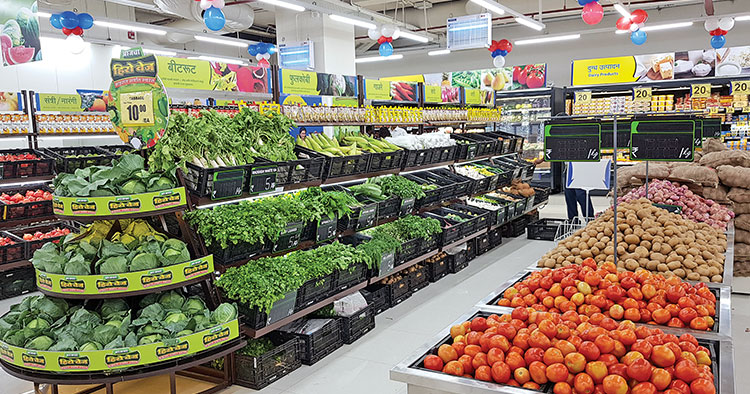
Reliance SMART
PETRO RETAIL
Reliance Retail operates 516 owned Petro
Retail outlets. These outlets are spread
across India with a focus on serving highway
corridors between major cities.
Reliance Petro Retail outlets yield significantly higher volumes than industry average led by efficient processes, technology backbone and well-trained employees. It offers diesel, petrol and LPG to its customers with a focus on serving clean and pure fuel.
CONNECTIVITY
Reliance Retail works as the Master
Distributor for Jio connectivity services.
The distribution network comprises over
7,600 Jio stores. These in turn work with over
1 million retailers across the country for new
customer acquisition and recharges.
INTEGRATED VALUE CHAIN
Behind all of Reliance Retail’s stores and omni-channel initiatives is its integrated value chain that connects farmers, small producers,
manufacturers, national and international brands to consumers through its pan-India presence of stores, B2B ecosystem and service network.
RELIANCE RETAIL INTEGRATED VALUE CHAIN ACROSS MULTIPLE CONSUMPTION BASKETS
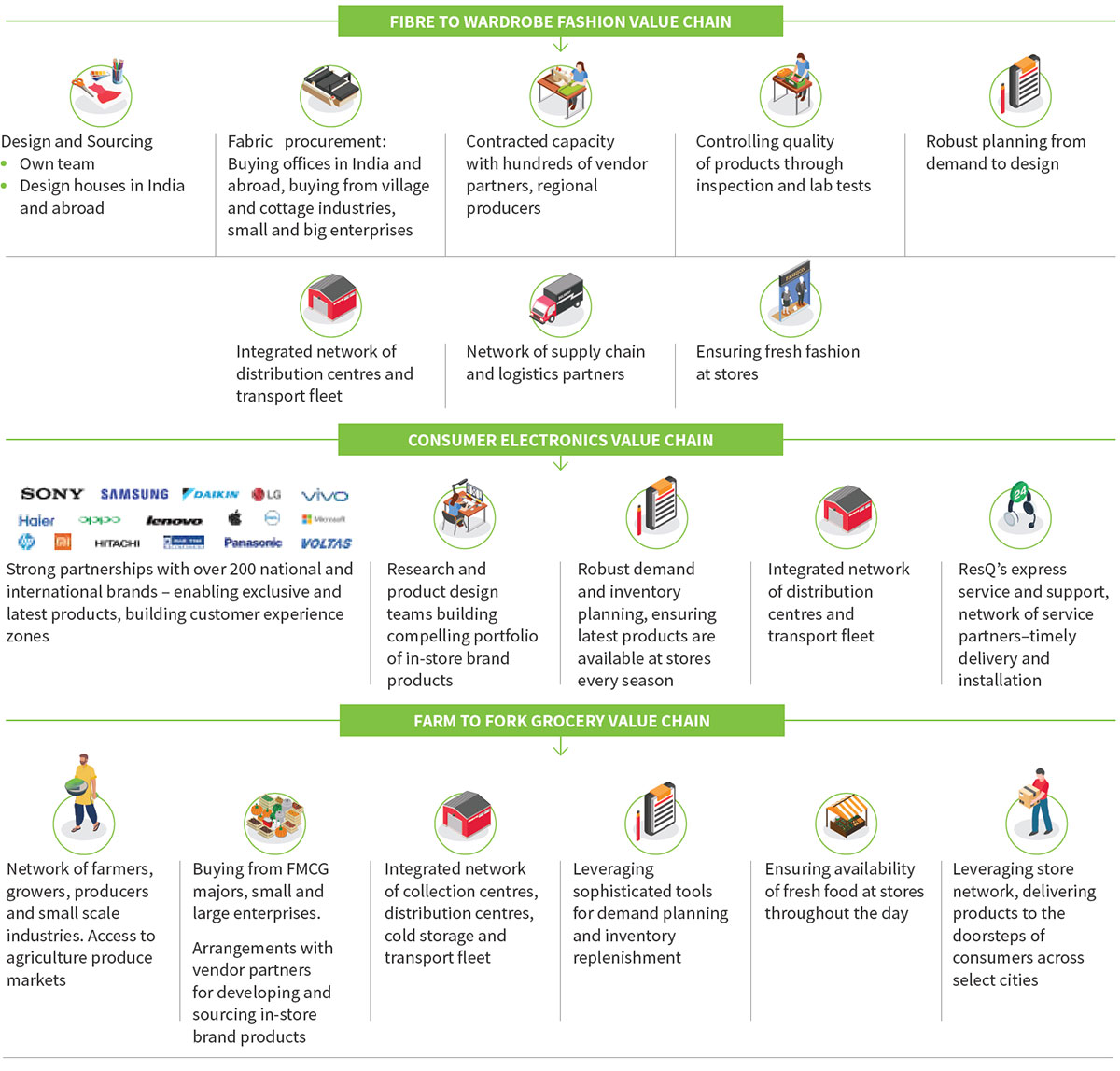

Reliance Retail achieved a turnover of `1,30,566 crore in FY 2018-19, an increase of 88.7% y-o-y. The business delivered an EBIT of `5,546 crore for FY 2018-19, more than doubling over previous year. Core Retail (excl. Connectivity, Petro-Retail) PBDIT margin improved to 7.0% vs 6.0% last year.
Reliance Retail operated 10,415 retail stores in over 6,600 towns and cities covering an area of 22 million sq. ft. as on March 31, 2019. Additionally, Reliance Retail operated 516 petro retail outlets as on March 31, 2019.
BUSINESS PERFORMANCE
Reliance Retail witnessed resilient growth
across all consumption baskets during
FY 2018-19. It continued accelerated
expansion of stores and operationalised
more than 2,800 stores across all
consumption baskets during the period.
A record of over 500 million footfalls was
received during the period, a growth of
44% y-o-y.
Reliance Retail operates more stores than any other organised retailer in India. The FY 2018-19 revenue and profits of Reliance Retail demonstrates the leadership position it has established in the market. Reliance Retail’s growth is not only noticeable in the Indian context but also at a global scale. Reliance Retail has been ranked as the 6th fastest growing retail company in the world and features 94th in the list of Global Powers of Retailing by Deloitte based on FY 2017-18 revenues.
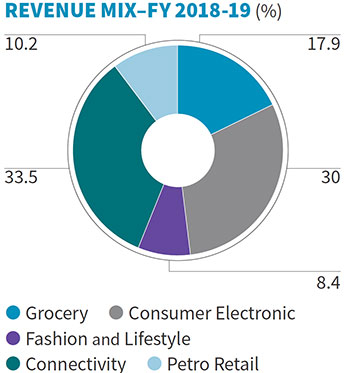
During the period, Reliance Retail formed several long-term strategic partnerships. These partnerships add significant value to its offerings across all consumption baskets.
- Partnership with Disney to develop and market co-branded (Disney and Reliance in-store brand) SKUs across various categories such as food, fashion, toys and much more
- Reliance Brands formed an exclusive partnership with Mothercare, UK along with the purchase of the current Mothercare India business
- Genesis Luxury Fashion and Genesis Colors, which became a subsidiary of Reliance acquired exclusive rights for Salvatore Ferragamo, an Italian luxury brand
- Reliance Brands announced a partnership with Replay Jeans, Italian leader in the premium denim segment
- Reliance Brands announced a partnership with Williams-Sonoma to bring Pottery Barn, Pottery Barn Kids and West Elm to India
In Fashion and Lifestyle, Trends witnessed strong growth backed by accelerated store expansion and strong same-store sales growth during the period. Trends continued its mission to democratise fashion across India. More than 2/3rd of Trends stores are now serving Tier II and III cities and generating strong growth from these markets.
During the period, Trends rolled out 65 small town Trends stores, thus further penetrating in to Tier III/ IV towns. The concept has received encouraging response from consumers, paving way for its expansion. Trends Man and Trends Women concepts continue to gather strong traction from consumers and have expanded to 10 stores and 21 stores, respectively. Trends is the largest and fastest growing fashion retail chain in India and has opened more than 125 new stores during the period.
During the period, Reliance Retail acquired from ITC Limited all rights, title, interest, trade-marks and intellectual property in the brand ‘John Players’. John Players is a mid-segment menswear brand with national presence.
The curated online fashion destination AJIO continued to grow with strong customer traction during the period. It features more than 1,30,000 options and witnessed nearly 2/3rd revenue from repeat customers. AJIO mobile app continues to be one of the top shopping apps on Google Play Store and Apple iStore with over 12.7 million app downloads during the period.
AJIO implemented omni-channel initiatives during the period whereby 555 Trends stores were integrated for online order fulfilment, return and refund. AJIO also launched AJIO Gold during the period, which offers a collection of premium and luxury brands such as Superdry, Steve Madden, Dune, DC, Scotch and Soda, Gas, and many more.
Reliance Brands launched a new multi-brand store ‘The White Crow’ featuring brands like Diesel, Marc Jacobs, Onitsuka Tiger, etc. The White Crow is a destination store for the world’s finest international brands.
Reliance Jewels opened over 80 stores during the period. It now operates 143 stores / Store-in-Stores (SIS) pan India.
In Consumer Electronics, Reliance Digital witnessed strong growth driven by robust customer demand, wider coverage, effective marketing communication and rapid store expansion during the period. It continued to outpace the market growth across key categories of mobiles, laptops, UHD TVs, Air Conditioners, Washing Machines, etc. Reliance Digital continued to delight customers by upgrading store environment to enhance customer experience, aggressive opening price points and focused promotions.
In Grocery, Reliance Retail witnessed strong growth across staples, fruits and vegetables, home and personal care, confectionery and snacks and general merchandise categories. It strengthened in-store brand portfolio with new product launches across food FMCG, home and personal care, staples, luggage, disposables and stationary categories. A glimpse of new product launches is depicted in the below image. Reliance Market saw strong growth backed by growth in business with Kirana and HORECA members.
OUTLOOK
With the world’s largest millennial
population embracing digitisation, social
media and technology, India’s retail
trade has no longer remained a mere
buy-move-sell architecture. It is imperative
that retailers deploy sophisticated tools
such as artificial intelligence, analytics,
automation, etc. to identify existing
need gaps, foresee future requirements, design and develop ‘solutions’ than just
products to address demands of aspiring
consumers, follow up and periodically
assess the consumer feedback.
Reliance Retail is rightly positioned to exploit this opportunity and transform the retail landscape in India. Reliance Retail has been growing at a rapid pace with revenues growing over 7 times and EBITDA growing over 14 times in the last five years. Reliance Retail aims to continue this journey of rapid growth. Following key drivers will form growth pillars as business marches ahead:
a. Continued expansion of physical store presence
Reliance Retail has opened more than 10 stores a day over the last 2 years to cross 10,415 stores across 6,600 plus towns and cities with careful planning and execution. This provides Reliance Retail a first mover advantage across so many Tier 3 and Tier 4 towns. Reliance Retail will continue to invest in expanding the existing store network across all consumption baskets.
b. Integration of online and offline channels connecting everyone, everything, everywhere
To further supplement the reach of physical stores, Reliance Retail has created an online channel for its consumer electronics and fashion and lifestyle businesses. The physical stores are now being equipped with kiosks so that consumers can browse endless aisles and shop for products which may not be readily available at stores. Stores are also being equipped to handle delivery, return, replacement and refund to provide anytime, anywhere shopping experience to consumers. Reliance Retail will further develop and enhance core capabilities such as mobile apps, social media linked interactive app features, delivery and fulfilment infrastructure, etc. to provide superior omni-channel solutions to connected and mobile consumers across all consumption baskets.
c. Strengthening in-store brand portfolio
Developing a set of robust in-store brands across consumption baskets and its acceptance by consumers will provide Reliance Retail an edge in terms of generating sustainable demand, growing revenues and improving profitability. The growing market opportunity provides tremendous potential to create wider portfolio of in-store brands across multiple categories, which can serve consumers through Reliance Retail’s physical reach and distribution. Reliance Retail would continue to innovate with in-store brands through a solutionbased approach to share increased value with its supply partners and customers.
d. Enhancing customer experience
Reliance Retail operates with a vision to be the most admired and successful retailer that enhances the quality of life of every Indian. With this ethos, Reliance Retail has always endeavoured and will continue to provide superior customer experience through continuous improvements in store environment and create consumer focused store concepts.
Further, Reliance Retail aims to enhance its core capabilities, including leveraging customer insights through use of sophisticated tools and much more to cater to the ever increasing demand of surging India and consolidate its market leadership across all consumption baskets and store concepts.

In-store brand products
BUSINESS STEWARDSHIP
Reliance Retail operates its business
keeping societal well-being as a key
objective. Few of the social initiatives that
demonstrate how Reliance Retail is making
a difference to the society are captured
below:
- People with disabilities usually find it extremely challenging to get jobs in India. However, Reliance Retail employs over 1,000 Persons with Disability (PwD) in various roles at store level. PwD employees bring immense potential and value to the workplace and their attrition rate is the lowest in the Company. The Company has laid down focused hiring strategies to ensure steady growth of these numbers.
- Urbanisation has been on a rise in India as more and more people from small towns are migrating to larger cities in search of work opportunities. With the spread of Reliance Retail store network in 6,600 towns and cities, Reliance Retail has been able to create work opportunities in thousands of small towns and spread avenues of livelihood for such families.
- Reliance Trends’ leading position in India’s fashion apparel market is backed by its ‘Make in India’ commitment. This year, Trends sourced more than 3 crore metres of fabric from Indian producers. Reliance Trends works closely with over 400 vendors across India, providing them with committed volumes, educating them on modern manufacturing techniques and supporting them to enhance productivity and quality.
ILLUSTRATION
DIVERSITY, EQUITY AND INCLUSION
Reliance Retail’s HR policies carry an agenda for Diversity, Equity and Inclusion across three pillars of Employment, Engagement
and Empowerment.
Employment
Engagement
Empowerment

Action
Reliance Retail is an equal opportunity employer, employing without any discrimination with respect to age, gender, caste or disabilities. Furthermore, the Company celebrates diversity and promotes inclusivity through several leadership programmes such as 'Saksham' for PwDs and 'Jagriti' for female employees
Action
Rigorous employee training of 1-3 weeks covering all SOPs/Processes before joining the shop floor; focused leadership development and step-up programmes for employees and particularly for women; same training and benefits for all employees including PWDs
Action
Launching Womens Resource Groups (WRG), which are steered by senior women colleagues to guide and mentor women through their careers, mentoring young mothers returning from maternity breaks
Impact
As of March 31, 2019, Reliance Retail has 22% women employees pan India, over 1,000 PwD employees ; offered employment to nearly 40,000 unskilled resources during FY 2018-19
Impact
24 women taking over store leadership role in Reliance Fresh, Reliance SMART and Reliance Market
Impact
Promoting and empowering women in the workplace
Outcome
Equal opportunity, fairness and equity in employment practices, which ensure customer satisfaction
Outcome
Attrition dropping by 33% and customer complaints reducing by 50%
Outcome
Safety and security for women and PwD staff in all locations

Sanjay Mashruwala
Mathew Oommen
Pankaj Pawar

Kiran Thomas

Harish Shah
Jyotindra Thacker

Anish Shah

Anshuman Thakur
Rajneesh Jain
V. Sridhar

Ashish Lodha
Shyam Mardikar

Anuj Jain
Prateek Pashine

Aayush Bhatnagar
Jio is the fastest growing digital company globally with 306.7 million subscribers as of March 31, 2019. Among the many accolades it has received since inception, Jio was ranked as the top company globally on Fortune's 'Change The World' list that ranked companies that have helped the planet and made an important social impact. The whole-hearted acceptance of Jio’s digital services is evident from over 3 Exabytes per month of data that is carried on its wireless network.
Jio has been the key catalyst in the creation of a broadband data market in India and is now ranked #1 amongst mobile telecom operators in the country by Adjusted Gross Revenue (AGR). Following up on its success in wireless, Jio is now aiming to catapult the wireline infrastructure and services in India to global standards, with the launch of its FTTH and Enterprise services. Jio continues to build a digital ecosystem spanning across media and entertainment, commerce, financial services, education, healthcare and agriculture through group affiliates.
Jio remains committed to the Digital India campaign with focus on providing world class digital services at affordable prices to every citizen of the country.
Connecting lives through JioPhone
STRATEGY AND VISION
Jio is determined to connect everyone and everything, everywhere – always at the highest quality and the most affordable price. In this context, the strategy and vision is to completely digitise the customer lifecycle. Through platforms held by group affiliates, Jio will offer not just connectivity solutions but also services across media and entertainment, commerce, financial services, education, healthcare and agriculture.

COVERAGE
Coverage refers to anytime, anywhere mobile broadband access. Jio’s 4G coverage at present is greater than 2G coverage in India and is fast approaching its target of 99% population coverage. This coverage is backed by pan India 4G spectrum across three bands and the best fiber and tower infrastructure in the country, providing the best network experience and farthest reach.

DATA
Average per capita data consumption on Jio’s networks is nearly 11 GB per month with potential upside from new use cases coming up every day.

QUALITY
India has been a supply constrained market with limited network infrastructure. Jio offers services on an all-IP, LTE network with best-in-class customer service, easy app-based customer interaction for query resolution and recharges, and AI based bots to provide seamless onboarding and service experience.

AFFORDABILITY
Affordable and simple pricing plans have been the key to the large-scale adoption of Jio services. Jio has been able to offer these on the back of superior technology based operating efficiencies, enabling it to offer services at the most affordable price.

AGILITY
Jio’s adoption of agile model while developing its systems has supported its ability to scale and adapt in an orderly manner. The same was demonstrated post discontinuation of Aadhar based e-KYC. Jio implemented the alternative digital KYC process seamlessly in a timely manner, without affecting its operations.

Media and Entertainment
- JioTV
- JioCinema
- JioSaavn
- JioNews
- Network18
- BookMyShow

Commerce
- O2O platform
- Enable 20 million small merchants to compete with organised retail
- Data Analytics and AI for consumer insights

Education
- Digitally enabled education to overcome infra challenges
- Connect 58,000 colleges and 1.9 million schools
- Infra for 200 million children in 2 years

Healthcare
- Overcome deficit of physical infra
- Telemedicine, Tele-radiology, e-Diagnostics, Genomics
- Infra for 200 million children in 2 years

Agriculture
- Combine digital tools with wisdom of farmers
- Tech for water conservation, soil management, precision farming

MARKET ENVIRONMENT AND OUTLOOK
Adoption of VoLTE – India now has over 500 million mobile broadband data subscribers, buoyed by Jio’s entry and subsequent adoption of its services. Jio’s VoLTE offering on its fully dedicated IP-networks has prompted an industry wide transition from Circuit Switched technology to VoLTE (Voice over LTE), and deeper penetration of 4G networks. Device ecosystem too has seen a transition with 100% of the smartphones shipped into India now being 4G enabled.
Data upsurge – Adoption of LTE and improving device ecosystem has led to a transition in data consumption trends, with more than 90% of wireless data in the country carried on 4G network now. There has also been a surge in video usage with 70% of all data traffic on Jio network being used for video.
A combination of increasing device and network penetration, and higher affordability is likely to result in further increase in data demand across wireless networks in India. As per data in the Cisco VNI report, mobile data in India is expected to grow 9x during FY 2017-22. Government’s strong policy framework and push towards ‘Digital India’ is helping in this rapid transition towards digital economy and society.
Regulatory impact – From regulatory perspective, TRAI had set a definitive path towards eliminating Interconnect Usage Charges (IUC) with effect from January 1, 2020. This will hasten the adoption of more efficient technologies like VoLTE, which have a negligible cost for carrying and servicing essential voice services. Jio has been a pioneer in the rollout of digital technologies and this sets a clear path forward for an industry wide rollout.
TRAI has also set the ball rolling for 5G spectrum auctions in India with availability in newer frequency bands like 700 MHz and 3,300-3,600 MHz. Jio with its 5G ready network would play a key role in development of the 5G ecosystem in the country, based on market dynamics.
Data Localisation – Jio has been a strong supporter of local storage of data, which is critical for national interest and security given the increasing sophistication of cyber-attacks. Data localisation will also spur investment in creating server and cloud capacity in India, incentivising research and development and creating employment in line with the Government of India’s 'Make in India' initiative.
Jio believes that Indians are the true owners of their data and the ownership should not be transferred to any corporate entity. Without the consent of the user, no data should be collected, processed or used by any corporate. This would require a regulatory framework to ensure that corporates are taking adequate measures to ensure data protection.
Wireline networks - Wireline remains a huge opportunity in India, given that fixed broadband penetration is at less than 7% of households, with most being served by legacy infrastructure and technology. Fiber penetration at less than 2% is significantly lower than global benchmarks. Given the trend in mobile broadband consumption wherein close to 70% of data is consumed indoors, need for high speed fiber connectivity at homes and enterprise is well established.
Last mile connectivity and intracity fiber networks will be a key differentiator. In this context, Jio is well positioned to tap this virtually greenfield opportunity to offer FTTx services with its extensive layout of fiber network and customer touch points across 1,600 cities.
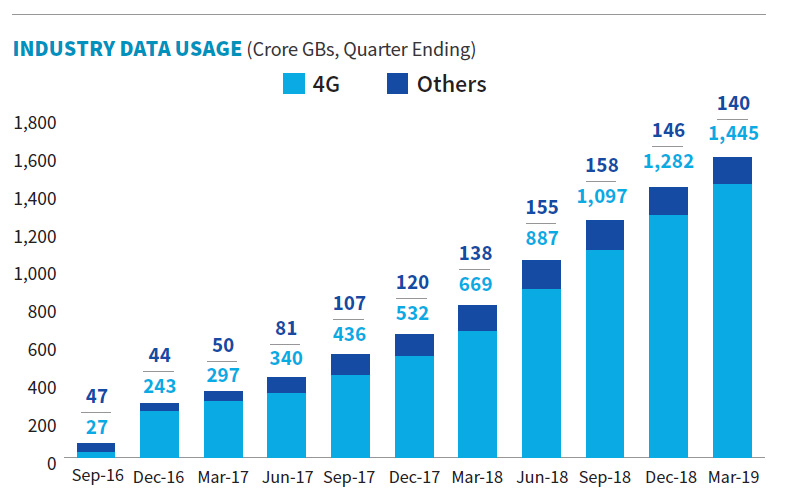
BRIDGING THE URBAN RURAL DIVIDE
India has set new incentivising standards for mobility led inclusion, driven by a combination of private and public initiatives. Jio realises that reducing the digital inequality is crucial to ensure equal access to information and knowledge, as well as foster innovation and entrepreneurship. Jio has been a key catalyst for data usage across geographies and strata of society with its deep network coverage and affordable data plans. This has been the primary reason for the data boom that the country has seen over the past two years. Prior to the launch of Jio services, the total mobile data traffic across all networks in India was 0.2 Exabytes per month. At present, Jio network alone carries over 3 Exabytes per month, with the industry data traffic being more than 5 Exabytes per month.
India is the second largest smartphone market in the world after China, with approximately 400 million smartphone users. Notwithstanding, smartphone penetration has been low, constrained by low affordability and adoption in rural areas. This should improve as device prices go down and per capita incomes increase. JioPhone has played an important role in providing the power of data and internet to rural India and the lowest economic strata. The 'Monsoon Hungama' plan for JioPhone has been very successful in driving first time adoption by mobile internet users, especially in rural areas. Also, Government initiatives on Digital India has been a big driver along with deeper rollout of LTE networks.
Despite this, rural India remains a highly underpenetrated market and presents a huge opportunity for digitisation. According to data from TRAI, rural mobile penetration stands at 57% while rural internet penetration is 25%, indicating that rural remains primarily a voice market. Rural broadband penetration is even lower at 21%.
As per EIU forecasts, Indian households have been witnessing an upward trend in their disposable income for the last few years. Deloitte expects that rising affluence will drive adoption of internet-based services. Supported by affordable network and devices, India’s young population is set to lead the data revolution in the coming years as untapped markets start adopting more digital services.
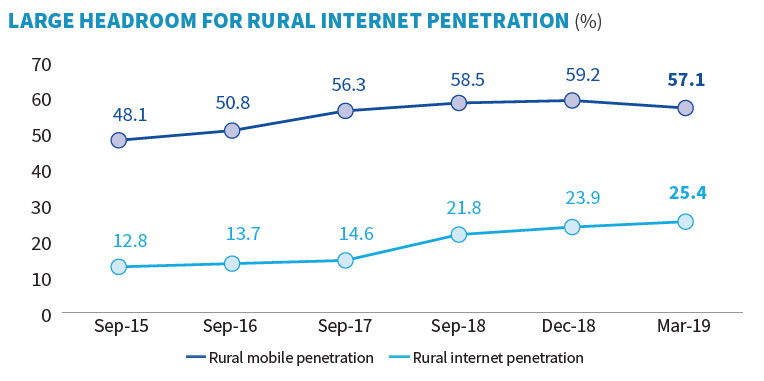
JIO – AN INTEGRATED DIGITAL SERVICES FRANCHISE
Jio’s transformative entry and collaborative approach across the consumption value chain has catalysed industry transition towards convergence of wireless, wireline, media entertainment and other value-added services.
JIO LEADING FROM FRONT
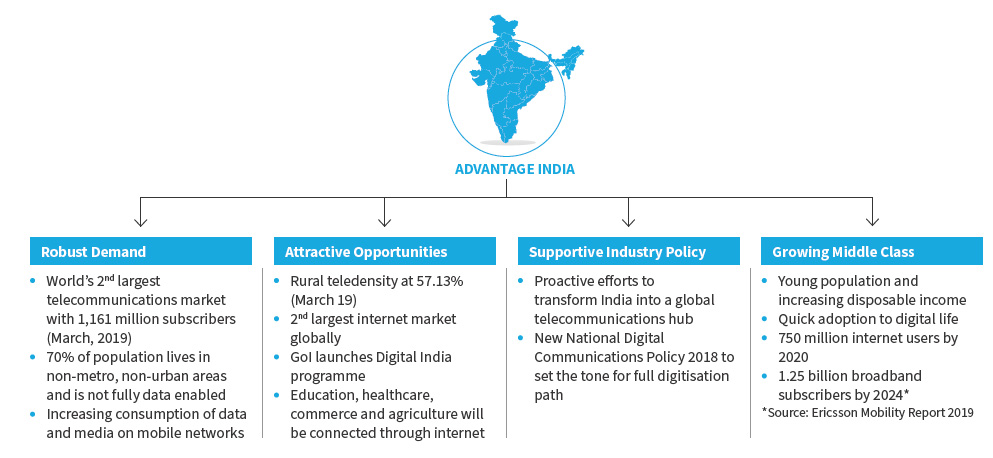
NETWORK BUILT FOR COVERAGE AND CAPACITY
Jio has built the country’s largest all-IP data network on 4G-LTE technology. The network has been built as a mobile video network, provides VoLTE and is future ready for transition to 5G and beyond. Jio’s target is to reach 99% population coverage, significantly ahead of any 2G network coverage in India. It is also augmenting capacity by adding new sites, fiber backhaul and small cells.
BEST IN CLASS NETWORK QUALITY
Jio’s wireless network now carries over 3 Exabytes of data and nearly 25,000 crore minutes of voice per month. Across the 306.7 million subscriber base, this translates to a per capita usage of 10.9 Gigabytes and 823 minutes per month. Despite this growing traffic, call drop rate on Jio networks remains the lowest in the industry and data download speed is also by far the fastest in the industry. According to TRAI’s data, Jio is the fastest 4G operator with highest average download speed for the last 27 months – registering average download speed of 20.8 mbps on its network, more than twice to that of the nearest operator (at 9.5 mbps). The entire scale up of Jio has come alongside sustained network performance underlining its quality and capacity.
LIBERALISED SPECTRUM ACROSS THREE BANDS
Jio’s network is designed to seamlessly work across 800 MHz, 1800 MHz and 2300 MHz frequency bands. In fact, each of the sites on the network radiates all three bands. The combined spectrum footprint of 1,108 MHz (uplink + downlink) across the three bands in 22 circles provides significant network capacity and deep in-building coverage. Average life of the spectrum portfolio is over 14 years with all spectrum liberalised, which can be used to roll out any future technology.
UNDERSEA CABLE NETWORK FOR GLOBAL CONNECTIVITY
Jio has been actively creating a multi terabit capacity international fiber network. Jio with its partners is a part of two undersea cable network consortiums:
- BBG (Bay of Bengal Gateway), a state of the art 8,100 kms undersea cable system providing direct connectivity to SE Asia and Middle East, then onward to Europe, Africa and Far East. This strategically important undersea cable facility has a landing facility in Chennai
- AAE-1 (Asia Africa Europe) stretches over 25,000 kms from Marseille, France to Hong Kong. This is the longest 100 Gbps undersea cable system with 21 landing stations across Europe and Asia. In India, it has a landing station in Mumbai
JIO DIGITAL VISION
DEMOCRATISING DATA

Most affordable
data in the world – ensuring access to
the common man
Best value offering in data

Connectivity for every Indian
Rich bouquet of digital services
Affordable devices with data
connectivity and applications

High quality data
Uninterrupted and high speed data
access anywhere, anytime
High speed video ready network

Widest network in India
Spread across cities and villages
To cover >99% of India’s population
BEST IN CLASS NETWORK ARCHITECTURE
Investment in infrastructure and innovation are crucial drivers of economic growth and development, and Jio has been a forerunner in deploying world class digital infrastructure, while constantly thriving for innovative solutions to deliver the best services for its subscribers. Jio’s next generation network is amongst the best in the world. Built from the ground up to support high data usage and low latency, advanced features such as Software Defined Networking (SDN) and Network Function Virtualisation (NFV) have been incorporated into its design. Combined with significant in-house data centre capacity already built and investments into CDN (Content Distribution Network), the network does not just support superior customer experience but is also future ready, with potential transition to 5G in cost and time efficient manner.
NETWORK AND PLATFORM INNOVATION
Jio has been on the forefront of innovation, be it for network technology, platforms or consumer services. Till date, the company has filed 100 patents for the pioneering initiatives it has undertaken, of which 18 have been granted. In FY 2018-19 alone, the company filed for 35 patents and was granted 12. These patents span across devices, network, cloud, digital media, branding and customer experience. Jio’s patents cover areas of cutting-edge technology including video bots, blockchain, NFV (Network Function Virtualisation) and eMBMS (Evolved Multimedia Broadcast Multicast Services).
TRULY DIGITAL JIO PLATFORMS
Since its inception, Jio has taken a platform approach to integrate digital experience and services with Jio Digital Platforms. This has made all systems and processes extremely modular resulting in quick time to market for any new solution or system changes. This was evident in recent suspension of Aadhar based eKYC process during the year, when the new process was developed and deployed across the country in less than 2 weeks.
Taking the same approach further, JioCloud is now hybrid cloud ready and migrated to an open source. To keep pace with technology transitions, the company has created horizontal organisational frameworks and communities to institutionalise all current and ongoing learnings at Jio.
JIO-INTEGRATED DIGITAL SERVICE FRANCHISE
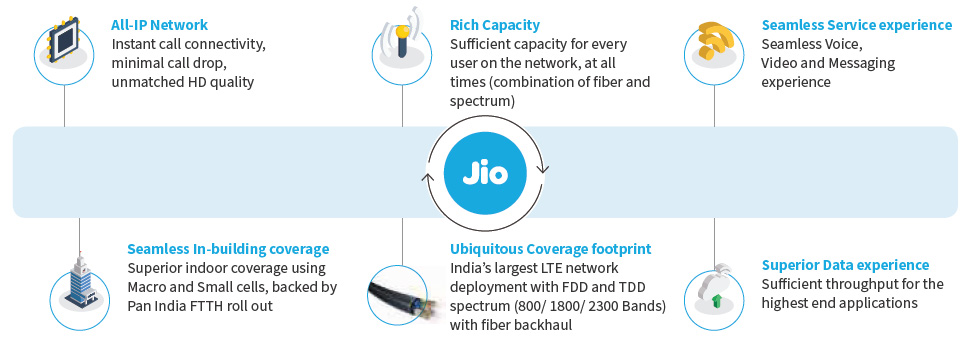
CREATING A MICROSYSTEM WITH NEW ENTREPRENEURS
India is fast emerging as an innovation centre for new technologies. Young entrepreneurs are using technology to solve customer problems across the strata of population. Jio, because of its best in class 4G network has been a key catalyst for this ecosystem. Taking this a step further, Reliance is nurturing and developing this ecosystem further through investment and collaboration.
In FY 2018-19, through group affiliates Reliance has invested in companies like C-Square (software), EasyGov (e-governance), Grab-a-grub (logistics), Haptik (chatbot solution), Netradyne (AI, logistics), NEWJ (digital and social media), Radisys (5G, IoT), Reverie (language as a service platform), Sankhyasutra (simulation services) and SkyTran (transportation technology). Each of these investments have been carefully selected to fit into Reliance digital ecosystem to enhance and keep its offering across mobility, homes and enterprises future ready.
DISTRIBUTION TO COVER THE LENGTH AND BREADTH OF THE COUNTRY
Reliance Retail works as the Master Distributor for Jio connectivity services. The distribution network comprises of over 7,600 Jio stores. These in turn work with over 1 million retailers across the country for new customer acquisition and recharges. In addition to this, services are also sold through the MyJio application, the most popular self-care application in the country.
MAJOR CONTENT PARTNERSHIPS IN FY 2018-19
To improve customer engagement on the network, Jio has entered into a series of content partnerships in FY 2018-19 to provide best in class content to its subscribers. These include:
- Partnership with Disney to offer content from Disney, Pixar, Marvel, Lucas Film on JioCinema app. The app hosts a dedicated Disney branded section on the homepage with content spanning across movies, animation and short series
- Agreement with Star India for a period of 5 years, for the telecast of all BCCI Cricket matches (T20, One Day Internationals, International Test Matches, BCCI Domestic Tournaments) on the JioTV platform
SUITE OF DIGITAL SERVICES
Jio’s all IP network is fully enabled and capable of delivering content focused services. This enriches customer experience due to the network’s ability to carry and deliver multimedia content. Jio through its group affiliates has created a rich suite of applications and tools that encompass entertainment, news, information, commerce and self-service. Jio’s digital suite of applications are already amongst the most popular in their respective categories and have won various accolades. Most popular ones include JioTV (630+ channels of live and catch up TV, across 16 languages and, 11 genres), JioCinema (Video on Demand, 10,000+ movies, 1,20,000+episodes, 70,000+ music videos), JioMoney, JioNews (Personalised news app with use of AI and ML algorithms consolidating various content formats including Live TV, Short videos, News articles, Magazines and Newspapers) and JioChat. Through the MyJio app, digital self-service and e-Care capability is offered, which proves to be a cornerstone of Jio’s Digital proposition for its customers.
During the year, JioMusic and Saavn were brought together into a single application, creating industry leading user interface and analytics with a library of over 45 million tracks in 16 languages. The platform is differentiated through the exclusive content produced via its Artist Originals Program. This is the first Jio OTT (Over The Top) content application which is also available to non-Jio customers across the world, on a freemium model. JioSaavn has global collaborations with leading artists. During the year JioSaavn’s Artist Originals 'AO' facilitated collaboration between Bollywood composer Pritam and Marshmello, which got 70 million views of ‘BIBA’ track on OTT platforms, and AO collaboration between global hip hop legend Nas and India’s two biggest rap stars, Divine and Naezy.
SUITE OF DIGITAL APPS FOR THE CONSUMER

MyJio
- Full service app with MACD – Prepaid Postpaid payments, Voucher, Loyalty, Troubleshooting, Vitual Assistant

JioTV
- Live and catch up TV – 16 languages, 11 genres, 630+ channels, 130+ HD channels

JioCinema
- Video on demand – 10,000+ movies, 1,20,000+ episodes, 70,000 + music videos, Exclusive Web Originals

JioMoney
- Jio Money is a digital payment platform. Jio Payments bank is a JV with SBI where live trials are in progress.

JioNews
- Intelligently packaged consolidated and personalised news app with use of AI and ML algorithms
- Varied contents formats including Live TV, Short videos, News articles, Magazines and Newspapers
- 175+ Live channels, 900+ magazines, 300+ newspaper editions

Embibe
- Unique data driven AI based education services platform catering to Engineering, Medical, Banking and Class 8-10

JioChat
- Fully encrypted messaging, HD quality group voice and video conferencing, events and play-along initiatives

JioSaavn
- Launched integrated JioSaavn app with refreshed UI/UX
- 45+ million tracks under license across 16 languages with key differentiation through Artist Originals Program
- Key initiatives include new original content releases and programmatic ad deals and live lyrics/karaoke
RIL also acquired a majority equity stake in Indiavidual Learning Pvt Ltd (Embibe), a leading AI-based education platform leveraging data analytics to deliver personalised learning outcomes to each student. The investment in Embibe underlines Reliance's commitment to developing the education sector in India and the world, making education accessible to the widest possible group of students by deploying technology. Reliance aims to connect over 1.9 million schools and 58,000 universities across India with technology, while strengthening Jio's leadership position as a digital technology company.
During the year, Jio also came out with a unique and differentiated offering, Kumbh JioPhone to enrich the spiritual experience of devotees visiting the Kumbh. The Kumbh JioPhone offered a suite of benefits like real time travel information, ticket bookings, stay options, routes and maps, family locator, multimedia devotional content, news alerts and entertainment, among others.
WIRELINE NETWORK TO ENHANCE CONNECTIVITY
India currently has only 19 million households (6.3% penetration) with fixed broadband connections, including less than 2% fiber connected households. Jio has set out a target to connect 50 million homes across the country with its GigaFiber services. These services would include home broadband, wireline, content and smart home IoT solutions. Jio GigaFiber is designed to provide fast and secure ultra-broadband home experience to the Indian audience.
To accelerate this rollout, RIL has made strategic investments in Hathway Cable and Datacom Limited and DEN Networks Limited. These investments will create a win-win outcome for Local Cable Operators (LCOs), consumers, content providers and overall ecosystem. Through these investments, Jio will be strengthening the 27,000 LCOs aligned with DEN and Hathway to provide Jio Home solutions to millions of homes. This will accelerate Jio’s commitment to provide services to 50 million homes in the shortest possible time.
DEMERGER OF TOWER AND FIBER ASSETS
Board of Reliance Jio Infocomm Limited (RJIL) approved the demerger of its passive infrastructure, tower and fiber assets into two separate SPVs. The scheme of the demerger was effective from March 31, 2019 post all requisite internal, shareholder, debt holder and regulatory approvals. The assets would be held by a separate SEBI registered Infrastructure Investment Trusts (InvIT). This demerger deleverages the balance sheet and establishes Jio franchise as an asset-light, digital services company.
FINANCIAL, OPERATING AND CUSTOMER ENGAGEMENT METRICS
Jio continued its momentum from the previous year to FY 2018-19, reporting robust revenue growth and margin performance. This was driven by strong adoption of Jio services, reflected in strong subscriber addition and usage metrics on data and voice. Subscriber addition of 120 million in FY 2018-19 was well ahead of the 83 million added in FY 2017-18. Gross revenue of `46,506 crore for FY 2018-19 on a subscriber base of 306.7 million and EBIT margin of 18.9% marked the continuation of profitable growth.
FINANCIAL PERFORMANCE
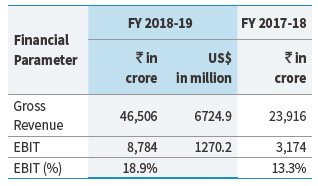
Jio continues to transform Indian Telecom industry with its leading performance benchmarks as follows:
- Industry leading ARPU of `126.2 per month during the quarter ended March 2019
- Average voice consumption at 823 minutes per user per month (highest per subscriber usage in the industry) during the quarter ended March 2019
- Average data consumption of 10.9 GB per user per month (amongst highest per subscriber usage globally) during the quarter ended March 2019
- Total wireless data consumption of 956 crore GBs during the quarter ended March 2019 (one of the world’s largest and fastest growing mobile data network)
- Video consumption drove most of the usage, increasing to over 500 crore hours per month
OUTLOOK
Jio will continue to invest and build world class digital infrastructure for the citizens of the country, making a meaningful socio-economic impact and generating shareholder returns over the next several decades. This will be built on the tenets of providing data network with best coverage and network quality at the most affordable prices. In addition to connectivity solutions and already established media and entertainment services, Jio strives to create a comprehensive digital ecosystem, with focus on scaling up its new offerings across commerce, education, healthcare, financial services and agriculture.
Working on its commitment to Wireline services, Jio has built the product and services to transform every home to SMART Home by serving the digital needs of tomorrow’s India today – including ultra-high speed internet, content, Home voice services and Home IoT services, among a list of digital services. Jio will continue to work relentlessly to provide widespread fiber connectivity to Modern India.
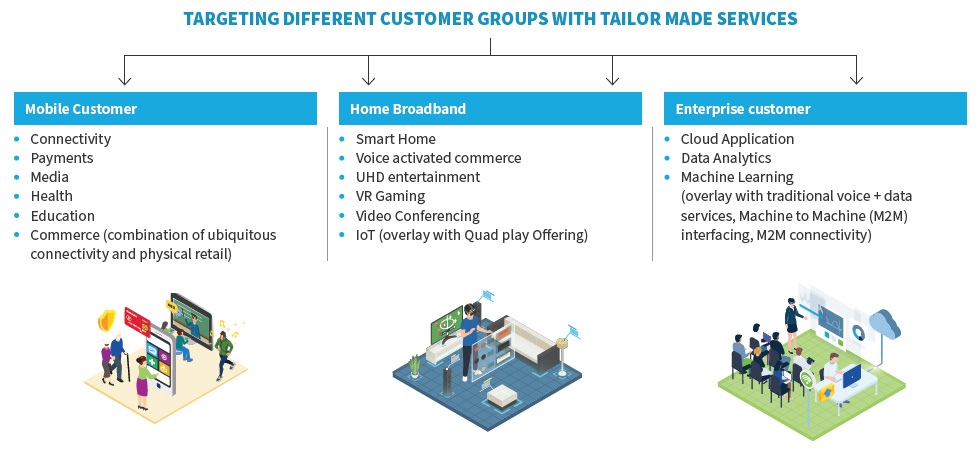
RELIANCE JIO-AN INTEGRATED DIGITAL SERVICE COMPANY
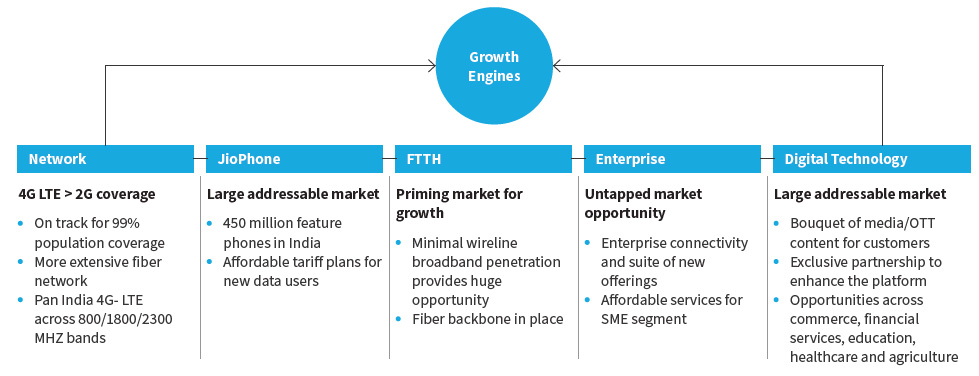
Jio Apps and Smart education
Smart education for Girl Child
Better farm productivity
Increasing farm output
Superior healthcare
Bringing superior healthcare to people
Situation
Jio has been a key catalyst for the digital revolution in India, building numerous cases of social, economic and sustainability benefits across the country.

Action Taken
Jio Gyan Shala was inaugurated at
Maharani Laxmi Bai Government Girls
Higher Secondary School in Satna,
Madhya Pradesh
Scale of Impact:
Smart classes to help over 2,000 girl students
Outcome
Bringing high quality education to the girls in villages
Action Taken
Providing farmers with easy availability
of expert advice on fertilisers, pest
management and animal husbandry
through JioChat
Scale of Impact:
Farmers across multiple states
Outcome
Boosting agriculture output during both
Rabi and Kharif seasons, improving
milk productivity in livestock thereby
increasing annual earnings of farmers
Action Taken
As a test case, the first ever tele-robotic
operation was conducted in the state of
Gujarat (using Jio’s fiber connectivity over
32kms)
Scale of Impact:
Performing intervention by operating robotically controlled instrument
Outcome
Building new cases for long distance
treatment and surgery for overcoming
healthcare infrastructure challenges in
the country
Affordable devices and digital education
Improving digital education
Improved business results
Multiple business cases emerging among small business owners (and MSMEs)
Situation
JioPhone was launched with the objective of empowering every Indian with the power of digital services, especially first-time mobile data users who could not afford a smartphone. Its adoption and popularity have empowered many and changed countless lives for the better.
Action
JioPhone delivers online learning content used for primary /
middle school students in rural India where there is sub-optimal
education infrastructure
Scale of Impact
Rural population and first-time mobile internet users in villages
Outcome
Significant opportunity for improving rural education content
using digital platforms, ready access to updated educational
content, increasing awareness among children and adults
Action
With the affordable device and solutions, multiple use cases
have emerged with businesses using video chat to track their
field sales force, training manpower, tourist operators facilitating
connectivity in remote areas and fishermen using it for tracking
weather patterns and relaying information
Scale of Impact
All small business owners across sectors ranging from small
machinery and parts manufacturing, sales and services
organisations, tourism and fishery
Outcome
Leverage affordable technology to improve business results,
create efficiency, improve customer experience and navigate
hazardous situations


Rahul Joshi

Sudhanshu Vats

Jyothi Despande

Ramesh Damani
Network18 continues to grow in stature and significance, with an aim to deepen engagement through extending our powerful brands in news and entertainment across mediums, distribution platforms and business models. With India’s vibrant media sector as its playground, and an unbridled aim to reach out and intermesh with the lives of Indians across demographics and languages, Network18 maintains its position at the cutting edge, touching the lives of 1 in every 2 Indian. Network18’s forays into subscription models through its flagship digital properties are aimed at embracing change and accelerating growth as it continues to invest towards becoming an industry leader.
STRATEGIC ADVANTAGES AND COMPETITIVE STRENGTH
Network18 is RIL’s flagship investment into the media and entertainment sector. It is one of the most diversified media conglomerates in the country, with footprints across television broadcasting, movie production and distribution, digital content and commerce, print magazines, mobile content and allied media services.
- Network18’s television channels reach out to 800+ million people in India, representing 95%+ of the TV viewing universe. This makes more than 1 in every 2 Indian, a consumer of Network18's broadcast content.
- Subsidiary TV18 has cemented its #1 position amongst News networks in India. Its 20 domestic channels span 15 languages, providing a solid leadership in reach. With a 10.6% share of news viewership in FY19, TV18 maintains its leadership even versus to legacy brands and free-to-air networks.
- Subsidiary Viacom18 is the youngest and fastest growing premium entertainment network in India. It is the #3 pan-India entertainment broadcaster (ex-sports), with an 11.1% viewership share in FY19. Apart from TV broadcasting, its full portfolio-offering includes a film studio renowned for clutter-breaking cinema and a leading OTT platform.
- Network18’s digital content properties across news and entertainment are now used by over 130 million people; and one in every four internet users in India is on Network18 websites or apps.
Network18’s operating model puts the audience at the centre, and is driven by its zeal to provide consumers with best-in-class media and entertainment products and content that establish new benchmarks in creative excellence, fair journalism and audience engagement.
OPERATING PILLARS

CHANNEL-AGNOSTIC APPROACH
Network18 strives to be channel-agnostic to ensure its content reaches seamlessly to consumers through their platform of choice. This approach is increasingly relevant considering the advent of digital entertainment and the splintering of platforms.

REACH FOR
IMPACT
Network18 is future-ready with its relentless focus on the identified axes of growth: regional content and digital delivery. This two-pronged approach enables the Company to reach its audiences regardless of geography, language or demography.

THOUGHT
LEADERSHIP
Network18 is steered by a professional and experienced team that helps it to consistently strive to host thought leadership on-air, online and on-ground. It is driving leadership not only through consumption numbers, but also by facilitating the development of new ideas and emerging thought processes.

NETWORK SYNERGY
Network18 comprises leading television channels, digital and mobile properties and publications in all key media genres. This facilitates cross-promotion and crosspollination of content and expertise across its network, enabling enhanced advertising and subscription revenue generation.

STRATEGIC COLLABORATIONS
Network18 has a track record of building successful strategic alliances with international media companies such as Viacom in entertainment, CNN in English general news and CNBC in business news, A+E Networks in factual entertainment and Forbes in the business magazine genre.

BRAND EXCELLENCE
At Network18, the focus is on driving the highest standards of creative excellence by fostering a culture of innovation to build new content formats across platforms, thereby creating strong brands across diverse media.
OPERATING MODEL
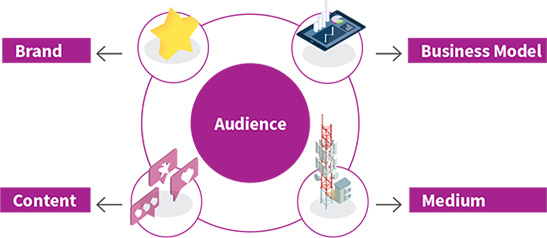
Value-chain: Network18 dovetails with the Jio ecosystem across content creation and distribution, thereby delivering the best of Indian and global content and brands to discerning audiences across India’s vast demographic diversity.
VALUE CHAIN
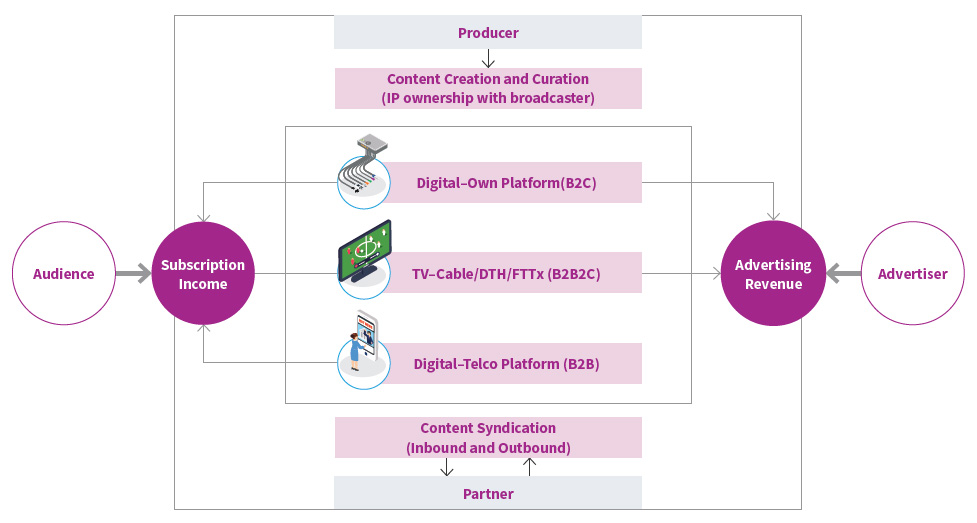
Network18 and its affiliates across the media, telecom and broadband valuechain are stitching together a compelling value-proposition for its viewers in a pipe-agnostic manner. Synergies in content creation and efficiency in distribution serve to amplify the reach of Network18’s brands, delivering impactful ideas and immersive imagery in class-leading packaging.
MARKET ENVIRONMENT
India’s media and entertainment sector grew at a robust pace in CY 2018 (13.4% y-o-y) to reach a size of `1.67 trillion, driven by a strong recovery following the temporary ad-revenue hiccups post implementation of GST in the previous year. The industry is slated to grow at 12% CAGR over CY 2018-21, reaching a size of `2.35 trillion in CY 2021. This growth is likely to be driven by tailwinds of better connectivity, higher disposable incomes and availability of wider variety of content, especially in Indic languages.
Within the media and entertainment sector, the subs-sectors that Network18 primarily plays in are well-placed; TV continues to be the dominant medium while Digital is the fastest growing (after the nascent segment of online gaming), and is likely to overtake Films this year and Print by 2021.
(Source: EY-FICCI FRAMES 2019 report)
MEDIA AND ENTERTAINMENT SECTOR SEGMENTS
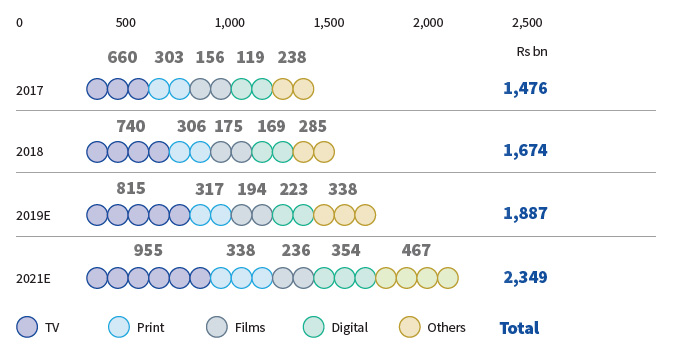
(Source: EY-FICCI Frames 2019 report)
GROWTH DRIVERS
Consumption drivers:
1. Socio-economic tailwinds: With more households having television sets, better rural electrification allowing for more consumption, and improved awareness and propensity to watch, TV viewership in India continues to rise. As measured by BARC, TV penetration in India currently stands at 66% and overall viewership is still rising, despite the advent of the Digital medium.
2. Advent of digital medium: India is still substantially a single-screen market (only 4 million out of 198 million homes have multiple TVs), and hence coviewership at home is the norm. The availability of cheap data and handsets has spurred a mobile revolution in India, which has opened up a wide pipe that is used the maximum for content viewership. As mobile (and especially smartphone) penetration has risen, the convenience and personalisation of viewing content digitally has caught on, which has created a parallel channel for video consumption vis-a-vis TV. As a result, Indians spent 30% of their phone time on media and entertainment apps (EY-FICCI FRAMES 2019 report)
MOBILE SUBSCRIBER GROWTH
(million)
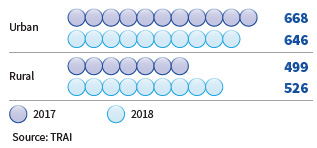
3. OTT revolution underway: Led by the promise of direct-to-consumer monetisation, OTT apps have proliferated, with Global and Indian content players (broadcasters and producers) as well as distribution platforms launching their (mostly video) offerings. 325 million people viewed videos online in 2018, a growth of 25% from 2017 (EY-FICCI FRAMES 2109 report).
4. Telco partnerships for Digital media: While paid digital video viewers grew from 7million in 2017 to 12-15 million in 2018 (driving Digital subscription up 262% to `14 billion), the percentage of paying subscribers to total consumers is still less than 5%. In contrast, over 200 million people accessed digital content through telco data bundles. As a result, ~60% of video viewership volumes were generated by telcos. (Source: EY-FICCI FRAMES 2019 report)
5. Rise of vernacular consumption: India is a linguistically diverse market, and people wish to consume content in their own language to a very large degree. Hence, content producers (both Indian and Global, across broadcast and digital) have increasingly created vernacular offerings, which have found instant traction. A substantial chunk of viewership growth on TV is presently being led by regional languages as a result.
VIEWERSHIP GROWTH WAS LED BY REGIONAL LANGUAGES (%)
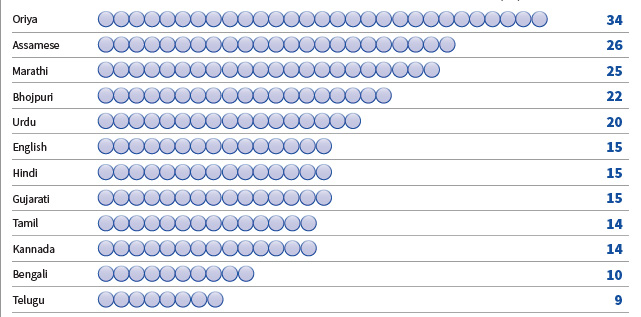
All India/2+/Channel Lang/Wk 38-50/2017 and 2018
(Source: BARC)
6. Segmentation of content offerings: As the number of channels has risen and the digital medium has grown in significance and scale, more segmented content which can cater to different sensibilities and age groups is being created. While escapism GEC and Movies still command the lion’s share of viewership, other genres are attaining critical mass.
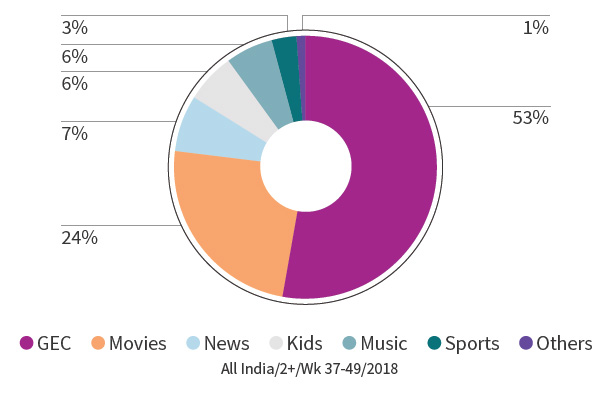
Monetisation drivers:
1. Digitisation of cable: The digitisation of cable has enabled improved subscription revenue, as it has reduced rampant under-reporting of subscribers as well as improved billing and identification of customers. India’s ARPU (average revenue per user) has continued to rise as a result, and the broadcaster share has risen to 25%.
2. New TRAI tariff regime: The new tariff regime ushered in by the regulator allows for unbundling of bouquets to enable customer choice, and betters transparency across the broadcast value chain. This process shall allow strong content propositions to thrive, and optimize the financials of a channel based on its demand and the propensity to garner advertising and subscription revenue. While it shall lead to some flux in the short-run, the regulation shall turn the broadcaster model from B2B to B2C, which is a positive for monetisation as the broadcaster share of on-ground collections shall rise substantially. The new regime shall also reduce carriage/ placement expenses substantially, which has been a major pain-point for (especially new) broadcasters.
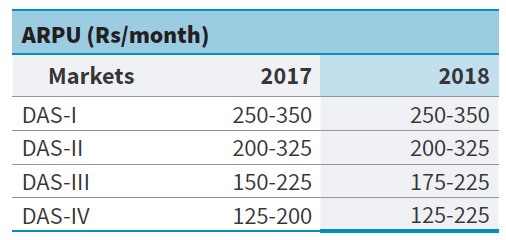
(Source: EY-FICCI FRAMES 2019 report)
3. Adoption of Digital Advertising: As the advent of digital content consumption (especially video) continues, more advertisers are increasingly attracted to digital advertising. As volumes of digital content have risen very sharply, advertising rates on digital have been under pressure; but the influx of new advertisers onto the medium and the promise of impact-measurability is making digital advertising an integral part of media plans. The aim of reaching out to varied audiences coupled with the possibility of targeting has driven even traditional advertisers to allocate ad-budgets to digital too. This is driving sharp growth in digital advertising on local media platforms, despite global behemoths like Google (esp. YouTube) and Facebook cornering a disproportionate chunk presently.
FINANCIAL AND OPERATIONAL PERFORMANCE
FINANCIAL OVERVIEW
Network18 continued on its growth trajectory, and invested in key areas to fill whitespaces and ring-fence its position. While the first three quarter of FY 2018-19 were buoyed by the revival in ad-spends and rising traction with viewers across the board, the last quarter dragged due to the new tariff regime for TV channels, and impact of absence of movie ‘Padmaavat’, Union budget and some Cricket/Live events this year. On a comparable basis, FY 2018-19 ex-film revenue rose 7% y-o-y on regional growth and a reviving ad-environment. FY 2018-19 operating EBITDA was up 13% y-o-y despite `131 crore additional investments into regional channels and digital expansions (VOOT International & Kids and CricketNext). This was led by regional news gestation losses compressing 42% y-o-y, and Business-asusual Entertainment EBITDA margins rising to 9% (vs 5% in FY 2017-18). EBIT however was impacted by fair valuation of financial assets.
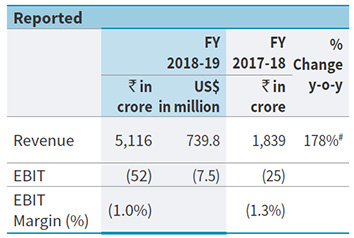
# +2% on a comparable basis
CORPORATE RESTRUCTURING
There have been realignments in corporate structure for group simplification, which have provided operational synergies.
The scheme of arrangement for the merger by absorption of wholly-owned direct and indirect subsidiaries of Network18 and TV18 with the respective parent was approved by the National Company Law Tribunal (Mumbai bench). The scheme became effective from 1st November 2018, the appointed date being 1st April 2016.
NEW TARIFF REGIME
New tariff order (NTO) implementation is medium-term positive, but has resulted in viewership being impacted for all broadcasters as process of consumers choosing channels/packs and distribution realignments is still underway. This also resulted in volatile viewership data, and advertisers pulling back spends in Q4 FY 2018-19, dragging full year growth. Subscriber base has yet to normalize due to implementation challenges. The channels (through ‘Colors wala pack’ as well as distributor packs) have witnessed strong uptake in this transition phase; led by breadth of content at a value price-point, and improved distribution tie-ups.
We believe that in the new regime, pay channels will have better consumer connect as well as distribution economics in the medium term. Our Free-to-Air (FTA) channels Rishtey (General Entertainment) and Rishtey Cineplex (Hindi Movies) were withdrawn from DD Freedish, and relaunched as pay channels with strong content propositions.
TV18 News still retained its leadership even versus FTA peers despite being a paynetwork, though the cluster’s viewership share fell to 9.3% post NTO implementation (11.5% pre-NTO).
Post NTO and shift from Freedish, the viewership share of top 4 entertainment broadcasters (ex-sports) all fell by 2 to 4% each. Our Entertainment cluster’s viewership share was 8.6% (11.7% pre-NTO), maintaining its #3 position.
THE YEAR OF VERNACULAR
The year was defined by regional content consumption as well as monetisation witnessing accelerated growth across all parts of the media industry that Network18 plays in, whether broadcasting or digital; and straddling news, entertainment and film.
TELEVISION BUSINESS
NEWS


Business News constitutes CNBC TV18 and CNBC Awaaz, No. 1 in English and Hindi business news genre, respectively, and CNBC Bajar, India’s first Gujarati business news channel.
Highlights of the year: Amidst choppy markets, the business news channels continued their dominant leadership in their
respective genres.
General News includes CNN-News18 and News18 India.
Highlights of the year: News18 India became the #2 General Hindi News channel. The channel also touched #1 position in primetime in a highly competitive genre.
Regional News includes 13 News18 channels (including erstwhile ETV channels) and News18 Lokmat.
Highlights of the year: The market share of News18 regional channels has grown from 2.5% in late 2016 to 6% (pre-NTO).
ENTERTAINMENT


Hindi General Entertainment includes flagship general entertainment channel (GEC) Colors, GEC Rishtey, and Hindi movie channel Rishtey Cineplex.
Highlights of the year: For the entire FY 2018-19, Colors was the #2 player in the pay Hindi GE category and a clear category leader in all day prime time. Despite a much smaller library, Rishtey Cineplex as an FTA channel continued to climb, taking the #1 spot in a cluttered genre of Hindi movie channels, led by smart curation and distribution.
Youth and Music includes MTV India, the No. 1 youth brand, and 24x7 Bollywood music channel MTV Beats
Highlights of the year: MTV Beats remained the fastest growing music channel in the country.
English Entertainment has VH1, Comedy Central (India’s first 24-hour English comedy channel) and Colors Infinity.
Highlights of the year: While Comedy Central is the top-ranked English Entertainment Channel, the English cluster comprising of Comedy Central, Colors Infinity and VH1 combined to control nearly 60% share of the English Entertainment space
Kids Entertainment constitutes of Nickelodeon, Sonic, Nick Jr. /Teen Nick and Nick HD+.
Highlights of the year: Nickelodeon has been the No.1 channel in the kid’s category since August 2014 and continues to lead the segment.
Regional Entertainment The regional entertainment bouquet comprises of Colors Kannada and Colors Super (Kannada), Colors Bangla, Colors Oriya, Colors Gujarati and the latest entrant Colors Tamil.
Highlights of the year: The regional portfolio was extended into movies to further provide segmented offerings to a growing consumer-base, with the launch of Colors Kannada Cinema.
Infotainment has factual entertainment channel History TV18 and lifestyle channel FYI TV18.
Highlights of the year: FYI TV18 has grown from strength to strength to cement its position as the No.1 Lifestyle channel.
FILM BUSINESS

Film business includes Viacom18 Studios and Jio Studios.
Highlights of the year: Andhadhun, became the highest rated 2018 Indian Film on IMDb. Manto, one of our finest movies was India's official entry in the 'Un Certain Regard' Category at Cannes. Viacom18 Studios successfully forayed into Telugu cinema with 'Devadas' and into Malayalam cinema with “Kodathi Samaksham Balan Vakeel”.
DIGITAL BUSINESS


Digital Content includes Moneycontrol.com (leader in the finance category), VOOT (#2 broadcaster–OTT in the country) and
News18.com (digital destination for all general news), as well as fledgling properties IN.com (celeb news) and CricketNext.
Highlights of the year: Broadcast OTT VOOT has amassed over 130 mn gross downloads, and boasts of the highest
watchtime in broadcast-OTTs at 45mn+.
Digital Commerce includes Bookmyshow
Highlights of the year: BookMyShow entered into Live event production with world’s largest live entertainment company Cirque Du Soleil with their production show “Bazzar”. The show which was held for the first time in India in Nov-Dec18 at Mumbai and Delhi got an overwhelming response.
PRINT/PUBLICATION BUSINESS

Publication business Publication business has a portfolio of highly reputed magazines comprising Forbes India, Overdrive, Better Photography and Better Interiors.
- Growing ad-spends in regional channels (news, led by regional elections; and entertainment, driven by rising consumption and value-perception) was a consistent theme for the TV channel portfolio as well as Digital properties like News18.com and VOOT.
- Viewership share of our regional news cluster increased further to 6% of all news viewed in India, vs 2.5% two years ago. Improved ad-traction and active cost control pruned gestation losses of our 8 regional news channels launched over FY 2015-17.
- Regional entertainment channels continued their viewership and monetisation improvements across most of our geographies, clocking in excess of 30% growth y-o-y on aggregate.
- Viacom18 Studios sharpened its focus into regional cinema, through films like Thackeray (bilingual in Hindi and Marathi), Ani…Dr Kashinath Ghanekar (Marathi) and Devadas (foray into Telugu).
GROWTH AND INNOVATION
Network18 has been striving to improve its portfolio as well as enhance its outreach, so as to realise economies of scale and attain leadership. Substantial investments continue to be made to create a compelling proposition for viewers.
Free-to-Air (FTA) channels, Rishtey and Cineplex, were taken to the pay ecosystem and rebranded as Colors Rishtey and Colors Cineplex respectively, establishing the channels as premium urban entertainment destinations. The Colors Cineplex library is being beefed up, to function as a full-fledged pay movie channel. In the case of Colors Rishtey, it is likely to allow for an overall increase in monetization in the long-run, and slots-in better with industry dynamics in the new tariff regime.
Investments were made to revamp and extend MoneyControl MoneyControl took initial steps to venture into subscription model (ad-free and premium features) and transactions (mutual fund distribution).
Cricket portal CricketNext (#3 portal in India) was relaunched with a dedicated app. Over the next few months, CricketNext intends to build on this momentum with its coverage of the IPL and World Cup.
News 18 Languages portfolio has steadily grown its spread across regional languages, with content in Hindi, Marathi, Bangla, Gujarati, Kannada, Tamil, Malayalam, Telugu, Punjabi and Urdu (Malayalam was launched in May 2018 and Telugu went live in August 2018). Unique Users on languages grew 118 per cent (December 18), with more than 96 per cent of our users coming through mobile phones.
Entertainment portal IN.com was relaunched in August 18. It will be India’s premiere destination with opinionated content around celebrities. Largely aimed at millennials, the language and content promises to be fresh and young.
Regional movie channel Colors Kannada movies was launched in Q2 FY 2018- 19, to complement our leading GECs in Karnataka. It solidifies our existing leadership, and is #2 with 15% share in Kannada movie genre.
VOOT’s product proposition has been bolstered through making news channel content available on it too. Additionally, the platform is making rapid strides towards a pay model too, with the first international launch in UK through a partnership with Virgin mobile. VOOT Kids, a differentiated, niche pay offering went into Beta
Viacom18 studios announced its digital content arm–Tipping Point in May 2018. The intention was to create short-form content for Digital (especially for VOOT) by utilizing the strengths of the movie studio; thereby creating high-value content inhouse, amidst the current high-competition war for content.
RISKS
TRAI’s new tariff order shall benefit broadcasters in the long-run as carriage/ placement costs gets rationalized, the business becomes more B2C than B2B, and transparency improves broadcasters share of consumer ARPU. However, the changed business model on subscription and flux in advertising mechanics is likely to impact business in the short run.
Fragmentation of viewership: With the advent of Digital and a launch of multiple new platforms led by cheaper bandwidth, viewership has expanded significantly, thereby fragmenting the consumer base across platforms. This higher churn rates and lower stickiness provides an opportunity to wean away viewers from traditional dominant players in television, but also is a challenge as monetisation models are still evolving.
Digital monetisation is lagging investments, especially amidst strong competition.
Content costs: Spike in demand for content creation/curation is driving up content costs across Digital, Movies and GEC.
Consolidation (both horizontal and vertical) continues to exert influence on the market. There have been multiple cases of M&A across the broadcast and digital value chain, examples of which include Star’s acquisition by Disney, DishTV acquiring Videocon D2H, and Reliance Industries taking controlling stakes in Den and Hathway.
OUTLOOK
Network18’s growth aspirations stem from an inherently high-quality portfolio of properties, a relentless drive for garnering market-share, and a concerted effort to utilise synergies and push efficiencies across its owned and affiliate media (traditional and digital) and telecom portfolio. The Company believes that India’s media and entertainment sector is poised for substantial growth, as the segment steadily gains international stature in terms of both advertising and consumer spends.
BUSINESS STEWARDSHIP
At Network18, Corporate Social Responsibility (CSR) is embedded in the Company’s long-term business strategy. The Company’s community initiatives help elevate the quality of life of millions, especially the disadvantaged sections of the society. Network18 seeks to transform people’s lives by promoting health, education and sports.
Some socially relevant programs undertaken during the year are -
- As a responsible broadcaster, Nickelodeon has an annual pro socio campaign, Together for Good, which aims at making kids responsible and positive agents of change in society.
- In an industry first, Viacom18 has partnered with the world's largest philanthropic organisation, Bill and Melinda Gates Foundation, and development communications specialists, BBC Media Action to create a general entertainment fiction series with an underlying behaviour change message on sanitation.
- CNN-News18 did the chilling expose #ChildSexHighway which uncovered the disturbing secret of child sex trade along national highways.
- Swasth Immunised India–Network18 and Serum Institute of India joined hands to help immunise the kids of India. The aim of this campaign is to spread awareness about immunisation in India.
- Road Safety Initiative – The road to safety campaign created by Network 18 in partnership with DIAGEO created awareness and inspired change for millions of people in India. Backed by ministers, bureaucrats and celebrities across 20+ states in the country, the campaign reached more than 130+ million people. State wise road safety issues were deliberated to ensure impactful steps are being taken to reduce the number of accidents.
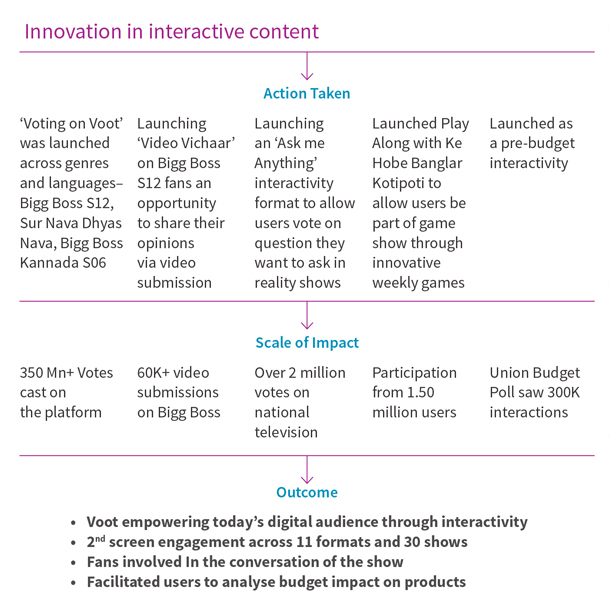
JIO STUDIOS
Jio Studios, RIL’s media arm, has been set up with the vision to build a 360 degree content ecosystem of films, web series, music and other content in Hindi and regional languages. “Stree” and “Luka Chuppi”, the first two Hindi film releases under the Jio Studios banner enjoyed tremendous box office success and there are several projects under development. With a rapidly growing 306.7 million Jio user base on mobility and the imminent launch of the fiber-to-the-home services, Jio Studios is tasked with aggregating the best in class content for JioTV and JioCinema as well as producing quality content to create a differentiated compelling consumer offering across all Jio platforms. Jio Studios will also look to build synergies with other media investments of Reliance such as Viacom18, Balaji Telefilms, Eros and JioSaavn to maximize the creative bandwidth within the group.
Jio Studios intends to work with all the top talent across Hindi and regional entertainment industry including producers, directors, writers and actors as well as music artistes and composers to bring interesting stories to the market in multiple languages whether in the form of film, web series or original music videos. Being a technology company, the focus is on weaving innovative elements into content to promote interactivity and increase engagement between users and content.
The mantra at Jio Studios is to become a one-stop-shop for every Indian’s entertainment needs by bringing them interesting stories that can be enjoyed across any device inside or outside the home.

Reliance has been at the forefront of integrating sustainability into its core business, pioneering change at the technological, behavioural as well as the policy levels. In its business strategy, the Company has gone much beyond risk management to inculcate a future growth oriented management philosophy which draws from four key enablers that reinforce the Company’s fundamental philosophy – ‘Growth is Life’.
The four enablers are:
A. Strategic Framework
B. Integrated Approach
C. Risk and Governance
D. Digital Platform
A. STRATEGIC FRAMEWORK AT RELIANCE
A prudent financial framework, a robust risk management framework and the Company’s short and long term objectives linked to value creation define Reliance’s Strategic Framework. It also outlines the expectations and boundaries within which each of the Company’s businesses must operate. The intent is to also provide guidance to the established as well as evolving businesses in the Group by setting effective business objectives for each. The entire framework is underpinned by the core belief that value creation and preservation are paramount. This cuts across the entire set of internal and external stakeholders and leverages a strong knowledge and asset base as well as investment in strategic opportunities.
Reliance’s Strategic Framework can be divided into three pillars:
- Approach
- Value creation
- Enablers
B. THE INTEGRATED APPROACH
Reliance is cognisant of the value it creates across its value chain for all of its stakeholders. This value creation is not only monetary but also takes several other forms, both tangible and intangible. The Company has adopted the six capitals postulated by the International Integrated Reporting Council’s (IIRC) Integrated Reporting <IR> framework to aptly delineate its value creation story:
- Natural Capital and Climate Change
- Human Capital and People Connect
- Manufactured Capital and Product Stewardship
- Intellectual Capital and Innovation
- Financial Capital and Credit Rating
- Social and Relationship Capital
A strong balance sheet is the outcome of a robust financial framework. By capitalising on additional opportunities such as efficient use of natural resources which leads to cost reduction and maintaining strong relations with stakeholders, Reliance is able to further augment its bottom line. Reliance’s growth ambitions are fueled by its people who are being constantly up-skilled and brought up to speed with the use of latest technologies. This enables the Company to leverage investments in emerging technologies which bring in more efficiency, which also leads to safer and environmentally friendly operations. The Company’s growth also fuels fast paced economic growth of the areas where it operates. RIL also leverages digital technology and smart manufacturing applications to create innovative solutions for business functions.
C. RISK AND GOVERNANCE
Risk management at Reliance is reviewed based on the ever-changing external and internal environment to ensure decision-making is aligned with the organisation’s business strategy, improving the resilience of the organisation, which creates sustainable value. The Company recognises that effective risk management is fundamental to its continued profitability and long-term sustainability. The infrastructure for risk and governance activities at Reliance comprise of the Enterprise Risk Management (ERM) framework. The ERM framework identifies, evaluates, manages and reports risks arising from the Company’s operations. ERM enables Reliance to manage its risks within acceptable limits by using risk mitigation techniques and allocating necessary resources.
D. DIGITAL PLATFORM
Taking the Reliance Management System (RMS) journey forward and to create an agile and responsive organisation, Reliance embarked on its Digital Platforms Journey in 2018. The move to Digital Platforms enables the Group to evolve the Reliance Management System (RMS) to the next level.
| Approach | Value Creation | Enablers |
|---|---|---|
|
Driving growth, value, innovation
and transformation in society |
Shareholder value |
Reliance’s Group Strategy is founded on five
enablers. These include safe operations,
digital technology, capital productivity,
operational excellence and ethics.
Reliance believes that the Health and Safety
of its people supersedes all production
targets. There is a continued focus on ensuring
compliance, which helps Reliance to preserve
enterprise value, and provide a perpetual
license securing its right to operate across India
and globally. |
| Key Reflections of 2018-19 | ||
|---|---|---|
|
Shareholder value
Employee value
Customer value
Societal value
|
Safety and compliance
Digital technologies
Capital productivity
Operational efficiencies and effectiveness
Ethics
*Current year outcome |

Pawan Kumar Kapil
Par Singh
RIL incorporates Natural capital considerations (air, water and soil) into its decision-making at all stages in its operational locations: design stage, operation stage and above all, in its interactions with the external world. Through sound governance, environmental impacts of each manufacturing location are maintained at levels which are lower than the prescribed legal obligations with respect to air quality, fresh water usage, soil use, impact on flora and fauna, and marine ecosystems. Reliance believes in the concept of resource optimisation, extracting more value from bottom of the barrel production in its hydrocarbon business and handling maximum GB of data per unit of emission in its digital business. The Company’s strategy towards combating climate change aims to reduce emissions in its operations, allow better assessment of impacts and support an orderly transition to a low-carbon economy. Reliance’s refining complex, which is the largest in the world, is designed to operate solely on desalinated sea water, thus making fresh water resources from lakes and rivers available for communities to use. RIL believes that timely and sufficient availability of natural resources is imperative for continuity of its business operations and it is an obligation for any industry towards all its stakeholders. RIL developed over 6,151 acres of green belt, enriching ecological balance and biodiversity.
MATERIAL TOPICS
1. Energy Efficiency of Operations
2. Carbon Abatement and Offsetting
3. Managing Environmental Impact
4. Water management
5. Waste management
6. Renewable and alternative energy
7. Ecosystems and Biodiversity
OTHER FRAMEWORKS REFERENCED
API/IPIECA, UNGC, WBCSD, GHG Protocol, TCFD, Natural Capital protocol, UNGP, NVG-SEE, NGRBC
UNITED NATION’S SDGs


PMO’S INITIATIVES SUPPORTED BY THE NITI AAYOG

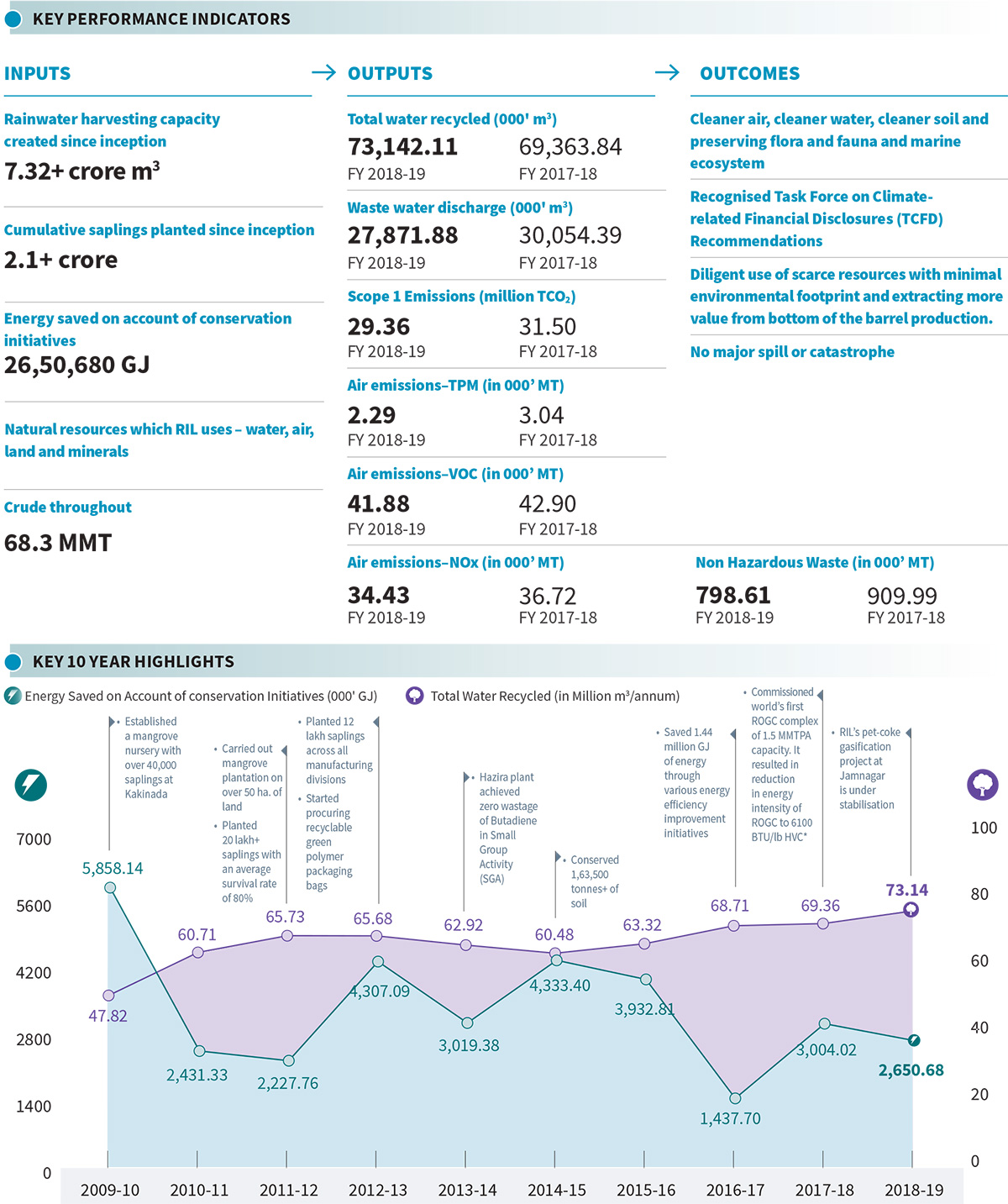
MANAGING NATURAL CAPITAL AT RELIANCE
Reliance strives to improve its environmental performance continuously with enhancement in its current practices and implementation of
management systems across all locations. The Company’s aim is to promote ‘Nature Neutral’ practices across its operations and value chain.
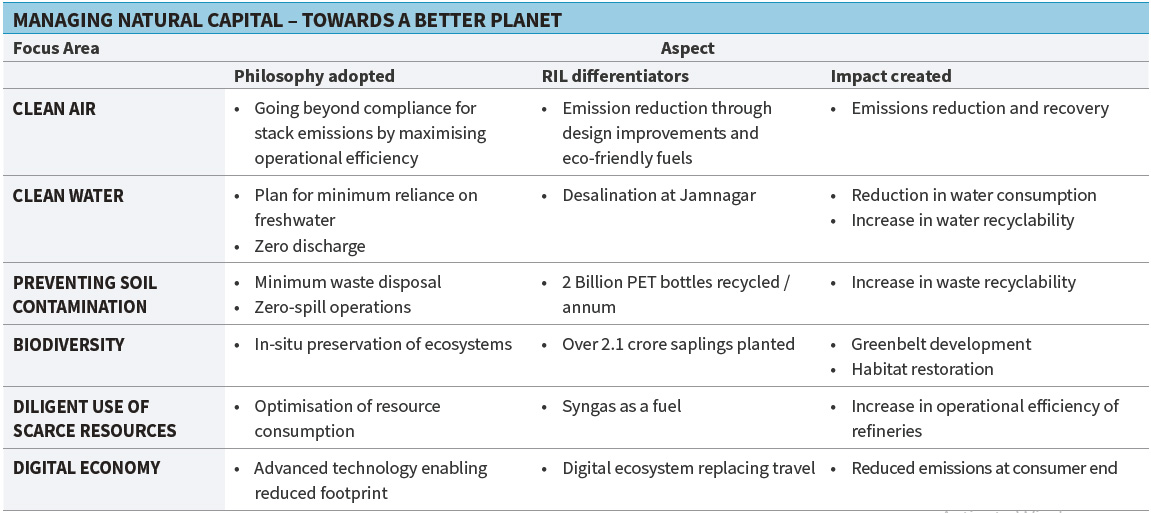
ENVIRONMENT MANAGEMENT –
TOWARDS A BETTER PLANET
RIL's Environment Policy5 reaffirms its
commitments towards environment and
society and addresses relevant issues
applicable to all its employees, contractors,
suppliers and customers.
RIL further strengthened its statutory compliance system during the year. The Environmental Management Systems at all the manufacturing locations have migrated to ISO-14001:2015 standard. The ‘integrated reliance compliance management system’ (iRCMS) ensured that all new applicable regulations are also fully complied with. RIL’s manufacturing locations continue to improve environmental practices under ‘Green Card Performance Rating System’, and detailed second and third-party environmental audits. The environmental compliance review committee reviewed compliance status, every quarter, and provided guidance for improvement in compliance and beyond.
During the year, Environmental Clearance was granted by Ministry of Environment, Forests & Climate Change (MoEF&CC) for the proposed expansion and debottlenecking project of the petrochemical complex at Nagothane.
TRAINING
To strengthen employees’ skills, hands-on
computer-based training on air dispersion
modelling was imparted. Training and
awareness session on statutory and
technical aspects of rainwater harvesting
was arranged. The session, delivered by
renowned experts was also telecasted
live through video conference across all
manufacturing locations to benefit more
employees.
PERFORMANCE
All manufacturing locations prepared
environmental sustainability plan for
the year and worked towards achieving
improvement in their environmental
performance. Some of the major initiatives
during the year include improvement
projects at ETP resulting in increase of treated effluent recycled, enhanced
rainwater harvesting capacities and
recycling of waste through co-processing in
cement industries.
The Company is extending its internal studies on ‘Life Cycle Assessment’ for its major polyester products. RIL periodically organises Suppliers’ meets to discuss and further improve their environmental performance.
RIL is one of the 10 companies from India that is a member of World Business Council For Sustainable Development (WBCSD), which reflects its commitment towards playing an active role in transforming business and shaping society. The Company’s vision of transformation and growth mirrors WBCSD’s position: ‘Business is good for sustainable development and sustainable development is good for businesses’.
CLEAN AIR
ENERGY EFFICIENCY
Strategic investments
Reliance’s commitment towards maintaining energy efficiency in its operations drives it to promote a broad range of energy conservation initiatives at all its manufacturing locations. A dedicated team works to identify and implement energy conservation initiatives, resource optimisation and renewable energy projects at all of RIL’s manufacturing sites. For more details, refer Annexure V of Board’s Report.
- Petcoke gasification integrated with combined cycle gas turbine, commissioned at Jamnagar for steam and power generation, is identified as a cleaner technology by International Energy Agency (IEA). Aim is to transform the Jamnagar refinery into a unique 'bottom-less' refinery by converting refinery residue (petcoke) into syngas.
- The gas turbines at Jamnagar are being retrofitted to facilitate syngas firing capability with reduced NOX and SOX emissions.
- Efforts on energy cost reduction and energy security is demonstrated by installation of two coal fired thermic fluid heaters in Patalganga Manufacturing Division.
- To minimise flare losses, operating procedures during start up and turndown are modified together with hardware changes resulting in reduced operating costs and GHG emissions.
Design stage
The Company’s initiatives on clean
technology, energy efficiency and
renewable energy include:
- Renewable energy usage in CCPP: Use of the dried bio-sludge from Effluent Treatment Plant as a fuel in CCPP and trials planned for biomass co-firing in CCPP boilers in the Dahej manufacturing division.
- Partnering with global technology leaders, RIL is developing a bespoke technology for extracting Vanadium Pentoxide (V2O5)/ FerroVanadium (FeV) from gasification slag, a byproduct from petcoke gasification process. Alongside these efforts, in-house R&D is also being pursued with a focus of low cost high efficiency hydro process for the same. This will boost gasification margins and help India develop into a global source for V2O5 and ferrovanadium in the near future.
Retrofitting process equipment
1. Technology change
- Converting the distillation process for dehydration of acetic acid water mixture from conventional distillation to azeotropic distillation resulting in reduced steam consumption at Hazira Manufacturing Division.
- Replicating the success of advanced distillation technology, Divided Wall Column (DWC), to other applications is under study.
2. Optimisation
- Installation of sonic horn in place of conventional soot blowers to improve performance of boilers in Captive Power Plant at Hazira and Dahej.
- Real time closed loop control and Advanced Process Control/ Real Time Optimiser systems to ensure economic, safe and reliable operations.
- Automated reporting and data collection and monitoring through Management Information Intelligence System (MIIS) dashboard enables effective analysis and faster response.
- Installation of Solar PV of 60.48 kWp at Jamnagar.
- Replacement of conventional lamps to LED lamps for lowering energy consumption.
- Waste heat recovery:
- Implementation of recovery of heat from overhead streams in crude distillation columns in DTA and SEZ reduced steam consumption
- Modification of crude preheat exchangers for improved heat recovery and consequent reduction in fuel consumption.
- Installed air preheaters in all Coker heaters at JMD, resulting in reduced fuel consumption.
- Improving cogeneration by switching to lower pressure steam consumption, thereby generating more electrical power and reducing steam consumption at Hazira and Vadodara manufacturing divisions.
- HP Nitrogen compressor operated at 50% load, avoiding spillback to save electrical power at the new MEG plant of Jamnagar manufacturing division.
To set organisational boundaries for consolidated GHG emissions, Reliance has utilised the operational control approach for the various entities covered under the Report. RIL’s accounting GHG emissions is based on the 'GHG Protocol Corporate Accounting and Reporting Standard' issued by the World Resources Institute (WRI) and the World Business Council for Sustainable Development (WBCSD). In FY 2018-19, Scope 1 emissions from fuel consumption were 29.36 million tCO2e and Scope 2 emissions from electricity consumption were 1.15 million tCO2e. The total GHG emissions from Reliance’s operations decreased by 5.18% in FY 2018-19.
RIL has registered eight CDM projects with the United Nations Framework Convention on Climate Change (UNFCCC). These projects are related to energy efficiency, use of renewable energy and cleaner fuels. The Company has built in-house capacity to develop CDM projects and obtain the registration and issuance of the same in the form of Certified Emission Reductions (CERs) from the UNFCCC. Reliance has recognised the TCFD recommendations with a commitment to enhance its climate-related disclosures. For more details, refer TCFD disclosures Page No 159.
PERFORM ACHIEVE AND TRADE (PAT)
TARGETS
RIL’s chlor-alkali unit at Dahej, Jamnagar
refinery and petrochemical units at Dahej,
Nagothane, Hazira and Vadodara and textile unit at Naroda have been given
specific energy consumption targets by
the Government of India under the PAT
scheme, a regulatory instrument to reduce
specific energy consumption in energy
intensive industries.
Air Emissions
RIL regularly monitors emissions as a
part of its environmental management
plan. In addition to GHG emissions, the
Company closely monitors the emissions
of Total Particulate Matter (TPM), Oxides of
Sulphur (SOX) and Oxides of Nitrogen (NOX).
The continuous emission and effluent
monitoring systems (CEMS) for emissions
and discharges, installed at the refinery
and petrochemical units, are now fully
operational and real time data is being
continuously transmitted to CPCB.
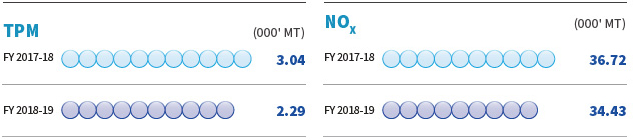
RIL’s refinery and all manufacturing units are in compliance with the prescribed permissible limits given by CPCB/SPCB for air emissions, effluent quality and discharge. All manufacturing units are ISO-14001 compliant and have robust systems in place to monitor environmental footprints. The Company frequently submits environmental monitoring reports to CPCB/ SPCB, and annually discloses environmental performance in its sustainability report. No show cause or legal notices were received from CPCB/ SPCB during the year FY 2018-19.
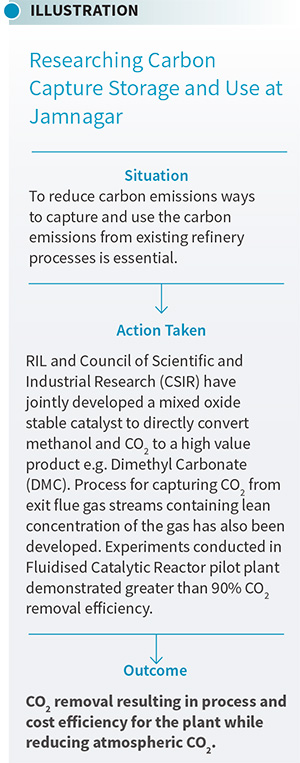
CLEAN WATER
At RIL, achieving minimum water
consumption at every manufacturing
location is a key priority. Hence, it employs specific measures to ensure the optimum
use of water sources such as rivers, lakes
and reservoirs with the aid of local water
utility departments. Use of cutting-edge
technologies at the Jamnagar plant
enables desalination of sea water, thereby
saving water from fresh water sources.
In FY 2018-19, the total water withdrawal
across all manufacturing plants was 179.55
million m3 as compared to 167.41 million
m3 in FY 2017-18, which represents a 7.25%
increase. RIL ensures that all wastewater
generated is treated and meets all state and
central regulatory requirements.
Continuous efforts have enabled RIL to increase the amount of recycled process water and meet increasing standards of environmental compliance.
Some manufacturing locations are already zero-discharge sites and the Company is working towards achieving zero-discharge status at all its operating locations.
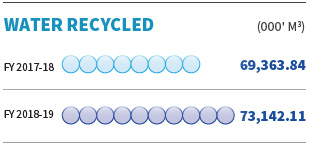
PREVENTING SOIL CONTAMINATION
RIL focuses on using resources as efficiently
as possible and simultaneously works towards minimising emissions and waste
generated. The Company ensures that all
waste is sent to government-authorised
disposal agencies only. Effluents generated
are treated to meet the most stringent
state and central regulatory requirements.
During the reporting period, RIL's effluent
discharge from all manufacturing units
reduced by 7.26% compared to last year,
to 27.87 million m3. RIL has undertaken
initiatives such as converting the
organic waste into bio-manure by vermicomposting
method, thereby reducingthe waste disposed. RIL also undertakes
stringent monitoring measures to prevent
spills during handling and transportation
of materials. During the reporting period,
the hazardous and non-hazardous
waste disposed from our hydrocarbons
operations were 89.69kT and 798.61 kT,
respectively.
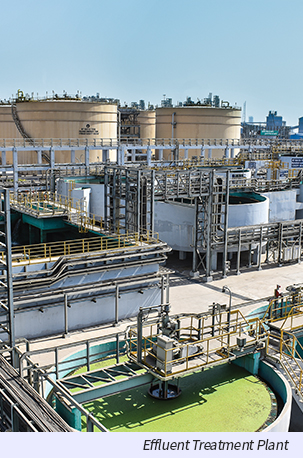
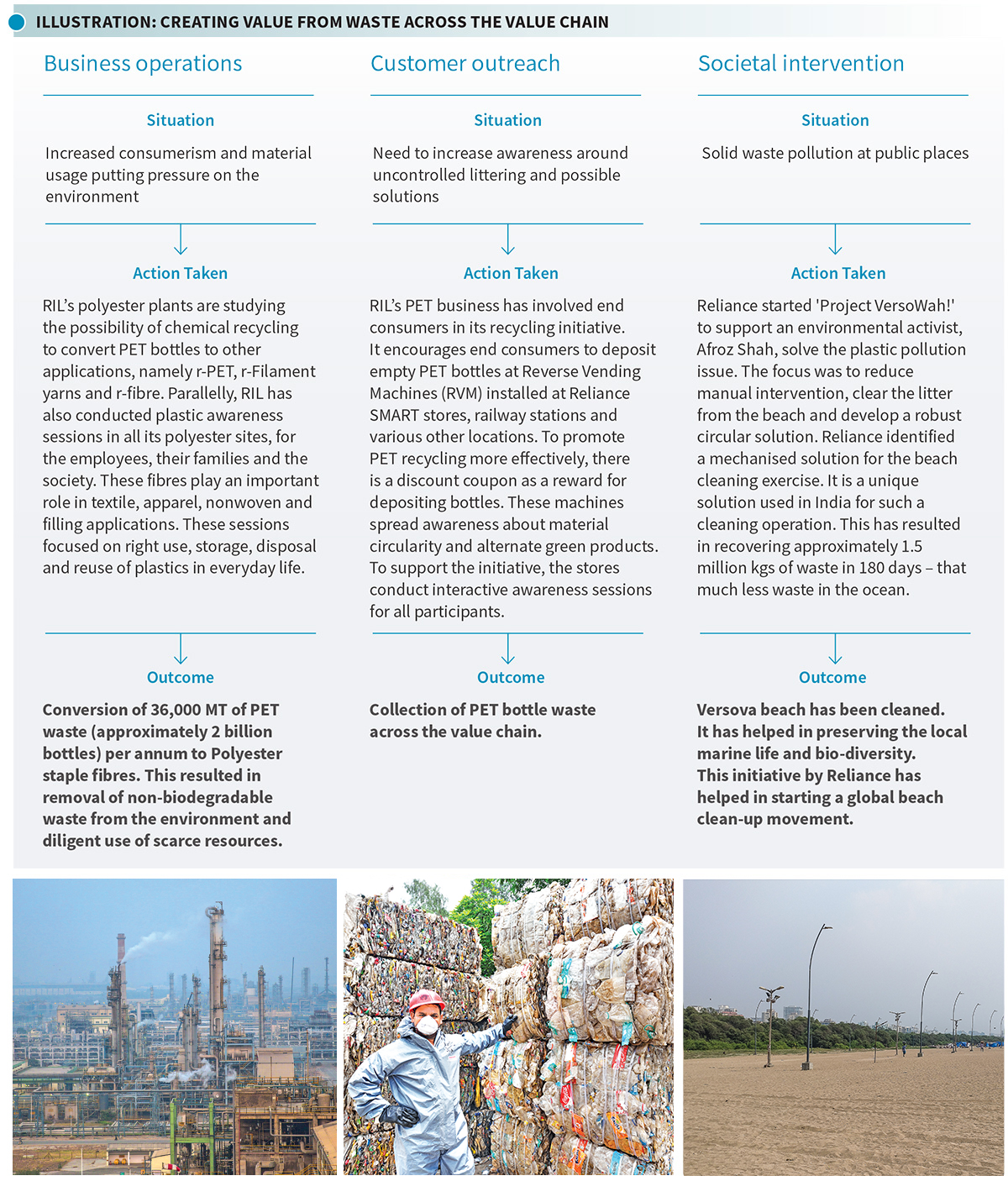
PRESERVATION OF BIODIVERSITY
RIL regularly monitors the impact of its operations on the surrounding ecosystem by conducting periodic environment impact studies through external experts. It also carries out environment impact assessments for all Greenfield and brownfield projects to understand and mitigate their impacts on the surrounding environment and ecosystem.
RIL understands the importance of interacting with various stakeholders to mobilise actions required to protect the environment. Consequently, in a one-of-a-kind partnership with the Ministry of Environment, Forests and Climate Change (MoEFCC), Government of India (GoI) and the Gujarat Ecological Commission (GEC), Reliance actively contributed to the setup of India’s first Centre of Excellence (CoE) for the study of coastal biodiversity of Jamnagar, known as the National Centre for Marine Biodiversity (NCMB).
Reliance has initiated an evaluation of its environmental aspects using the Natural Capital Protocol published by the Natural Capital Coalition.
To promote biodiversity, more than 2.1 crore saplings have been planted across all RIL sites till date. Apart from this, 6,151 acres of green belt has been added across all manufacturing divisions since their inception.
NATURAL CAPITAL PROTOCOL
Reliance has initiated the evaluation of
its environmental impacts with an aim to
include natural capital in decision-making
by using the Natural Capital Protocol. As a
part of the commitment towards Natural
Capital Coalition, Reliance has established
necessary management systems across
its operations for the conservation of
natural resources. The Company allocates
resources for new and expansion projects
by engaging with field experts to conduct
environmental impact assessment studies
and periodically monitor their impacts
on the local biodiversity. Hazira and
Dahej manufacturing divisions conducted
impact assessment on biodiversity and
marine ecosystem to determine ecological
sensitivities.
DILIGENT UTILISATION OF SCARCE
NATURAL RESOURCES
In order to improve its raw material
productivity and improve resource
conservation, RIL has taken various
measures such as recycling of used oil,
slop oil and oily sludge conversion of
organic waste into organic manure and
bio gas, recycle of spent catalysts through
authorised re-processors. In the last few
years, Reliance has put conscious efforts to
utilise more and more recycled PET bottles
as raw material for its petrochemical
operation and emerged as the single
largest recycler of PET bottles in India.
Additional initiatives include the increase
in the PTA bag size from 1.1 MT to 1.2 MT to
reduce use of packaging material, facilitate
higher transport efficiency at Dahej and
Hazira manufacturing divisions, and raw
material supply in bulk tankers that lead
to reduction in packing material, handling,
contamination and provided savings to
customers.
According to the Solomon’s energy intensity index, RIL’s refineries are among the top quartile performance. RIL’s key strength identified as per Solomon study are energy efficiency, operational availability and utilised processing complexity. Since the installation of the gasification, paraxylene and Refinery Off-Gas Cracker (ROGC) plants, the Jamnagar refinery is pegged to be among the highest conversion global refineries with no products that can be classified as ‘bottom-of-the-barrel’.
DIGITAL ECONOMY
Reliance continually explores new ways
to make its operations more efficient by
putting technology to use for direct energy
savings, increasing renewable energy
sources and establishing a culture of digital
collaboration that lessens the need for
travel
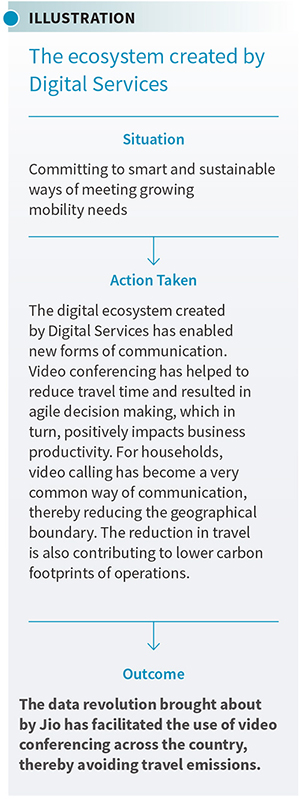


Jamnagar Green Belt

Hital R. Meswani
Ashwani Prashara
Sanjay Jog
Reliance seeks to create a working culture which is people-centric, inclusive, diverse and progressive. The Company wants to imbibe a sense of pride in its people, so much so that they reckon RIL as the best company to work for. This is bolstered by our approach to exponential learning opportunities which is augmented by a digitally connected ecosystem. With the launch of pioneering platform-based learning and development solutions, the Company is setting the stage for its burgeoning millennial population to feel more empowered, secure and content with their jobs.
The scale of Reliance’s operations lead to several indirect benefits. One of the most significant of these is the creation of indirect employment. With over 50 lakh people contributing to Reliance’s growth story, RIL gives back in terms of value creation for all.
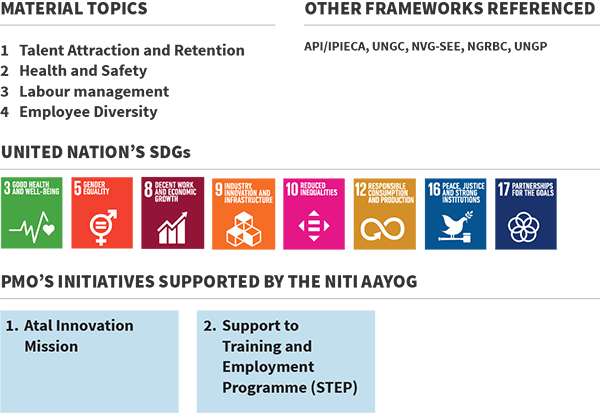
KEY PERFORMANCE INDICATORS
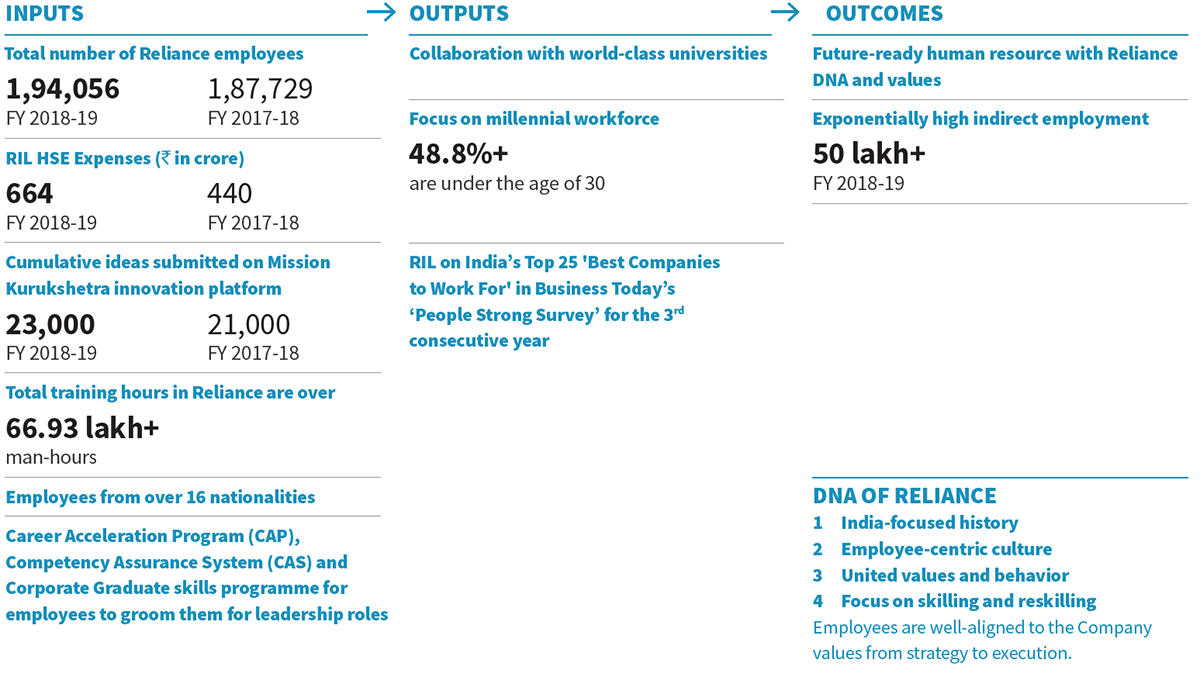
KEY 10 YEAR HIGHLIGHTS
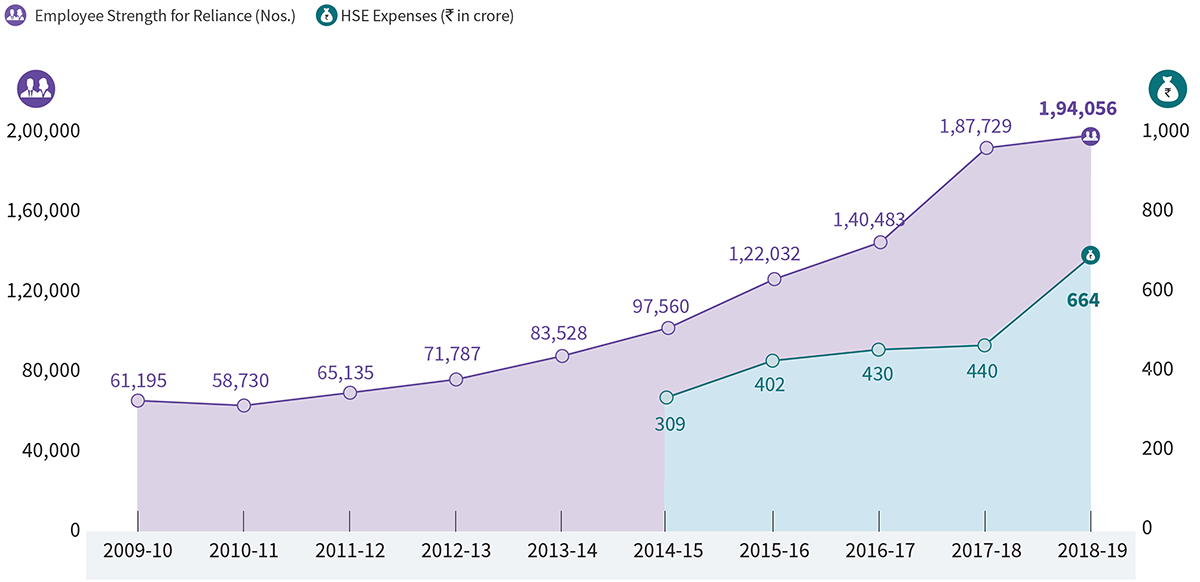
VALUES AND BEHAVIOUR
The Company’s success relies on the
continued support of its vastly diverse
human capital. To bring consistency in
approach and behaviour Reliance places
emphasis on aligning its people with a
strong value system, which is underlined
by six core values, viz Customer value,
Respect, Ownership mindset, Excellence,
One team and Integrity.
RIL has been recognised as an employer of choice, and has been ranked 10th in the 2019 'LinkedIn Top Companies: Where India Wants to Work Now' list, the only non-tech / non-IT company to make it to the top 10 companies in the list.
RIL on India’s Top 25 'Best Companies to Work For' in Business Today’s ‘People Strong Survey’ for the 3rd consecutive year
RIL fosters a culture that is performanceoriented, meritocratic and transparent. RIL focuses on holistic development of employees’ well-being at a professional and personal level. Through engagement initiatives, learning platforms, wellness and safety programmes, and sustainability initiatives, the employees across businesses and geographies are connected to each other and the Company – RIL is ‘connecting everyone, everywhere’.
CREATING EMPLOYMENT
OPPORTUNITIES
The Reliance Group is one of the biggest
private sector employers in India that
has created employment for more than
1.9 lakh individuals. With the help of a
robust, consistent and meritocratic HR
framework, Reliance continues to maintain
a progressive people environment, where
purpose driven talent is attracted and
engaged.
RIL’s entrepreneurial culture aims to motivate the young generation to play an integral role in the Company’s growth.
PEOPLE BREAKDOWN FOR RIL
As on March 31, 2019, Reliance Industries
Limited employee strength was 28,967
and total number of female employees
was 1,671.
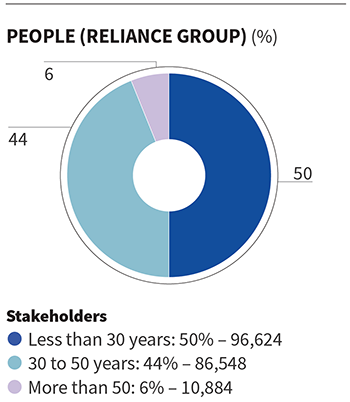
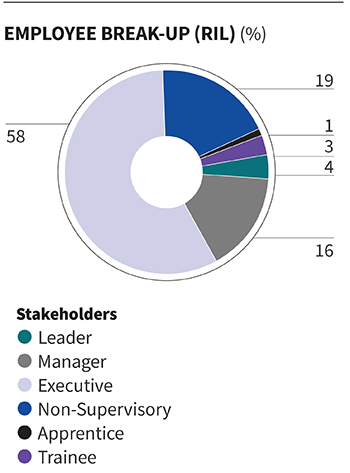
FOCUS ON HIRING MILLENNIALS
Reliance strongly believes in its millennial
employees and encourages them to be
a vital part in the Company’s growth
and development. The cadre building
programmes such as Reliance Emerging
Leaders Programme (RELP) and Graduate
Engineering Trainee (GET) Programme
are the key routes through which high
potential entry level talent is hired to help
build a young talent pipeline for all the businesses. With an increased focus on summer internship hiring, the Company is steadily establishing Reliance Summer as the primary route of hiring young talent. Reliance visits premier B-Schools and Engineering institutes including Indian Institutes of Management (IIMs) and Indian Institutes of Technology (IITs) to ensure intake of high-quality talent.
Further, engagements with institutes like the Aspire Leadership Connect Series, Alumni Connect sessions, online quizzes and social media engagement have positioned Reliance as an aspirational brand and a preferred talent destination.
TALENT MANAGEMENT
RIL endeavours to identify and
develop high potential talent within
the organisation and provide them
with accelerated learning and growth
opportunities. There are various initiatives
taken by the organisation to achieve the
same, including on-the-job training, digital
learning, coaching and workshops. Some of
the prominent ones are:
TALENT REVIEWS
Talent Reviews are conducted annually for
all employees at the leadership level. The
process helps identify, assess and develop
people to meet the leadership roles.
CAREER ACCELERATION
PROGRAMME (CAP)
Initiated in 2014, CAP is one of the flagship
cadre development programmes for middle
level managers and provides them with
multi-faceted learning, development and
mentorship opportunities. It grooms them
for senior level leadership roles.
SAPPHIRE COACHING PROGRAMME The programme provides focused and customised development opportunities to people managers in the manufacturing business. It emphasises on 2 key tenets of being a successful leader, i.e. Delivering Performance and Developing People. It uses the Growth, Self-Awareness, Authenticity (GSA) Development Model of Leadership Excellence. The fifth batch of Sapphire was kicked-off in 2018.
STEP-UP PROGRAMME
A highly focused programme was
introduced in 2015 to prepare high
potential employees to be skill-ready for
their transition into next level leadership
roles in the organisation. Over the last
4 years, around 300 employees have
benefitted from this programme.
DIVERSITY AND INCLUSION
The employees at RIL represent
diverse nationalities, culture, gender,
abilities, generations and experiences.
The Company strives to create a
comprehensive workplace environment
and leverages its rich and diverse human
resource with a sustainable competitive
advantage where each one is provided with
an opportunity to participate, contribute
and grow.
Diversity and Inclusion (D&I) at Reliance is fully integrated into its people strategy and broadly focuses on three areas – Gender, Ability and Generation. RIL recognises the intersection among these three areas and others such as work and life experiences and socio-economic context. RIL constantly works towards making its policies inclusive for all.
Based on specific needs of women employees, the Company has developed a maternity support programme along with reasonable adjustments such as reserved parking, specific learning sessions and Employee Resource Group (ERG) for new parents. The leave policies include 182 days of Maternity Leave followed by 6 months of half day leave policy for new mothers, 84 days leave policy for adoptive parents and commissioning mothers respectively. RIL also provides 5 days of Paternity Leave. Reliance undertakes pro-active measures such as 24*7 toll free helpline for women, D&I related learning interventions and self-defence workshops on a regular basis.
Jio’s D&I programme was launched by Ms. Isha Ambani. The first phase focused on training employees on unconscious bias, diversity sensitisation and nurturing gender diversity along with a series of initiatives such as Fireside Chat with accomplished women, Meet and Greet sessions with leaders of Jio, Tech Talks for women in technology, etc.
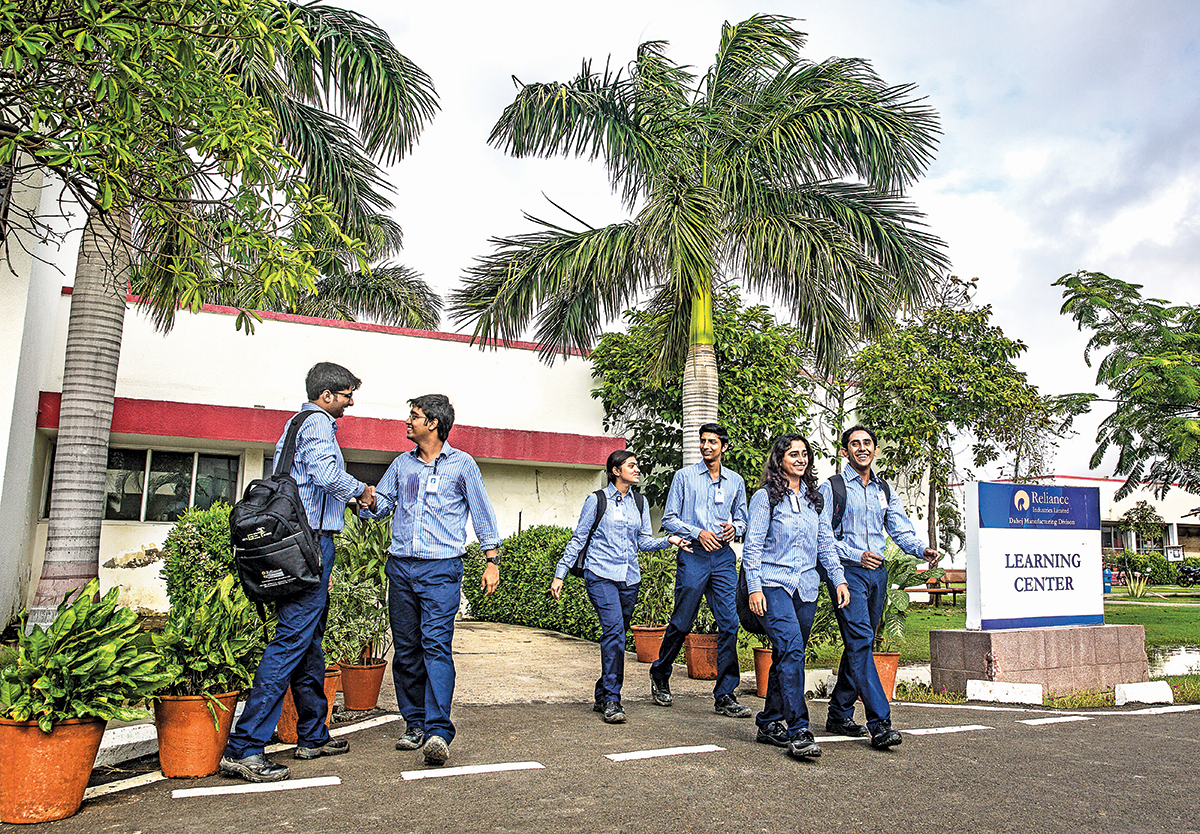
Reliance Employees
KEY ILLUSTRATION
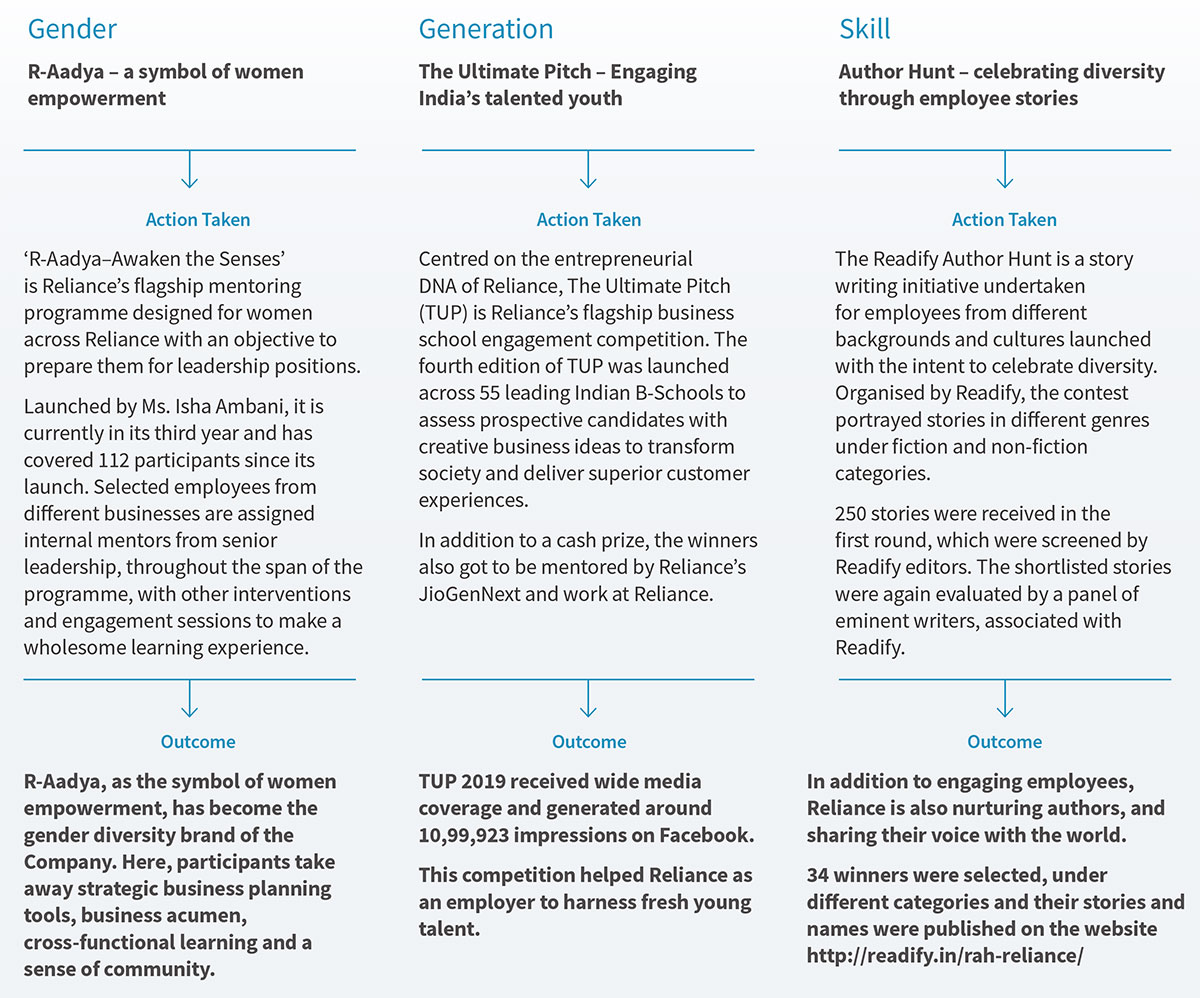
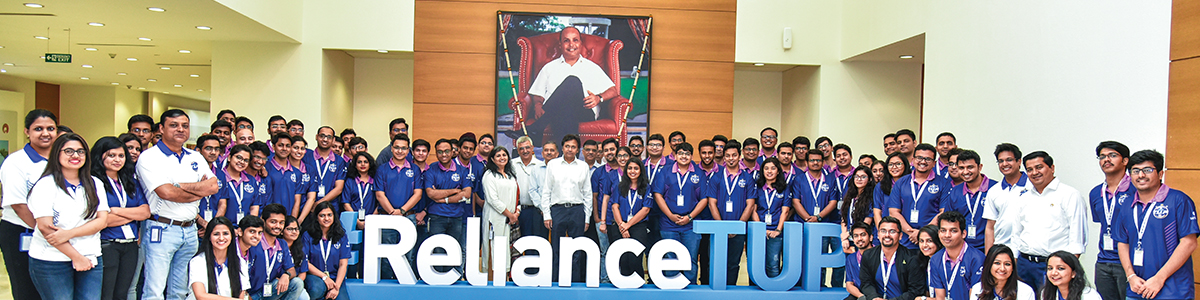
The Ultimate Pitch 4.0
The Ultimate Pitch has been recognised as the 5th Most Prestigious B-School Competition by Dare2Compete Awards.
Ability
Saksham – appreciating
PwD employees

Action Taken
With several inclusivity initiatives that started in 2016, Reliance Retail today employs over 1000 PwD (Persons with Disabilities) employees PAN India.
In 2019, Retail launched ‘Saksham– Transforming Capabilities’, a programme dedicated to highlight the strengths and contributions of its specially abled associates.
Over 100 PwD associates attended the programme at the head office in Mumbai in January 2019, which included various performances and leadership talks.
Scale of Impact
First edition of the Circular Design Challenge saw over 900 registrations from over 30 cities across the country.
Outcome
Through Saksham, PwD employees found a platform to share their stories and experiences.
“R Aadya has been a transformational Initiative. It has been a platform for women across geographies and business units to interact, learn and unlearn from each other. This cross-functional shared learning has been an enabler and a supportsystem to accomplish our goals. The mentorship sessions with the veterans of Reliance and focused training to unleash the potential in oneself has helped in the long run. It has been an opportunity and a matter of pride to be associated with it.”
Neha S Agrawal, Jio
EMPLOYEE ENGAGEMENT
RIL has conceptualised and has regularly
implemented multiple initiatives to
enhance employee engagement, thereby
leading to a more productive work
environment.
BRING YOUR FAMILY TO WORK
Bring Your Family to Work (BYFW) is an
initiative that fills employees’ family
members with pride and brings both home
and work families together. This year’s
BYFW event witnessed around 15,000
colleagues and their family members,
participating in a plethora of activities and
awareness initiatives. ‘Mitra’ robot marked
more than 6,000 unique interactions, and
kiosks of RelWood and R|Elan received over
1,000 queries expressing interest to buy
Reliance products in the market. More than
2,000 saplings and 9,000 recycled bags were
given as souvenirs to raise environmental
awareness. The event also garnered over
5 lakh impressions on LinkedIn, Facebook
and Twitter.
RELIANCE FAMILY DAY (RFD)
Reliance Family Day (RFD) is one of the
biggest corporate celebrations in India,
reflecting the spirit of ‘One Reliance’. Every
year, RFD is celebrated to commemorate
the birth anniversary of Shri Dhirubhai
Ambani. A host of indoor and outdoor
activities, before and during the event,
were planned for employees and their
families as part of the celebrations of
RFD ’18. In addition, several awareness
campaigns were carried out and blood
donation camps were organised to urge
employees to donate blood.
LEARNING AND DEVELOPMENT
RIL’s expansion into diversified
segments requires specialised skill sets.
The emphasis lies on progressing and
building a learning environment which is
accessible, automated and available for all.
During FY 2018-19, Reliance imparted 66.93
Lakh hours of training to its people across
the Group.
Learning and Development at Reliance supports in building capabilities both for individuals and the organisation at large. Towards this end, it envisages that:
- Learning becomes a way of life in RIL (democratisation of learning)
- Learning becomes a strong business enabler
- R-University becomes a well respected brand
- The future of learning fully integrates technology solutions and HR Platforms
- Employees are reskilled and upskilled to meet challenges of the future
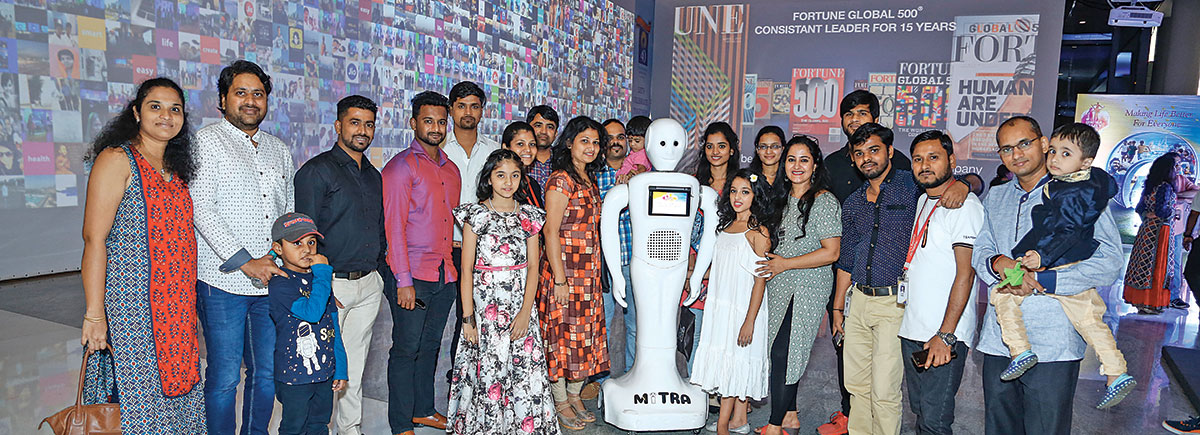
Bring Your Family to Work Week 2019
The organisation focuses on both technical or functional capability building and behavioural or managerial capability building.
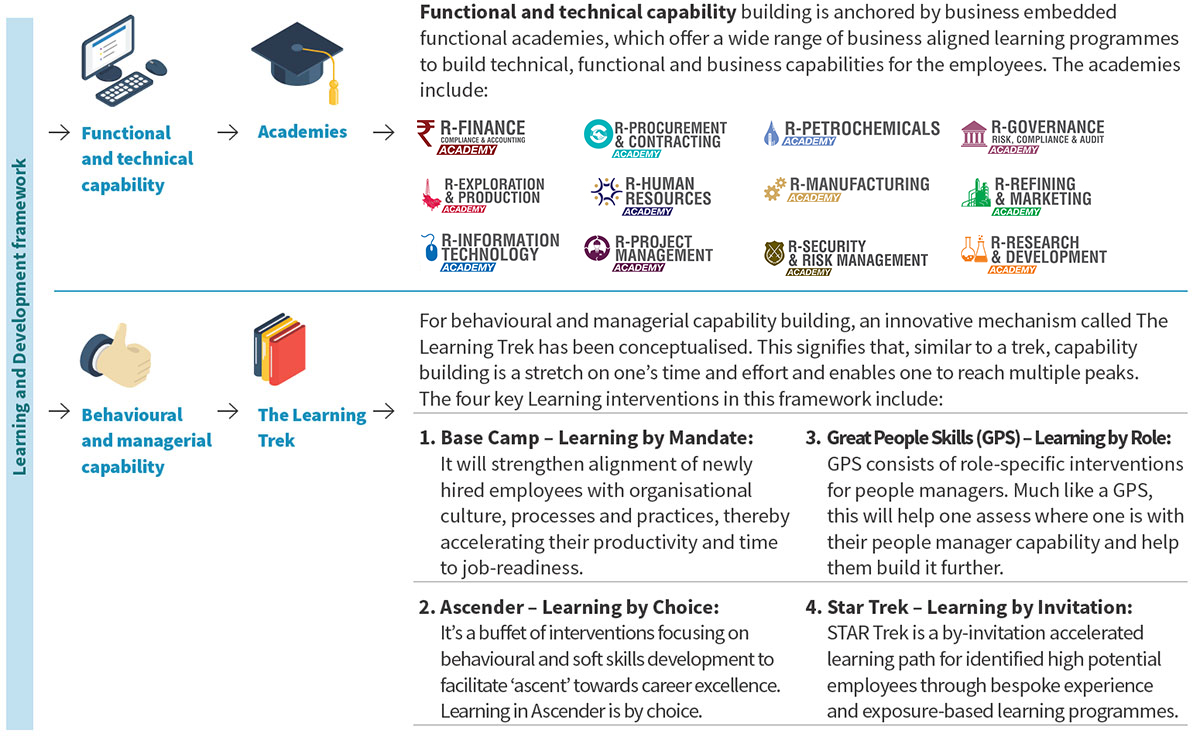
Bring Your Family to Work Week 2019
LEARN ANYTIME, ANYWHERE
In keeping with RIL’s philosophy
of providing learners the ability
to learn anytime, anywhere
and on any device, the Learning
function aims to develop
'Best-in-Class' digital learning
solutions in partnership with
the 'Learn and Grow' Platform.
Using technology, RIL also
offers employees a highly
interactive, collaborative and
device-agnostic social learning
platform
ILLUSTRATION
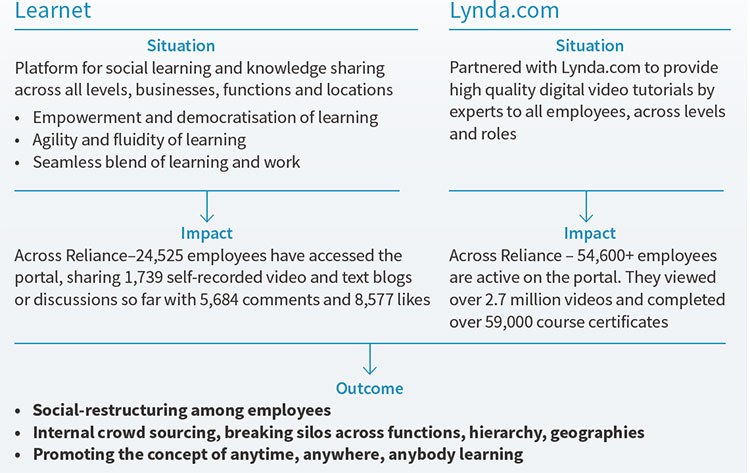
LEARNING WEEK
Spectrum is a week-long initiative aimed at strengthening the learning culture at Reliance. In its third edition in 2018, the initiative
witnessed around 30,000 employees participating in a plethora of learning activities, where one could learn anything right from how to
play the flute to using the collaborator quotient, to how to beat pollution.
Spectrum was intended to empower the academies to plan and execute learning interventions, and create heterogeneous teams to sustain the learning interventions across the Company. Other highlights of this unique and engaging learning intervention include:
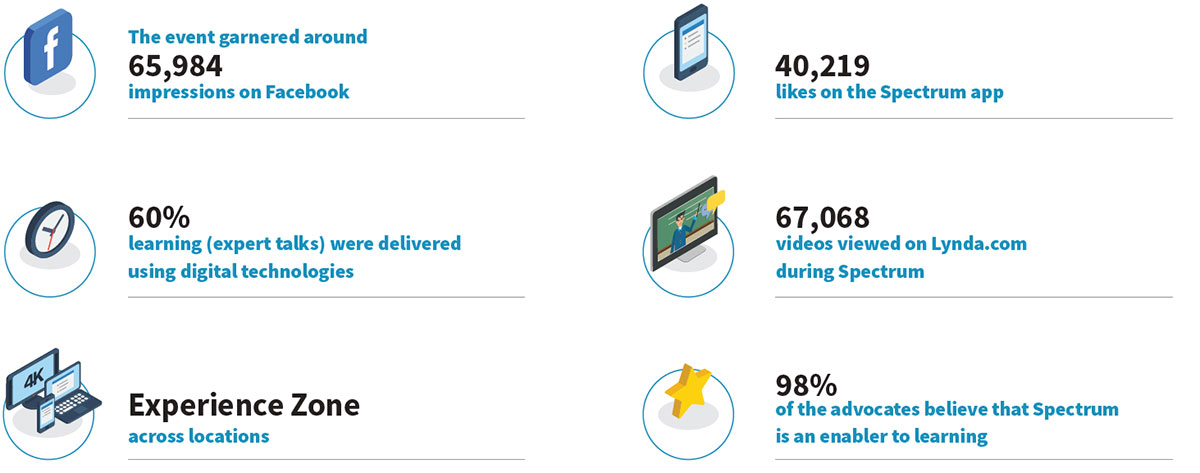
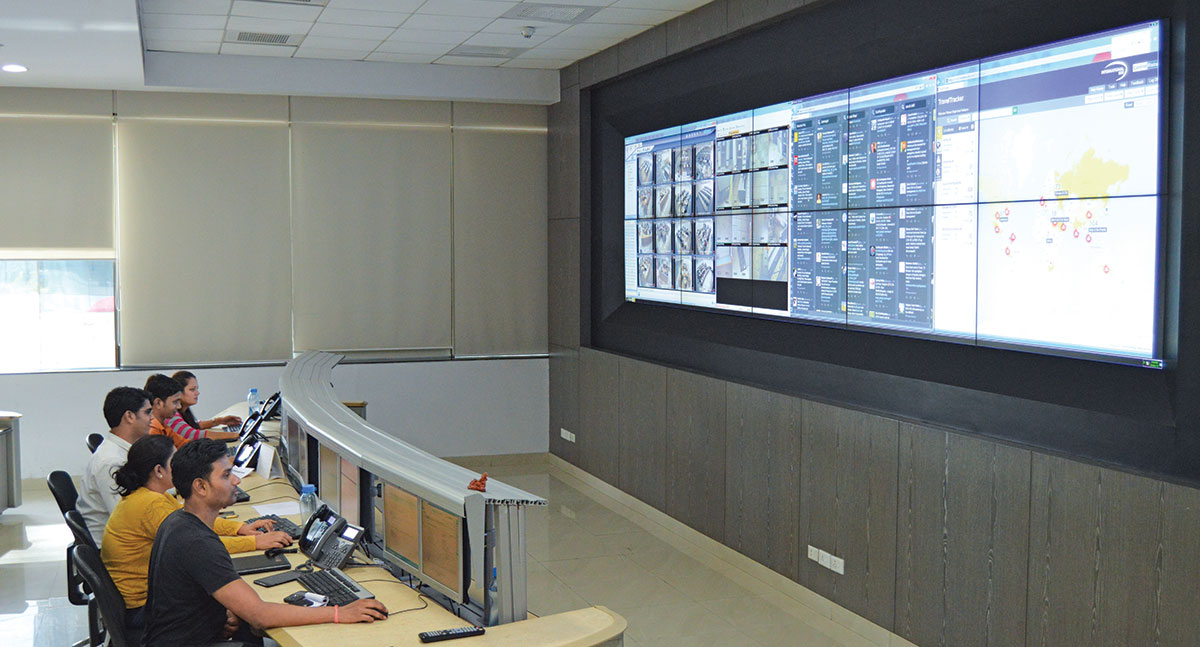
Training workshop
TRAINING TO ENSURE RELIABLE AND SAFE OPERATIONS–CAS
To ensure reliable operation delivery and safety competence among frontline staff, RIL has deployed a comprehensive Competency
Assurance System (CAS) in which manufacturing teams have established area specific job competency profiles and competency-based
learning content to train and develop all job appointees in asset facing roles. As part of the CAS process, employees go through robust self
and managerial assessments followed by assurance through online quizzes and field task tests. Over 8,500 customised quizzes and task
tests for each job role and work area have been defined.
Over 6,200 asset facing employees had enrolled into this programme in the past year. Over 4,000 employees have been fully certified for their role specific competencies and many more are in advanced stages of the assurance process.
ILLUSTRATION
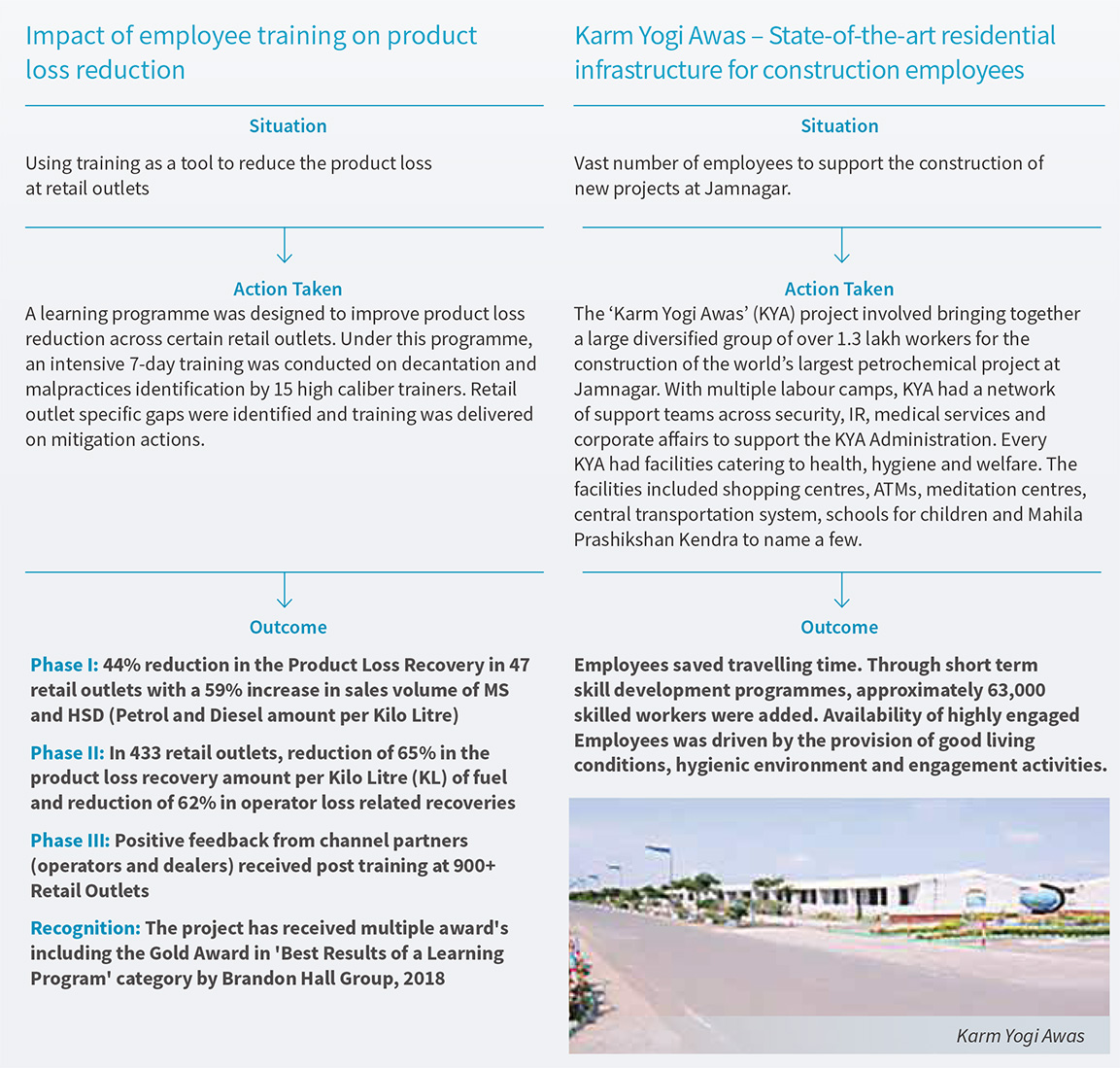
HEALTH AND WELLBEING
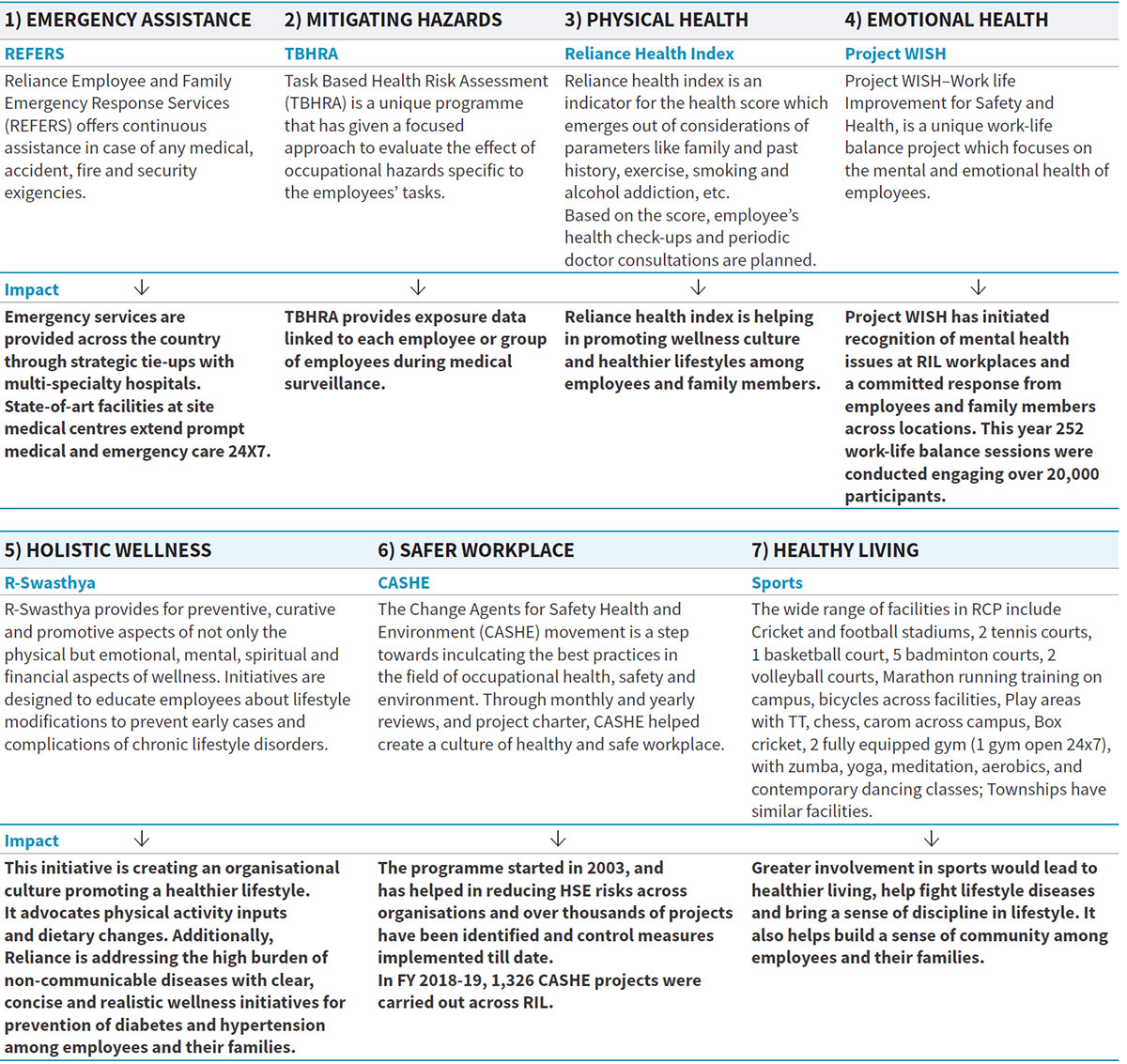
Additionally, our physical and digital assets help maintain a healthy working environment for all Reliance employees. The JioHealthHub, an IT-enabled platform, simplifies management of health records by enabling the users to upload medical data and maintain a medical profile. Additionally, RIL owns web based Health Management System (HMS), which is a robust databank containing health records of all employees. The Health Score of all employees and their spouses based on their periodic medical examinations are maintained within the HMS. Good Health and Health Improvement awards are given to employees across all locations based on system driven metrics, and acts as a motivation tool for creating wellness culture among employees and family members.
Occupational Health Centres (OHC) located at each of the manufacturing locations and corporate office offer preventive, promotive, curative and rehabilitative health services. These OHCs are equipped with state-of-the-art diagnostic and therapeutic equipment with accreditation from leading agencies like Joint Commission International (JCI), National Accreditation Board for Hospitals (NABH), and National Accreditation Board for Laboratories (NABL).
SAFETY
The Company’s safety principles and
practices are:
1. Safety of a person overrides all
production targets.
2. All injuries, occupational illnesses, and
safety and environmental incidents are
preventable.
3. RIL shall strive to be a leader in the field
of management of Health, Safety and
Environment.
The Company is committed towards promoting a safe working culture for all its employees and stakeholders. Reliance’s ultimate goal is to establish a zero accident work environment. To ensure this, all manufacturing locations have a fully equipped and well-qualified Health, Safety and Environment (HSE) and process safety organisation, which is supported by a Centre of Excellence (CoE) at the Corporate to bring in subject matter expertise and governance in various fields of HSE.
To improve on the existing practises and interpret incidents, RIL has implemented ‘Learning from Incidents’ across all its sites. Reliance has also developed a systematic approach to identify and define potential risks and protective measures at every facility level, on an annual basis. All the tools for risk management, incident management and Operating Management System (OMS) are digitalised to bring ease and uniformity across the organisation.
Some of the safety infinitives undertaken within manufacturing are given below.
DEVELOPMENT OF RISK REGISTERS
This year, Reliance developed risk registers
for more than 45 technologies for every
single manufacturing plant. These
registers form the basis for Reliance’s risk
management system, and help ensure
that right barriers are in place to prevent
incidents.
HSE CULTURE
The HSE culture transformation project
focuses on further enhancing the safety
leadership and engages operations to
create a safe workplace for all. Over the
past year, more than 1,000 workshops were
organised at all sites and within layers in
the organisation. This was seen in a positive
response by employees in culture surveys.
LIFE CAMPAIGNS
During the year, various safety initiatives
were rolled out to further reduce incidents.
The LIFE campaigns were based on data
analysis of past years’ incidents and
learnings from these incidents were
spread across all sites. As a result of these
campaigns, incidents related to falling from
heights, electrical safety, hot work, and
work with toxic gases have significantly
reduced. Also, process safety and fire and
smouldering incidents have reduced over
25% compared to last year.
ETHICS AND HUMAN RIGHTS
RIL’s Code of Conduct defines the
behaviour expected from all the employees
and stakeholders and practices along
with the policies and systems for effective
implementation. The Company’s Code of
Conduct ensures that all its employees,
suppliers and vendors are required to
respect human rights of not only each
other, but also of the communities in which
they operate. RIL has developed a set of
policies, codes, and guidelines to govern
its directors, senior executives, officers,
employees (whether permanent, fixed term
or temporary) and third parties, including
suppliers and business partners associated
with RIL. The Company takes into account
global standards and endeavours to comply
with all global norms on human rights,
including the principles outlined in the
United Nations’ Universal Declaration of
Human Rights.
An Ethics and Compliance Task Force (ECTF) comprising the Reliance Group’s Executive Director (Chairman, ECTF), General Counsel, Group Controller and Group Company Secretary has been established which oversees and monitors implementation of ethical business practices within Reliance. The task force meets once in three months to review the complaints and incidents and reports them to the Audit committee. The Company has established a vigil mechanism and a whistle blower policy for employees and directors to deal with issues related to ethics, noncompliance and violations of the company’s Code of Conduct. The whistle-blower can make a protected disclosure either to the Ethics and Compliance Task Force or directly to the Audit committee via email, telephone or through a letter. RIL’s Code of Conduct, Vigil mechanism and Whistle blower policy form the foundation of the Company’s commitment towards ethical conduct at all levels.
Reliance recognises the ‘corporate responsibility to respect human rights’, as outlined in the framework of United Nations Guiding Principles on Business and Human Rights (UNGP). An internal complaint committee has been set up at all operations locations where employees can register their complaint against sexual harassment. This is supported by the Anti-Sexual Harassment Policy, which ensures a free and fair enquiry process with clear timelines for resolution. During the reporting period, there were no cases of child labour, forced labour, involuntary labour, sexual harassment and discriminatory employment.
Reliance continues to report its progress against the 10 principles of UNGC in the Sustainability report. The 10 principles cover the topics of human rights, labour, anti-corruption and environment.
FREEDOM OF ASSOCIATION
At various sites, Reliance has recognised
employee unions and associations, which
encourage the employees to participate
in open and constructive dialogue with
the management, without fear of reprisal,
discrimination, intimidation or harassment.
Almost 100% of the non-supervisory
permanent employees at its manufacturing
locations are covered under the collective
bargaining agreements with trade unions,
which also comply with the local and
national laws.
GOVERNANCE AND INTEGRATION
The HR function continues to raise the
bar of excellence in people policies,
practices, systems and data. This has
been accelerated by a mature Human
Resources – Governance, Integration and
Assurance Team. This team focuses on
strategically driving key people-focused
transformational initiatives across Reliance
along with adoption of progressive HR
policies and institutionalising governance
meetings – from team level to the highest
governing body.
INNOVATION
Reliance believes in creating value via
innovation for all its stakeholders and has
always demonstrated that innovation is
in its DNA. This ethos led to sparking the
equity cult in India, setting up the world’s
largest grassroots refinery, and paved
the way for the largest retailer, fulfilling
aspirations of millions and ushered in a
digital revolution. Reliance’s innovations
have touched many facets of life in India,
including transportation, retail and
healthcare.
Reliance focuses on three aspects
surrounding business innovation
– talent, process and environment
– to find innovation opportunities.
Reliance develops and deploys relevant
programmes leveraging technology and
harnessing expertise aimed at creating
value and a culture of innovation.
INNOVATION PROGRAMMES
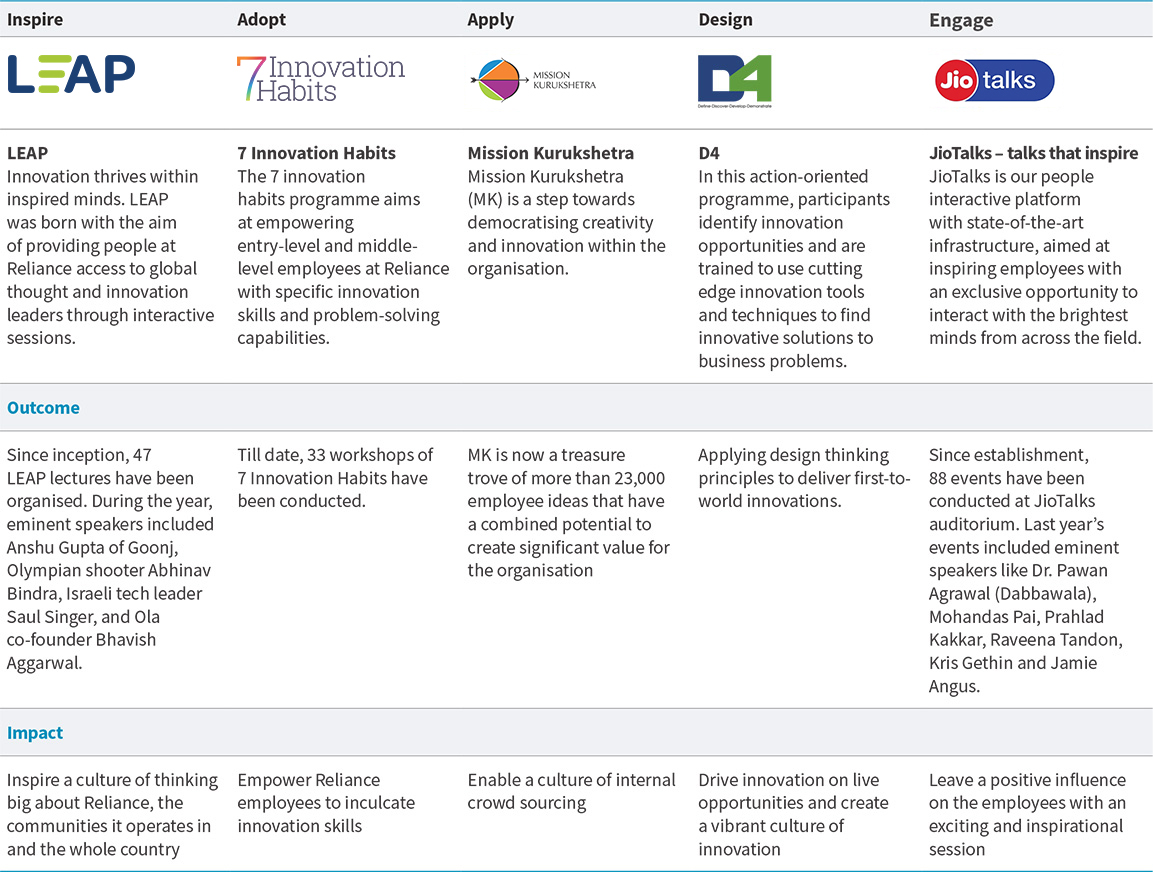


Hital R. Meswani
Pawan Kumar Kapil
B Narayan

Par Singh

Deepak Datta

Ravinder Batra

A. Srinagesh

Lalit Kasliwal
Reliance has tapped into some of the latest advances in manufacturing technologies to make its manufacturing plants smarter, safer and environmentally more sustainable. The Jamnagar expansion project is one of the world’s most complex and highly integrated project. Through this project, the Company has re-defined refining and petrochemicals integration. Not only has investing in these megaprojects and complex supply chains augmented capacity and enhanced complexities, it has also enabled the Company to improve energy efficiency and reduce operating costs per unit of output. Our next generation infrastructure, network and key partnerships enable us to have differentiated our businesses and deliver compelling customer experiences. In the digital business, the scale of fiber and tower infrastructure setup is unprecedented and future ready. Through adoption of new technologies such as 3D printing Reliance has entered the world of advanced materials and composites. The Company’s retail footprint is ever expanding, adding more stores year-on-year and increasing penetration to more rural as well as urban areas.
MATERIAL TOPICS
1. Raw Material Security
2. Managing Systemic Risks from Technology Disruption
3. Data privacy and security
4. Digital Inclusion
5. Asset Utilisation and Reliable operations
6. Security and asset protection
OTHER FRAMEWORKS REFERENCED
NVG-SEE, NGRBC
UNITED NATION’S SDGs

PMO’S INITIATIVES SUPPORTED BY THE NITI AAYOG
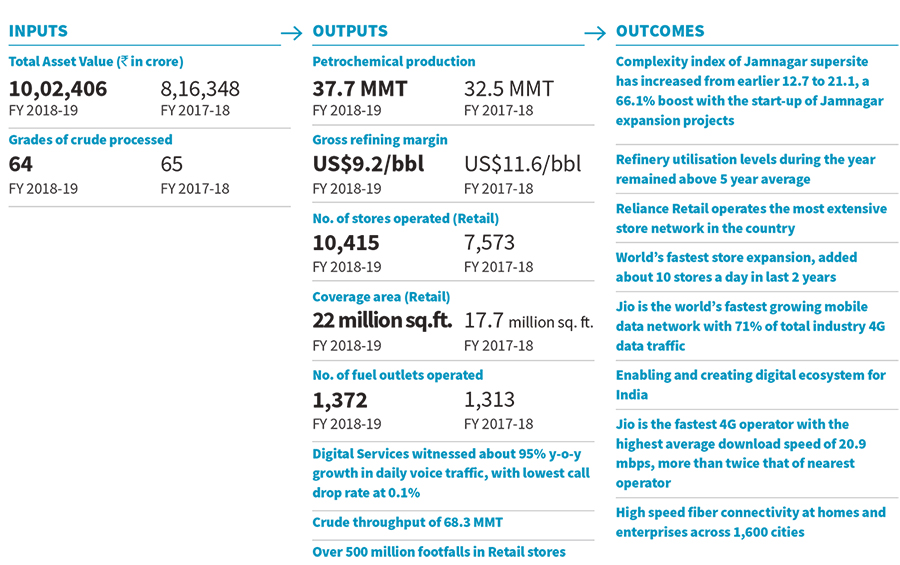
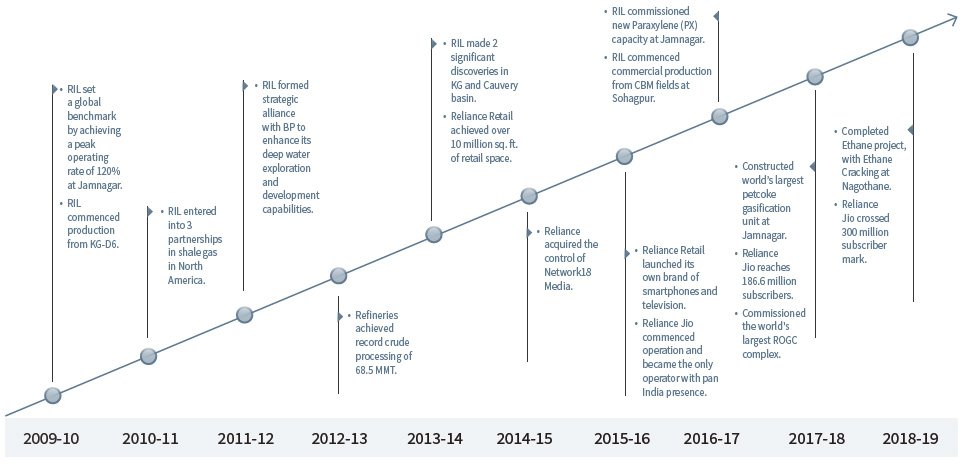
PUTTING MANUFACTURING EXCELLENCE AT RELIANCE INTO PERSPECTIVE
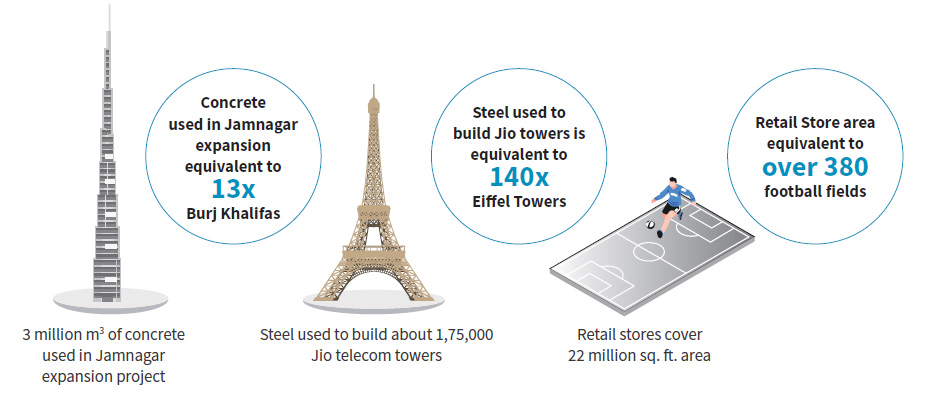
CAPACITY
Reliance has emerged as the world’s largest player in refining and petrochemicals. Jamnagar supersite ranks 1st in the world, in complexity-barrels, defined as complexity index times crude throughput in barrels per day. The Complexity Index of Jamnagar supersite, as per KBC, a Global refinery consultant, has increased from earlier 12.7 to 21.1 or a 66.1% boost with the start-up of Jamnagar expansion projects, including ROGC and downstream units, Paraxylene complex and Petcoke Gasification complex. Reliance Retail has transformed the retail landscape in India. About 10 stores a day have been added over the last 2 years to cross 10,415 stores across 6,600+ towns and cities. Digital services continue to scale up with 306.7 million subscribers translating this to a per capita usage of 10.9 GB and 823 minutes per month.
SMART MANUFACTURING
RIL promotes the culture of innovation and explores new opportunities for enhancing efficiency in business operations. The Company’s improved performance in terms of integrity, reliability and effectiveness of business is an outcome of adopting state-of-the-art technologies and smart manufacturing processes in its value chain. Smart manufacturing integrates data from various systems with process expertise, enabling proactive and intelligent manufacturing decisions in dynamic environments. The Company has implemented the development and implementation of Industrial Internet of Things (IIoT) based solutions at its manufacturing locations to analyse vast amount of operational data. RIL envisioned its smart manufacturing adoption through the following broad class of activities:
- Deploy / develop smart sensors and control elements, including edge devices
- No touch, remote operation, paperless manufacturing and workflow execution
- Advanced predictive and perspective analytics to predict future performance and alert equipment failure
The Company promotes and adopts new training opportunities in the fields of analytical platforms, computer vision, machine learning and AI algorithms and programming languages. RIL strives to enhance the skill sets of relevant personnel internally by converting these opportunities into success. These newly acquired skill sets, coupled with domain expertise, are applied in prescribing the solution for process performance and equipment health improvement. The Company engages its partners to have its own manufacturing data platform so as to facilitate elimination of data latency and drive quick adoption of big data analytics. Implementation of this initiative resulted in efficient application of new ideas to meet the ever-changing business requirements. The Operator Training Simulator (OTS) deployed at critical plants of RIL is extensively used for operator competency improvement, to train for start-up, shutdown and handle plant emergency and process safety related scenarios. The 'Learning by Doing' aspect of OTS has not only improved the operator confidence for taking charge at the panel, but also has reduced overall training time. RIL has also piloted Virtual Reality (VR)- based technology for training.
RIL’s manufacturing locations also showcased immense progress in executing a gamut of projects related to mobility application, image analytics and robotics technology. The Company is also co-developing these solutions in collaboration with several research organisations and premier educational institutes. RIL has already started leveraging smart manufacturing technologies in existing practices:
1. Deployed machine learning based solution for prediction of process health to take corrective/ preventive actions for any future performance deterioration
2. Deployed solution in manufacturing using image analytics technologies to eliminate off-spec rubber production due to contamination
3. Deployed mobile application in operations
4. Development of an IIoT device with real-time edge analytics to assess the health of rotary equipment and provide root-cause of health deterioration
5. Use of robots for inspection and cleaning of inaccessible location like AC ducts, which improves quality of air and thereby, the health of people
6. Implementation of new technologies in rotary/ inspection and corrosion monitoring for early event detection and deployment of thickness measurement and corrosion monitoring for static asset reliability
7. Real-time assessment of plant instrumentation, automation assets and performance insights to improve process stability and minimise operating cost
RIL has primarily focused on developing a secured IIoT and analytics based solution meeting the Company’s Integrated Risk Management standards. RIL is developing an ecosystem to integrate smart manufacturing solutions along with technology partners. This includes the support of infrastructure available through Jio network and Jio cloud. With this initiative, RIL is not only optimising its own process, but also contributing towards the inclusion of other small and medium enterprises (SMEs) in the journey.
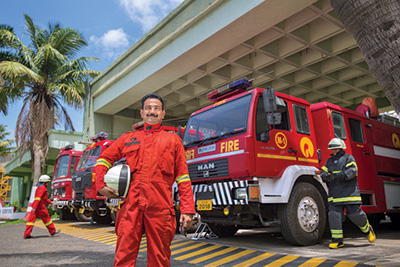
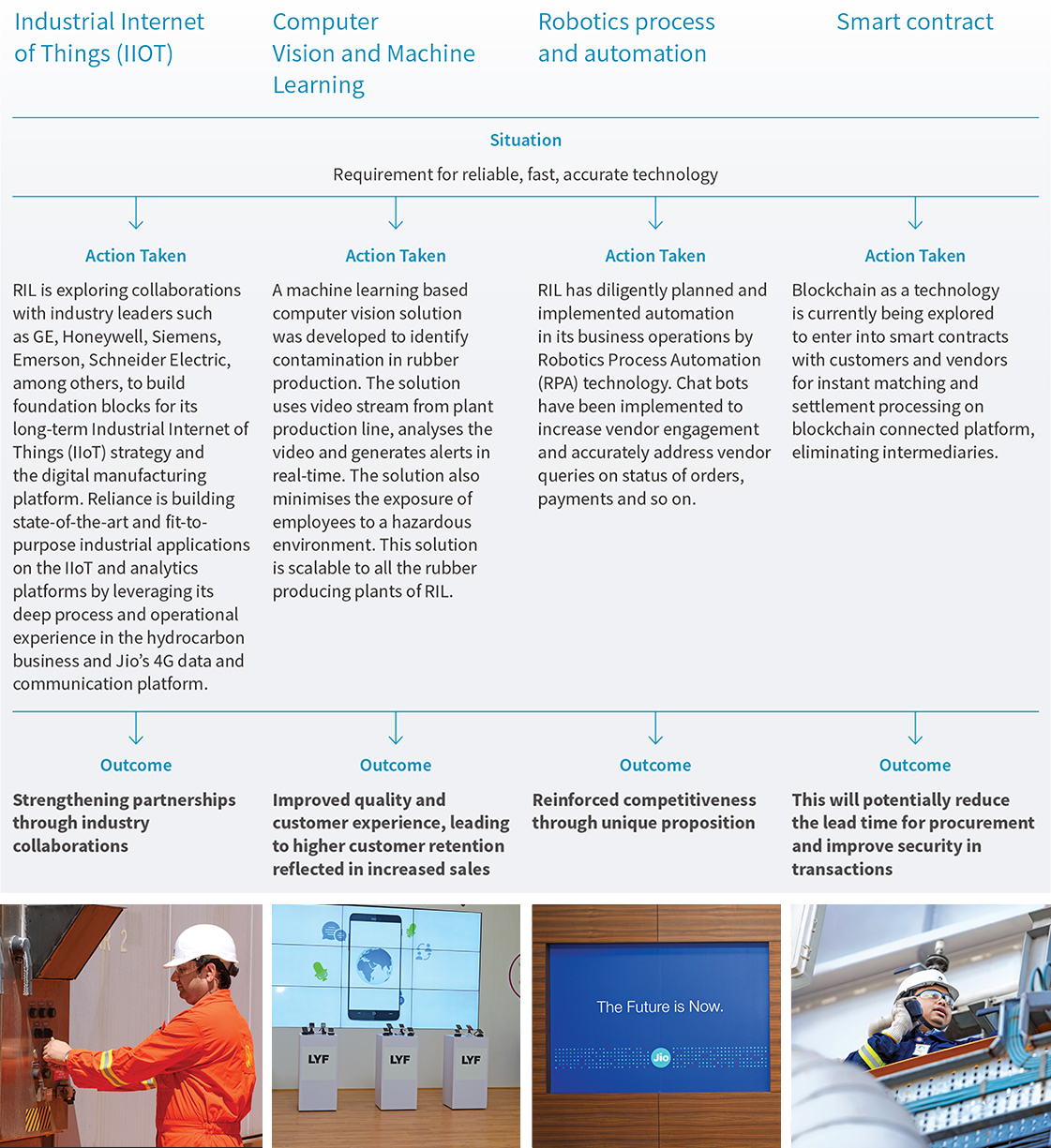
ELEMENTS OF RIL SECURED CONNECTED SYSTEM
RIL has developed and effectively implemented real-time analytics system known as RIL Secured Connected System (RILSCS). By virtue of this system, the Company can analyse the operations on instantaneous basis for predicting future challenges. The elements of RIL SCS are described in the diagram below:
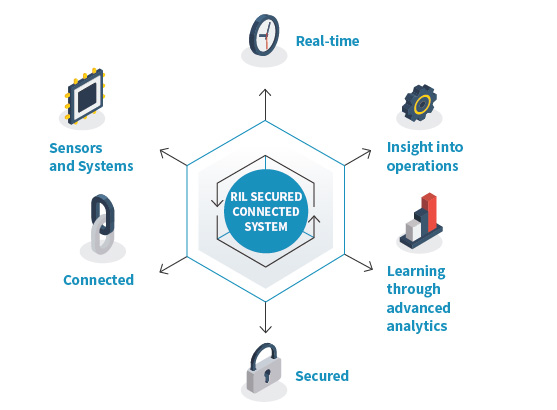
DIGITISATION
RIL is committed towards digital inclusion and has set an objective of developing all the underlying solutions co-hosted within the digital manufacturing platform. It is envisaged along with innovative digital technologies to drive business objectives and outcomes. With the help of these platforms, RIL has provided near real-time business insights to its end users, which allow them to take fast and effective business decisions through a common and intuitive User Interface (UI). RIL’s digitisation strategy is focused upon two main parameters:

RIL has a large portfolio of more than 1,800 applications being used across various businesses, including world- class implementations such as Meridium APM for asset performance management; GE SmartSignal for predictive maintenance; Honeywell Intuition Executive for process and performance monitoring; SAP HCM for hiring, onboarding and training; and state-of-the-art visualisation software.

In today’s connected world, cyber security continues to be a key area of focus. Many state-of-the-art technology solutions have already been deployed at RIL to detect, mitigate and prevent various cyber threats. It is working to fortify its frameworks and architecture to bring continuous improvements to its already strong monitoring, detection and mitigation capabilities. During this year, while its petroleum retail business got Payment Card Industry (PCI) Data Security Standard (DSS) certified, the petrochemicals business was also re-certified for ISO 27001.
Augmented customer experience To enhance the customer experience, RIL is planning to develop a new Supply Chain Management (SCM) transformation programme 'Augmented Customer Experience' (ACE). Objective of this programme is to enhance customer experience based on voice of customers and enable value added services. This initiative will enable integrated business planning through advanced analytics, better supply planning and execution, and thus lead to higher customer service levels. Fleet risk management dashboard through machine learning solution leveraging IoT technology was implemented to minimise the risk for the captive and external fleets. A desired outcome of this programme is to strengthen Customer Relationship Management (CRM) by enhancing agents and customer experience through dashboards and mobile applications.
PRODUCT STEWARDSHIP
Reliance proactively ensures that its products positively impact the environment and society at large. The three key categories of products that the Company manufactures are – transportation fuels, polymers and polyester fibres. RIL sets a uniformly high standard for product development, which goes beyond regulatory requirements. Product stewardship initiatives undertaken in FY 2018-19 are listed below:
REFINING & MARKETING
RIL has focused on debottlenecking, capacity enhancement, energy conservation and product quality improvement to enhance its competitive strengths. Some efforts include:
- Debottlenecking of Diesel Hydrodesulphurisation (DHDS) unit to higher capacity
- Improved diesel recovery with modifications to vacuum units
Jamnagar Refinery is not only state-of-the- art in terms of technical capability but also resilient to natural disasters. During the Gujarat earthquake of 2001, which was 7.7 on the Richter scale, Jamnagar refinery did not suffer any major damage.
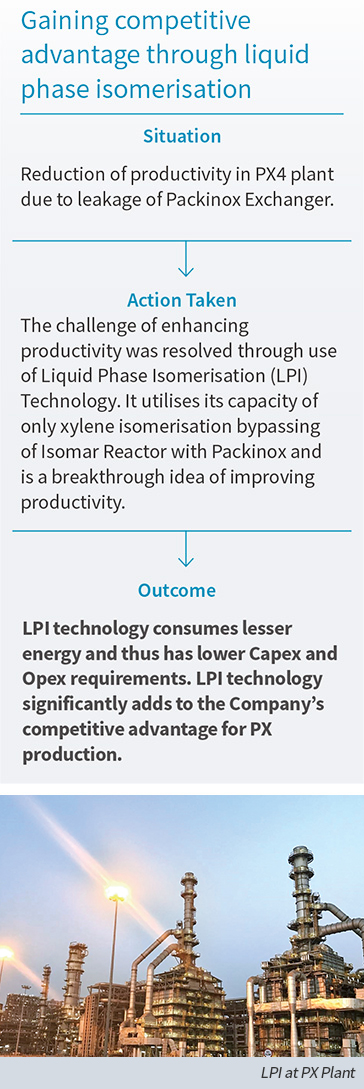
PETROCHEMICALS
Polymers
- Reliance is continuously developing its plasticulture applications, which have utility in agriculture and dairy industries in India. During the year, PE grades have been used for manufacturing of net for paddy stubble bales.
- Poly Ethylene manufactured by Reliance is used to develop special sleeves to protect saplings on hills from wild fire in Maharashtra.
- A breakthrough was achieved for usage of impact Co-polymer Polypropylene (PP) in mud liner of vehicles.
- Reliance is developing 2-dimensional nanomaterials such as graphene, which adds to the existing polymer portfolio.
Polyesters
R|Elan™ is RIL’s umbrella brand, which encompasses a range of new age fabrics. It is a blend of art and 'smart', with fabrics that provide enhanced aesthetics, performance and comfort. Through this, RIL fulfils the consumer needs, across apparel segments like active wear, denim, formal wear and women’s wear.
Composites and Carbon Fibre
Under its Trademark RelX™, Reliance Composite Solutions successfully developed the following projects:
- Developed FTTx Pole for telecommunication, which is light weight and cost competitive
- Designed and delivered underground fuel storage tanks for storing petroleum products as per the latest design, fabrication, inspection and testing standards
- Started producing interiors and toilet modules for train coaches
- Developed carbon fibre wrap, which can be used to strengthen depleted pipelines, buildings, roads and bridges
3D Printing
RIL has developed capabilities to design and print prototypes as well as end-use parts for Oil and Gas, Medical, Electronics and Industrial Tooling sectors. RIL is also working on developing 3D-printable materials out of our downstream products such as PP and PE.
Other Brands
Recron® Certified is the largest selling Pillow Brand in the country. It operates on B2B2C (Business to Business to Consumer) model. This enables RIL to reach millions of consumers across India.
RETAIL
Trends has grown rapidly over the last few years driven by store expansion and higher productivity of existing stores, lead by better merchandise and engaging shopping experience. In order to serve customers better and provide them with superior store experience, Reliance Retail has introduced new store concepts such as Trends Woman and Trends Man. These stores have received strong traction from customers since their launch, paving way for their expansion.
Reliance Retail has introduced compact Trends stores across Tier III / Tier IV towns that offer focused assortment at stronger value proposition. During the year, 65 small town Trends stores were rolled out.
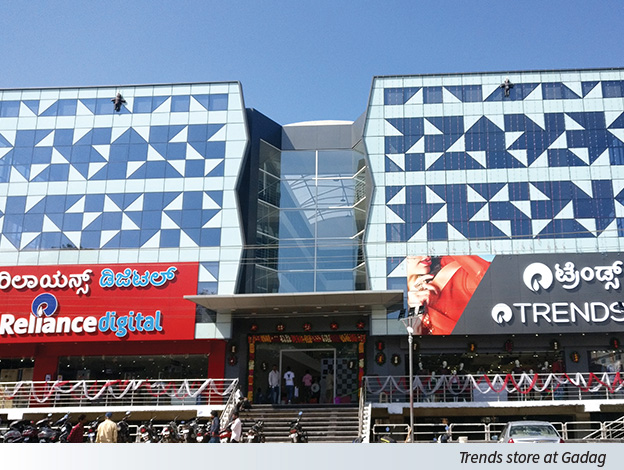
DIGITAL SERVICES
- Under GigaFiber, Jio has built the product and services to transform every home to a Smart Home by serving digital needs of tomorrow’s India today – including ultra-high-speed internet, content, home voice services and Home IoT services among others.
- Jio has built the country’s largest all-IP data network on 4G-LTE technology and as a mobile video network, provides VoLTE and is future ready for transition to 5G and beyond.
MEDIA
- During FY 2018-19, Network18 launched MC Pro, a paid app with premium and ad-free content. Further, MoneyControl also launched MC Transact during the year for enabling speedy investments.
- VOOT’s product proposition has been bolstered through making news channel content available on it. Additionally, the platform is making rapid strides towards a pay model.
- Viacom18 Motion Pictures announced its digital content arm–Tipping Point.
The intention was to create short-form content for Digital (especially for VOOT) by utilising the strengths of the movie studio, thereby creating high-value content in-house, amidst the current high-competition war for content.
EXPANSION PROJECTS
As the world migrates from fossil fuels to renewable energy, RIL will further maximise this Oil to Chemicals conversion and upgrade all of its fuels to high value petrochemicals. This up-gradation will be implemented in a phased manner over the next decade to meet the rapidly increasing demand for petrochemicals in India and the region. The hydrocarbon business is thus poised for robust value creation and exciting times ahead.
Refinery off-gas cracker
In January 2018, RIL announced successful commissioning of the world’s first ever Refinery Off-Gas Cracker (ROGC) complex of 1.5 MMTA capacity.
- The ROGC complex uses off-gases from Jamnagar refineries as feedstock, helping RIL emerge as one of the most efficient producers of polymers in the world.
- The complex was built in a record time with approximately 40% lower capital cost compared to similar projects globally.
- The unique configuration with sustainable cost advantage, competitive project schedule, lower capital cost and flawless start-up made the ROGC complex one of the best executed projects globally, right from conceptualisation to commissioning.
Petcoke gasification
- Petcoke gasification project, one of the largest clean initiatives in the world, uniquely turned Jamnagar refineries ‘bottom-less’ by converting low-value petroleum coke into syngas.
- One of the most complex projects, it has integrated 83 process units with refineries and other downstream units operating in extreme conditions, with temperatures ranging from (-)190°C to (+)1,480°C, and pressure fluctuating from vacuum to 120 standard atmosphere.
Downstream expansions
- RIL expanded the PX production capacity significantly, making RIL the world’s second largest PX producer.
- RIL added capacities of PTA, MEG, PFY and PET, reinforcing itself as the world's largest integrated polyester player.
- Thanks to the new LLDPE and LDPE plants, RIL can now produce the entire range of PE grades covering all end-uses in the Indian market. The additional capacities of MEG, LLDPE and LDPE helped absorb the ethylene produced from ROGC. Similarly, Propylene from ROGC enhanced output of Polypropylene (PP) at Jamnagar to produce high-value co-polymers.
GLOBAL CORPORATE SECURITY
Global Corporate Security (GCS) is a distinct function of RIL mandated to secure, safeguard and de-risk India’s largest private sector company. GCS officers are engaged round-the-clock for safeguarding RIL’s people, assets and operations, ensuring business continuity at all times and reducing the cost of doing business. GCS apex leadership comprises a multidimensional and diverse range of experts, including veterans from the military, central police organisations, paramilitary forces, law enforcement agencies, intelligence services and other subject-matter experts from the industry.
GCS operates the Reliance Security and Risk Management Academy (RSRMA), a first-of-its-kind training institution in India, dedicated to producing world-class security professionals. The academy has trained more than 900 security officers thus far. GCS also carried out a capacitybuilding exercise to create a favourable security posture around the campus and office facilities by de-risking the ecosystem.
Towards this, the security teams conducted 37 sessions on ‘Safety and Security’ for 5,361 school children covering 34 schools of Mumbai. RIL is also at the forefront of developing national-level security doctrines in coordination with academia and think-tanks.
As part of the next stage of its intelligence-led and technology-driven evolution, the Company is implementing platform-based hi-tech solutions for analysing risk, designing security processes and supporting operations on ground, with minimal impact on business operations. Digitised process enhancements, permitting comprehensive collection, collation and analysis of actionable information, will support threat assessments and risk-mapping, enabling future-ready security solutions for all RIL stakeholders.
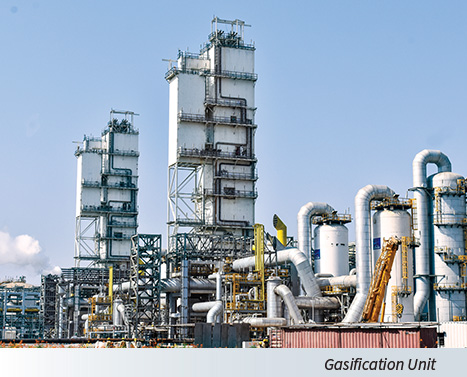


Hital R. Meswani

Ajit Sapre

Dr. J V Kelkar
Gerard Denazelle
Suketu Vakil
Kiran Thomas
Anish Shah

Rui Bastos
RIL’s DNA of organic growth has been institutionalised through the Reliance Management System (RMS) across the organisation, which is a key intellectual capital. Now Reliance is on a transformational journey where platforms are being implemented across businesses and functions, leveraging digital technology capabilities to enable rapid innovation, organisational agility and market responsiveness. Additionally, through Research and Technology, the Company creates next generation technologies, and has evolved from buyer and customiser of technology to developer of technology, across projects, products and businesses.
RIL continued to invest heavily in areas of research such as new materials for a cleaner environment and energy transition and security. This includes applications of synthetic biology that brings together the physical, digital and biological domains to better enable the Fourth Industrial Revolution.
Reliance has transitioned from buyer of technology to flagship developer of greener technology – for all its principal businesses ahead of competition. There’s significant potential to scale up and patent Reliance’s proprietary technologies. During the year, 120 patents have been granted. The Company’s tacit knowledge base is a significant resource that the Company taps into and uses internal crowd sourcing as an enabler to R&T.
MATERIAL TOPICS
1. Innovation and Technology
2. Data Privacy and Security
OTHER FRAMEWORKS REFERENCED
WBCSD
UNITED NATION’S SDGs
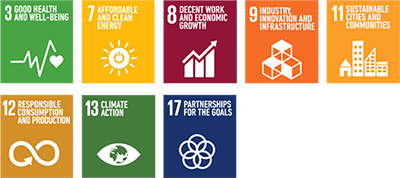
PMO’S INITIATIVES SUPPORTED BY THE NITI AAYOG

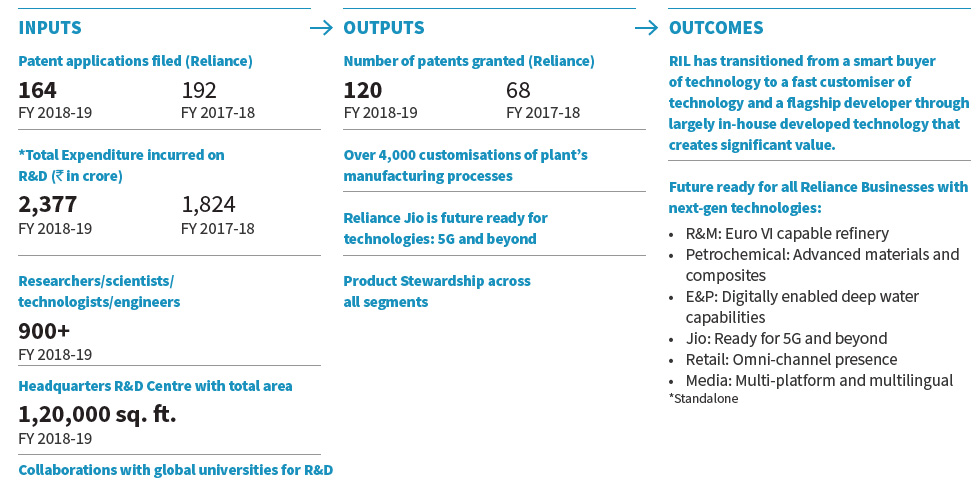
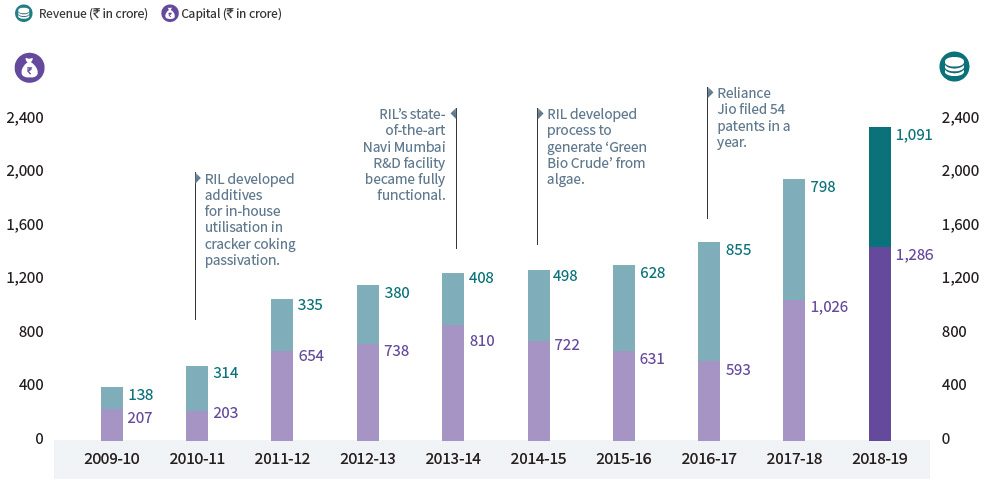
RESEARCH AND TECHNOLOGY (R&T)
R&D MEGATRENDS
RIL fosters a robust research and innovation culture to address emerging challenges and demands of its diverse customer base. As the world puts more emphasis on renewables and a low carbon economy, commodity chemicals give way to high-performing specialty polymers and chemicals. Digitisation and advanced analytics, when coupled with nanomaterials and biomaterials, will pave the way to derive maximum value from existing operations.
Across the spectrum, there is an accelerated use of digital technologies. The table below elaborates more on Reliance’s transition from a Buyer to a Developer, and shows the evolution of the Company as it capitalises on megatrends as an opportunity.
R&T MISSION
RIL shall develop innovative products, processes and catalysts to increase and sustain the profitability and growth of Reliance in a compliant, safe and reliable manner. To achieve this mission, RIL has transitioned from a smart buyer of technology to a fast customiser of technology and a flagship developer through technology largely developed in-house that creates significant value. R&T enables the innovation based growth agenda for Reliance.
Research and Technology plays a vital role in the growth agenda of Reliance by focusing on:
i) New products, processes and catalyst development to support existing business and create breakthrough technologies for new businesses
ii) Advanced troubleshooting
iii) Support to capital projects, and profit and reliability improvements in manufacturing plants
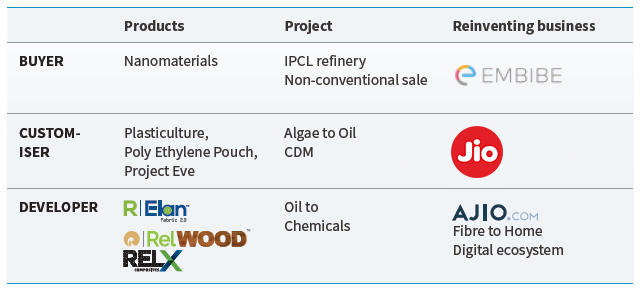
RESEARCH AND TECHNOLOGY (R&T)
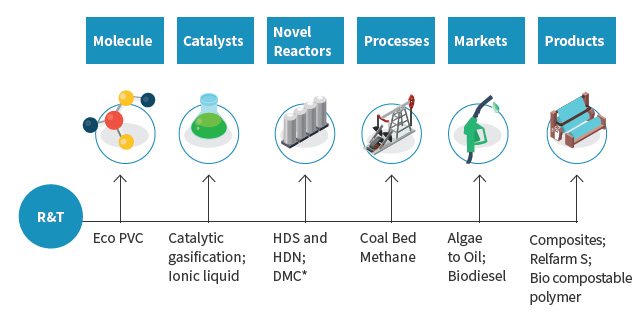
Reliance R&T: Fundamentals to value creation
R&T ENABLERS
Process and molecular modelling, advanced analytical, scale-up, R&T project management
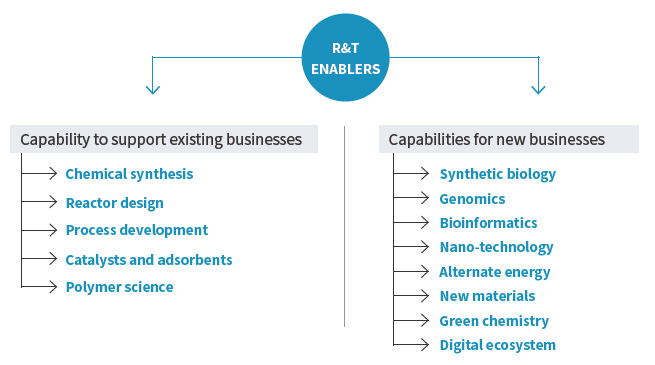
ORGANISATIONAL STRUCTURE
The R&T function at Reliance has two distinct themes:
i) Breakthrough R&T for existing and new businesses ahead of megatrends
ii) Near-term R&T to innovate processes and products for competitive advantage
At Reliance, R&T is governed and operated by a well-defined set of teams: strategic teams, leadership teams and functional excellence teams.
Reliance R&T is future ready
Reliance R&T has adopted an approach which is an amalgamation of physical, digital and biological innovations, which enables the Company to bring forth the next gen industrial revolution.
FOCUS AREAS OF R&T
R&T at RIL has end-to-end presence in value chain from feedstock to value-added products. RIL has grown to be one of the largest and most successful refining and petrochemical companies in the world. It is now becoming a world-class developer of technologies in alignment with global megatrends.
Reliance Jio continues to deploy various technologies, both wireless and wireline. The focus is constantly on underlying step-out processes in network design and deployment, applications and services development, with enhancement of customer experience as a pivotal focus.
Some of the key initiatives consistent with the above trends are mentioned below:
THEME: CLEAN ENVIRONMENT
Biodegradable Polymers as packaging material
Globally, plastic pollution is an environmental concern. RIL has developed biodegradable polymers for packaging applications. The developed product has performance that is at par with current packaging polymers in terms of physical and mechanical properties. This development will reduce plastic waste generation and adverse environmental impacts.
Eco-smart PVC, which does not deteriorate, for specialised applications
Inherently Polyvinyl chloride (PVC) is processed with higher quantity of external plasticisers, which subsequently leach out, resulting in deterioration of product quality and performance. RIL has developed PVC which does not need any external plasticisers. Eco-smart PVC retains its inherent properties, has better extrudability, better transparency and does not deteriorate over the life cycle of the product.
THEME: PRODUCT INNOVATION
Specialty PP Products and Catalyst Development – for high performance materials
The Polymer team has developed high melt flow PP products and Ultrahigh Molecular weight PP using advanced generation catalyst system having better hydrogen response and productivity. This strategic high performance material development provides an opportunity to move from commodity polyolefin – PP to specialty polyolefin catering to niche applications such as high performance PP products for automobile application.
Metallocene LLDPE products and catalyst technology – Indigenisation of catalyst
Global Metallocene LLDPE (mLLDPE) market is in the range of 5-6 MMTPA for different applications and the overall growth rates are expected to reach 7% per year. RIL has developed metallocene catalyst technology to produce mLLDPE in gas phase process for packaging film applications. The produced mLLDPE resin has chemical, morphological and molecular weight characteristics at par with target characteristics. This development has helped reduce dependence on external catalyst suppliers.
Highly Reactive Polyisobutylene (HR-PIB) Process and Product Development – additive for increased fuel efficiency
HR-PIBs carry a terminal vinylidene functionality. Due to this characteristic, they have found applications as intermediates in the preparation of additives for fuels and lubricants as well as other functional modifications. A new catalyst and process have been developed for HR-PIB products with desired functionality.
High Performance Elastomeric Products and Applications – self healing material
New elastomeric materials have been developed based on Endo-rich bromobutyl rubber. The elastomeric ionomers have self-healing characteristics and potential applications for high performance pharmaceutical stopper, high impact polyolefin materials for automobile and elastomeric fibres.
Carbon Fibers – light weighting of materials
Electric vehicles demand light weighting of automotive body parts without sacrificing strength. Carbon fiber composites have the potential to satisfy this need. However, they need to be developed at a cost-effective price point. Towards this goal, RIL R&T is developing technologies for carbon fibers using various raw materials and different process approaches.
Synthetic Biology – physical, digital and biological sciences to create value added products
Multiple cross-discipline researches for functional food, feed, nutrition, unique biomaterials and AI driven genomics and photosynthesis studies are opening up a plethora of opportunities. Synthetic biology, with all other allied technology development, serves as one of the most important pillars of the 4th industrial revolution as an amalgamation of physical, digital and biological platforms. Multiple and diverse disciplines, viz. molecular biology, genetic engineering, bioinformatics, systems biology, photosynthesis, biophysics, computer science, big-data analytics, and robotics are clubbed under the umbrella of synthetic biology. Synthetic biology makes it easier to assemble pieces of artificially synthesised DNA and modularising them in an automation pipeline to fast-track proof-of-concept validation, process standardisation and rapid commercialisation. Targeted genome editing using CRISPR has evolved as a robust technology, which has empowered synthetic biology with throughput, precision, accuracy and time-bound delivery of projects to products.
Synthetic biology platform for society at large, with Reliance’s strong capabilities in digital technology, promises to contribute and create opportunities in agriculture, environment and health. RIL has developed knowledge in the area of algae photosynthesis and translated the knowledge into modern agriculture crop productivity enhancement interventions by connecting photosynthesis with digital technology capability of Jio. This is helping to leapfrog into an era of precision agriculture, which will have a disruptive impact on Indian agriculture and would have the potential to address food security. RIL is committed to leverage the next generation biology advancement to create significant societal impact and make life healthier and more comfortable.
THEME: ENERGY TRANSITION AND SECURITY
Fuel Cell for–alternate renewable energy
The first fully indigenous prototype of a high temperature-polymer electrolyte membrane (HT-PEM) fuel cell system comprising fuel cell stack, methanol reformer, balance of plant and control system has been built and lab testing is underway followed by testing on simulated RIL-Jio towers.
Algae to Oil Downstream – converting feedstock to renewable crude
Reliance Catalytic Hydrothermal Liquefaction (RCAT-HTL) is a feed flexible technology that converts any biomass and organic waste into ‘drop-in’ energy dense renewable crude that can be processed in the existing refining infrastructure to produce transportation fuels. Various feedstock such as algae, food waste, industrial sludge, lignin waste, distillery waste and palm oil mill waste have been tested with RCAT-HTL. Engine testing using RCAT-HTL derived fuels shows promising results. RIL’s RCAT-HTL technology won the Golden Peacock Eco-Innovation Award and Global Clean Energy Award in 2018.
Coal Bed Methane (CBM) – converting unminable coal to methane
The unminable coal, if not redeemed for its value in the form of methane production, would be a waste of natural resources. RIL’s BioCBM process is targeted at converting unminable coal to methane, a fuel that can improve the country’s energy security.
Speciality fuel development – for India’s space programmes
R&T is contributing its bit to the nation’s space research programme with in-house technology development for ISROSENE (a speciality fuel). Molex Raffinate stream from one of our plants is being suitably upgraded using two alternate technologies to meet the stringent fuel specifications set by ISRO. Lab/Pilot scale optimisation is currently underway and scale up to a commercial unit is planned in the next phase.
THEME: HEALTH SAFETY AND ENVIRONMENT (HSE)
Ionic liquids replacing Hydrofluoric Acid – replacing hazardous catalyst
RIL developed an Ionic Liquid (IL)-based technology to replace the Hydrofluoric Acid (HF) catalyst for manufacturing of Linear Alkyl Benzenes (LAB). HF is potentially hazardous and will be replaced with the non-hazardous Ionic Liquid. LAB produced form the pilot plant has been used for market seeding. The customer feedback is very promising. The Company’s two commercial LAB manufacturing units in Patalganga and Vadodara will be converted from licensed HF-based technology to in house IL-based technology. RIL has several patents for this technology. This process significantly reduces the risk of health and environmental hazards of operation.
REFINING AND PETROCHEMICALS
Catalytic gasification – converting waste to value
RIL has developed a catalyst that can gasify feed like petcoke at temperatures below 750°C. The catalytic process can be used to convert high-ash Indian coal to high-value syngas. The process is demonstrated in both dual bed and single bed in pilot scale. The reaction mechanism of catalytic gasification and subsequent results are published in the ‘Energy & Fuels’ journal, by the American Chemical Society. Work is underway to demonstrate the technology at larger scale.
Multizone Catalytic Cracking (MCC) – producing high value petrochemicals
RIL has developed a new Multizone Catalytic Cracking (MCC) process, which converts a wide range of feedstock to high value propylene and ethylene in a single riser. The MCC process is a platform technology for producing high value petrochemicals in the refinery. MCC can be designed and operated in different modes to manufacture olefins and gasoline.
Low Cost Anti-Coking & Sulfiding Additive – import substitution of specialty additive
RIL has developed and started commercial production of low cost anti-coking and sulfiding additive from refinery waste. This is a cost effective alternate of imported commercial additive Di-methyl Di-sulphide (DMDS) for steam cracker and hydro treater applications. This indigenous product is being utilised in the world’s largest refinery off gas cracker (ROGC) unit of RIL Jamnagar manufacturing complex. RIL has received several prestigious awards, e.g., Golden Peacock (innovative product), FICCI (innovative process) and Centre for High Technology, Govt. of India (best R&D development) for this patented technology.
Slag waste to chemicals – green process to convert waste to metals
Hydro process requires large quantity of acid or alkali for leaching or the pyro process, which involves very high temperature. i.e., above 1,700⁰C. RIL has developed a low-cost low temperature hybrid green process to extract vanadium from gasifier slag. The green process is demonstrated in pilot scale, which is being demonstrated to scale.
Direct conversion of CO2 to Dimethyl Carbonate (DMC) – creating value out of CO2
RIL has developed a mixed oxide stable catalyst to directly convert methanol and CO2 to a high value product, viz. DMC. Until now, DMC production is being done through non-green phosgene process, which inherently results in high cost of production. Thus, various applications of DMC, including its use as additive for gasoline, gets ruled out. DMC is also the gateway for making polycarbonate and thus is of high strategic value. DMC used as fuel allows for economical methanol consumption without the demerits of direct use of methanol in Internal Combustion (IC) engine. 0.1 kg Catalyst was prepared for testing its activity. The result was an improved methanol conversion to 65-70 % with DMC yield of about 50%. A strategy for scaling up is being explored.
Agronomy – Biojet fuel for nation using Jatropha
In India, bio-fuels have taken a significantly positive turn in the last couple of years. Government of India (GoI) is aggressively promoting indigenous production and use of biofuels. Consistent with this biofuel ambition, the Indian Air Force (IAF) is also aggressively pursuing introduction of bio-jet for its fleet. IAF’s goal is to attain bio-jet blending level of 10% in its ATF requirement. At the most recent Republic Day fly-past, IAF flew an AN-32 transporter jet using bio-jet/ATF blend. The bio-jet used for this flight was produced using Jatropha oil as feedstock.
RIL’s Jatropha hybrid development programme has succeeded in developing high yielding Jatropha hybrids. Our hybrid productivity is the best globally. After successive generation of hybrid developments, our hybrids are stably yielding >3 mt/ha-year of seed yield under rain-fed conditions in poor quality soil. Availability of Jatropha seeds in significant quantity will mitigate the major challenge that biofuel industry is facing, i.e., lack of availability of quality feedstock.
RIL has developed a technology, which is ready for commercialisation.
Polymer composites for lightweight vehicle and body armour
RIL innovated and developed a new disentangled high molecular weight polyethylene (DPE). High strength tapes and fibre have been used to make composite materials suited to produce body and vehicle armour. The process inclusive of polymerisation, preparation of oriented tapes/fibres and composites is scaled up to pilot and armour products made from tapes. This process has been tested both for body and vehicle armour applications. RIL has patented this cuttingedge technology.
R&T PRODUCT STEWARDSHIP
Refining
The focus areas for R&T in refining are around process development and efficiency through processes like gasification, syngas and CO2 value creation, oil to chemical, value addition through refinery by-products, etc. Even advanced analytical models along with visualisation are being developed and delivered to business users in a phase-wise manner, thus helping to make informed decisions in the refining business.
Petrochemical
Polymers
- Reliance has manufactured cast film polypropylene to maintain high shelf-life of meat and other food products containing high fatty acids.
- Reliance has developed polyethylene bubble film for greenhouse applications, which provides better technical performance and longer shelf life of nearly 10 years. Usage of the film will help farmers to reduce recurring expenses with increased performance of greenhouse structures.
- Reliance has developed high melt flow index (MFI) polyethylene grades for application of stretch film.
- Reliance has developed a polyethylene pouch, which is 100% recyclable and suitable for consumer packaging applications.
Advance Process Control (APC) and Real Time Optimisation (RTO)
- APC and RTO applications facilitate minimising variations, increasing throughput, optimising yields, minimising utility consumption, improved stability, reliability and profitability of process units.
Advanced Material
- Reliance has entered the world of composites, materials that can deliver exceptional performance in terms of strength, durability and corrosion resistance at significantly lower weight compared to steel.
- RelWoodTM is another example of advanced material that looks and feels like high quality wood but has superior properties. It is a durable, water-resistant, fire retardant and termite proof product that can replace wood across all applications.
E&P
Reliance is engaged in R&T efforts to increase the recovery from CBM fields with Bio-CBM technology, which used microbe injection to produce in-situ methane where either coals are devoid of methane or conventional CBM extraction is uneconomical.
Retail
Reliance Retail entered into a partnership with Disney to develop and market co-branded SKUs across various categories such as food, fashion, toys and more.
Digital Services
Jio continues to innovate across the digital value chain through R&D in cutting-edge technologies such as video bots, blockchain, advanced features like Software Defined Networking (SDN), Network Function Virtualisation (NFV) and Evolved Multimedia Broadcast Multicast Services (eMBMS). Till date, Reliance Jio has filed 100 patents out of which 18 have been granted. In FY 2018-19 alone, the Company filed for 35 patents and was granted 12.
R&D EXPENDITURE

R&T ENABLERS
1. Infrastructure
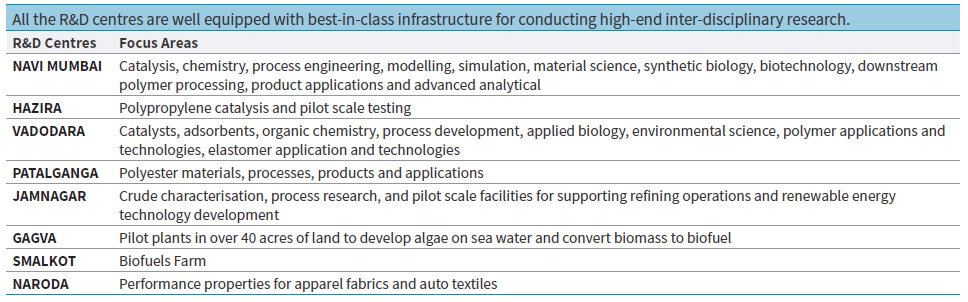
2. Collaboration
Reliance continues to actively pursue collaborations with various reputed institutes/partners in India and overseas. Some of Reliance’s prominent collaborators are University of Helsinki (Finland), Pacific Northwest National Laboratory, ICGEB (New Delhi), Ruia College, Ghent University (Belgium), Monash University (Australia), KAUST (Saudi Arabia), NUS (Singapore), KIER (South Korea), Ben-Gurion University of the Negev (Israel), IIP Dehradun, IIT Mumbai, IIT Kharagpur, IIT Chennai, NCL Pune, Florida State University, University of Massachusetts Amherst, University of Delaware, Penn State University, Kansas State University, University of Alabama, Stanford University and Massachusetts Institute of Technology, among others.
3. R&D Personnel
RIL runs initiatives and campus recruitment drives across universities and colleges to attract fresh talent and the next generation of engineers and scientists. To support the research and development activity, RIL has a pool of scientists and engineers (900+) from reputed Indian and international institutes; few of them are listed below:
Indian institutes
- Indian Institute of Science, Bangalore
- Indian Institute of Technology (IIT) – Mumbai, Delhi, Kharagpur, Kanpur, Madras
- Institute of Chemical Technology (ICT), Mumbai
- Tata Institute of Fundamental Research (TIFR), Mumbai
International Institutes
- Florida State University
- Massachusetts Institute of Technology
- Washington University in St. Louis
- Louisiana State University
Some of RIL’s scientists have membership/ fellowship in reputed bodies such as IICHE, NBRI and FANE.
4. Intellectual Property
At RIL, continuous R&T efforts have resulted in the creation of diverse technological solutions and corresponding patent portfolio spread across various geographies. A robust internal Intellectual Property (IP) governance framework ensures these patents are in close alignment with the organisation’s business objectives. In FY 2018-19, a total of 108 patents were granted to RIL.
For the last few years, Reliance has been consistently featuring among the ‘Asia IP Elite’, a select club of companies from the Asia Pacific region having best IP systems and processes with emphasis on integrating intellectual property with commercial decision-making. In the year 2018-19, Reliance was adjudged winner of the India Innovation Awards in the Corporate category organised by Clarivate Analytics.
5. Organised Big Data and Digitisation
RIL has implemented fit-for-purpose management systems, work processes and tools for achieving excellence. Few of the examples of the digitisation and process centric initiatives are mentioned below:
a) New Product Development and Introduction (NPDI)
Projects using a structured stage gate based methodology. This is an end-to-end digital process chain from “Concept to Commercialisation”. This module is integrated to several other SAP and non-SAP modules, viz. FICO, P&C, HCM, IMPS, ELN and others.
b) Intellectual Property Management System (IPMS)
R&D has implemented an enterprisewide Intellectual Property Portfolio Management application for centralisation of patent filing. It enables focused patent filing and helps in having a centralised repository for various stakeholders.
c) Electronic Laboratory Notebook (ELN)
R&D has implemented best-in-class ELN which is seamlessly integrated with the Laboratory Information Management System (LIMS). ELN is a procedure-driven application designed to give the scientists a robust platform to capture and store both structured and unstructured data as they conduct experiments or execute laboratory procedures. ELN user interface is entirely flexible and can be tailored by creating experiment templates that allow the scientist to easily enter information and directly capture results from interfaced analytical instruments and barcode systems for sample lifecycle management.
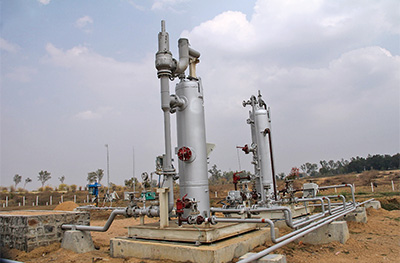
DIGITAL PLATFORMS
Reliance is moving to a digital strategy that leverages the new digital and cloud capabilities to create new value propositions for the businesses and markets in which Reliance operates.
Reliance’s digital strategy aims to reformulate a company’s value proposition in the markets in which it operates by integrating a combination of products and digital services that seek to anticipate and respond to current and future customer needs. To consistently deliver new digital solutions, Reliance is investing in new digital business capabilities:
- A cloud enabled operational IT backbone to drive efficiency and operational excellence
- A digital services platform to support business agility and rapid innovation through new digital products and services
Reliance has built its operational IT backbone over many years for all its businesses. Existing operational IT backbones provide foundational capabilities that are needed to enable digital services platforms but have historically been designed for reliability and efficiency, rather than speed, agile development and elastic scaling required for rapid digital innovation.
Reliance is therefore evolving its existing operational IT backbone with technology and business capabilities to build and operate digital services platforms which deliver on its digital strategies, while still ensuring the efficiency, scalability, reliability and predictability of Reliance’s core operations.
Digital services platform enables rapid innovation and agile change through technology and business capabilities that facilitate rapid development and implementation of digital solutions and innovations. The architecture of a digital services platform also facilitates experimentation and reusability of technologies and digital services to improve operational performance, user experiences and new sources of value.
The Reliance digital services platform’s strategy includes the rollout of 4 key elements:
1) Software as a service (SaaS) based platforms–Cloud based hosting environments for storing and accessing loosely connected services which deliver business solutions and services
2) Enterprise data lake–Integrated repository of massive amounts of data, whether from internal and public sources (e.g., from social media), purchased or derived from sensors (e.g., IoT)
3) Analytics and Data Science engines– Computing capabilities used for converting data into meaningful insights through data visualisation, machine learning and artificial intelligence
4) Enterprise Integration capabilities– Scalable connections to data and processes that reside in the Company’s operational backbones
The deployment of cloud enabled operational IT backbones and digital services platforms also require developing and embedding fundamental management practices related to:
- Rapid innovation and agility in identifying emerging trends and opportunities
- Cross-functional development of digital solutions and user-centred product and service design that integrate business partners (customers, suppliers, other stakeholders)
- Agile development and DevSecOps practices and the use of MVP (minimum viable product) concepts and continuous improvement capabilities and mindsets
- Leveraging business insights from big data repositories of structured and unstructured data
- Reusing and redeploying plug-and-play technologies and business skills and capabilities
Moving to digital services platform strategy is therefore a strategic investment in building integrated, difficult-to-replicate capabilities that deliver and sustain Reliance’s long term strategy in a digital future.

Reliance is always focused on improving shareholder returns by maintaining an optimal capital structure. The Company has significantly enhanced its operational performance by establishing prudent risk management framework. Reliance ensures access to funding to meet its operating needs and strategic objectives while securely and reliably managing its cash flows in a cost-efficient manner.
Reliance actively explores opportunities to optimise the cost of borrowing and aligns the maturity profile of its existing debt portfolio with its business strategy. Reliance retained its domestic credit ratings of ‘CRISIL AAA’ from CRISIL and ‘IND AAA’ from India Rating and an investment grade rating for its international debt from Moody’s as Baa2 and BBB+ from S&P. Cash generated through its operating activities remains the primary source for liquidity along with undrawn borrowing facilities and levels of cash and cash equivalents.
MATERIAL ISSUES
Economic Performance

KEY PERFORMANCE INDICATORS
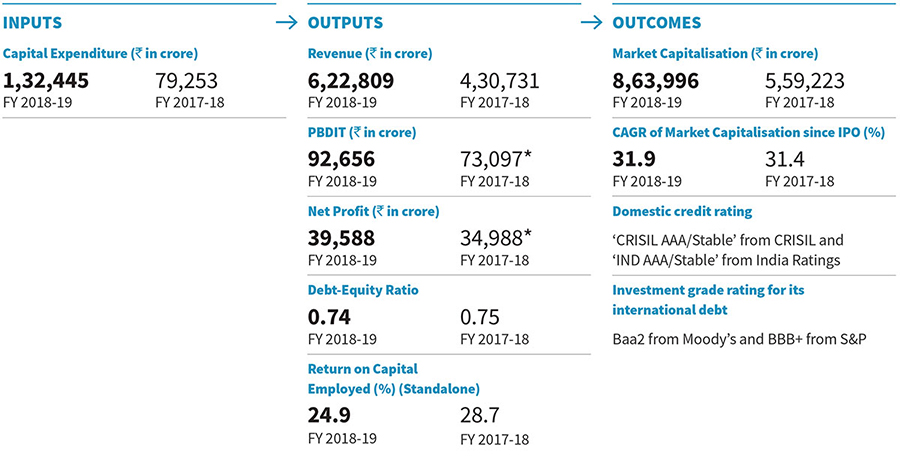
KEY HIGHLIGHTS
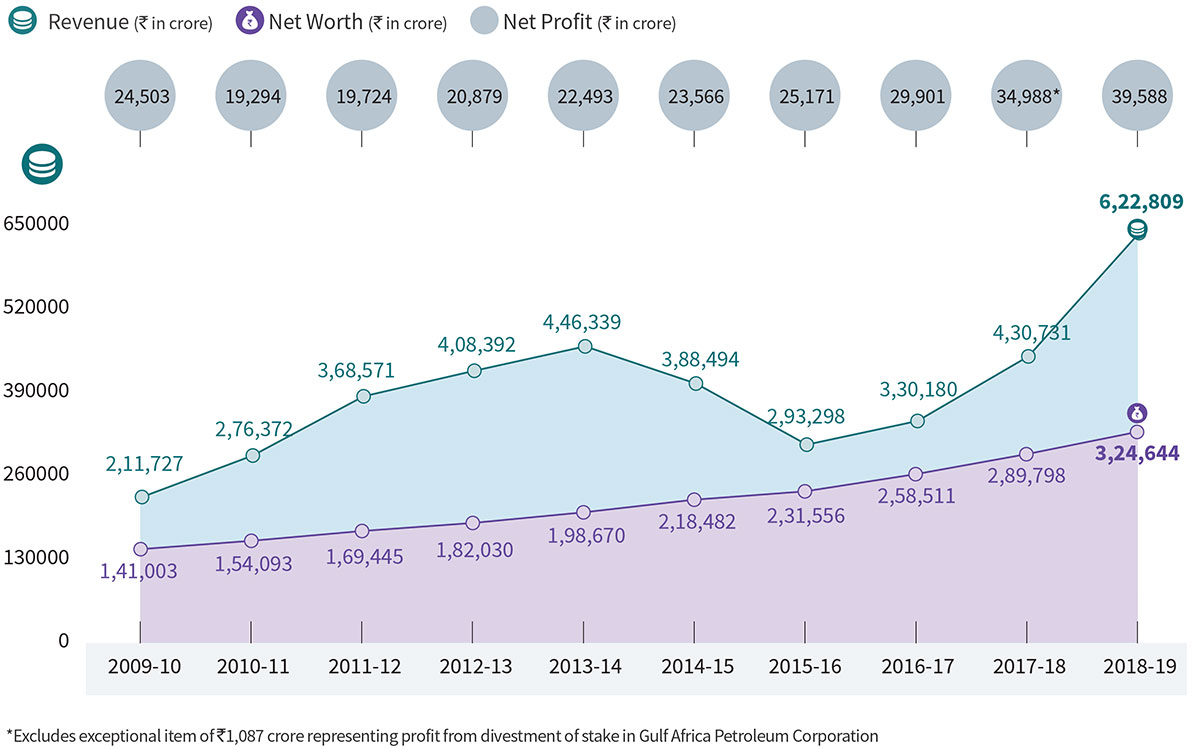

P.M.S. Prasad
B Srinivasan
Jagannatha Kumar
RIL, through its businesses, as well as through its community initiatives aims to progressively create more opportunities, thus creating enhanced societal value – directly and indirectly for the wider society. Through various initiatives such as Jio-GenNext and strategic investments, RIL is enabling platforms for startups to proliferate. This has helped create an environment which supports exponential growth of startups. There has been considerable focus on enhancing customer centricity. Customer-centric solutions for various products and services are helping the Company garner an extended outreach. This is achieved through a two-way approach including a wide network of brick and mortar stores, while simultaneously leveraging digital platform based offerings which are serviced by applications supported by Digital Services.
Social innovation is an important tool which the Company utilises through which its products and services ensure sustainable and inclusive growth. The Company’s nation-wide outreach ensures that economic prosperity is taken to the doorsteps of the farthest corners, ensuring abundance for all.
The Company will continue to work with every strata of the economy to benefit the society, industry and ultimately, the nation.
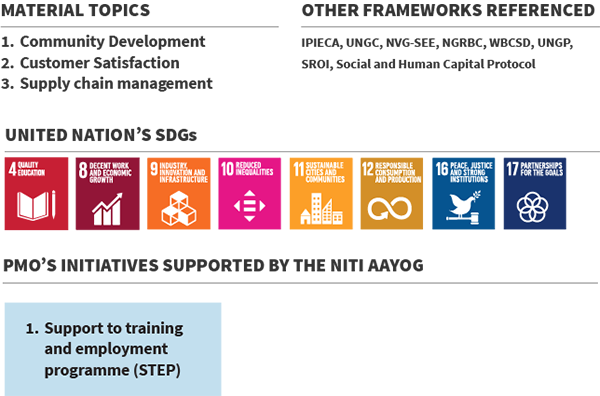
KEY PERFORMANCE INDICATORS
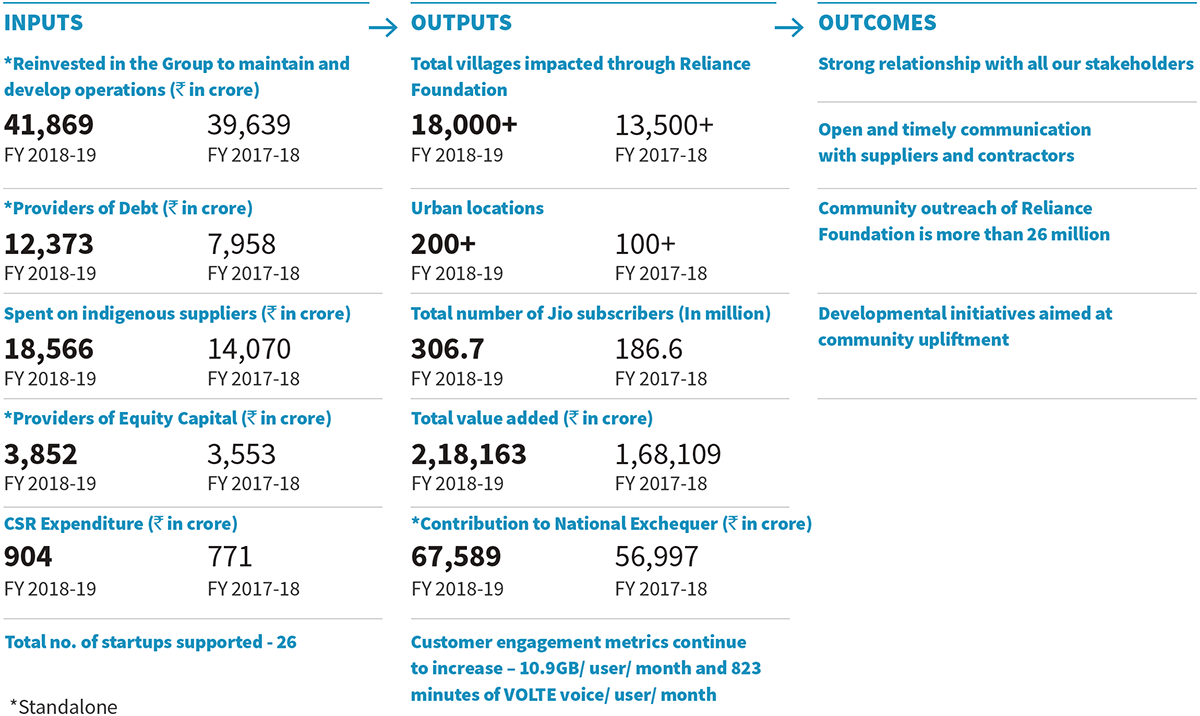
KEY HIGLIGHTS - RIL STANDALONE
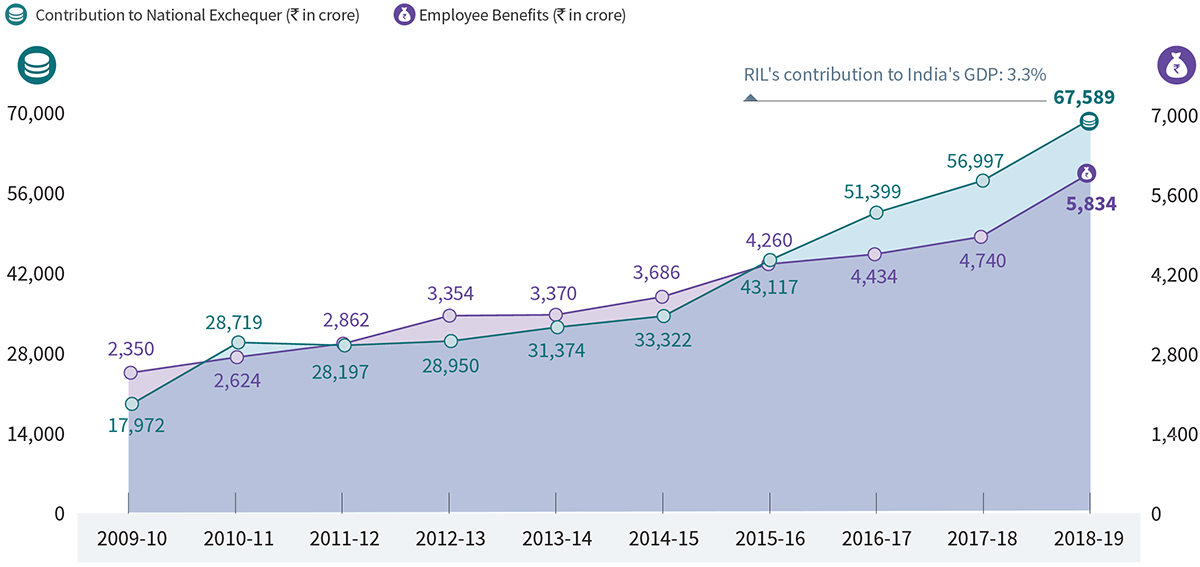
STAKEHOLDER ENGAGEMENT
Stakeholder's views, concerns and key expectations have been elemental in calibrating RIL’s business strategy. The Company maintains an
open and constructive dialogue with all its key stakeholders, namely, Investors and Shareholders, Employees, Customers, Suppliers, Trade
unions, Government and Regulatory authorities, Local communities and NGOs.
Internal and external stakeholders are mapped based on the analysis of topics which have the potential or actual impacts on the Company’s activities. RIL believes that engaging with stakeholders in a transparent manner helps in understanding their societal needs and expectations, leading to sustainable decision making and enhanced stakeholder value creation. In this regard, the first step is to identify the key priorities of the Company’s most pertinent stakeholders. For further details on the process, please refer to the RIL’s sustainability report at www.ril.com.
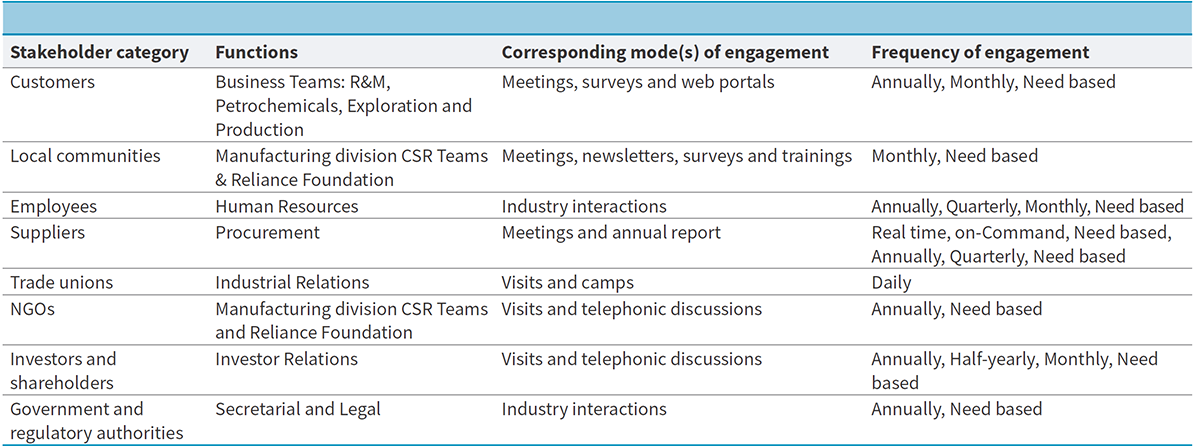
JIOGENNEXT: A UNIQUE STARTUP
ECOSYSTEM
JioGenNext has quickly established itself as
one of the leading corporate accelerators in
India since its inception in September 2014.
Over the years, it has played a pivotal role
in catalysing the entrepreneurial ecosystem
by assisting numerous early-stage
technology startups to achieve exponential
growth through mentorship, industry
connect and strategic partnerships.
JioGenNext supports startups on various
areas of business such as stakeholder development, product road map,
go-to-market strategy, customer acquisition
and engagement, talent hiring, pitching
and fund raising. Under the guidance of
the RIL leadership, it became the preferred
platform for exceptional founders to launch
their startup in the Jio ecosystem.
While Talent, Technology and Trust remain the three key pillars of JioGenNext, it is now incorporating a new framework of ASSURED, which stands for Affordability, Scalability, Sustainability, Universal, Rapid, Excellence and Distinctiveness. ASSURED is a tool or a framework given to every startup in the cohort. As they check off on each parameter, the startup’s success gets ASSURED and they tackle every possible risk that could lead to their potential downfall.
Each parameter when observed closely will ensure that a startup grows sustainably in the ecosystem while also ensuring that it meets the ultimate objective of a Digital India roadmap laid out by the Chairman.
KEY METRICS
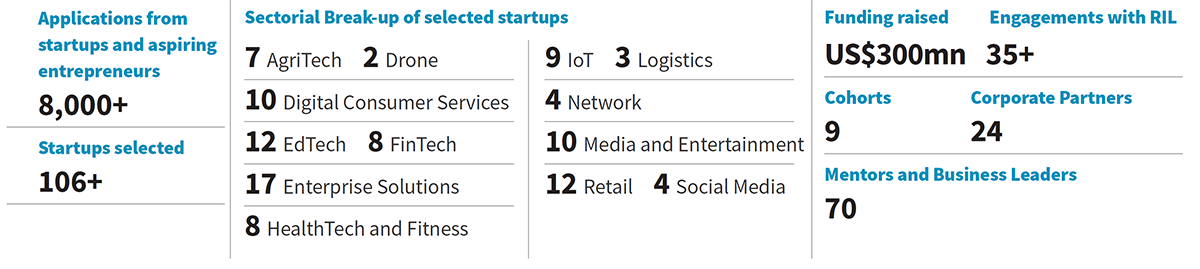
Jio-GenNext enables inclusive innovations to meet the needs of everyone. One of the challenges Digital Services aims to overcome is the poor and inadequate educational infrastructure by delivering high-quality education and skill trainings to schools, colleges and universities across the country through digital platforms. Once this is done, India will have one of the most digitally enabled education systems in the world. This has been the guiding principle behind the numerous EdTech startups. These entrepreneurs are providing unique educational solutions to an array of learners from different walks of life. Some of them are as below:
- Avaz (FreeSpeech) is the perfect app for anyone who is learning the English language, especially for the ones with special needs, such as autism, dyslexia and hearing impairments . It is also useful for anyone who is trying to make sense of English grammar.
- Guvi’s mission is to make technical education available to all in their native languages. Guvi offers technical video courses like Android, Python, Java, C, C++, Machine Learning, Big Data, MongoDB in vernacular languages, which are created by working professionals . These courses are available in various native languages like Tamil, Telugu, Hindi, Kannada, Bengali, etc.
- MadGuy Labs offers mobile-based exam test preparation services for government job aspirants in vernacular languages such as Kannada, Telugu, Marathi and Hindi, apart from English.
- Plowns is a platform for parents to store and share all the amazing things created by children like paintings, clay models, etc.
- Utter has built the world’s first mobile platform that enables English and Workplace Skills training for fresher’s and digital blue-collar workers. Powered by multilingual chatbots and expert tutoring, the platform has over 2 million learners so far.
These are few of the outstanding startups that were part of JioGenNext – Summer 2018 programme. Moving away from its sector-agnostic approach, JioGenNext launched thematic cohorts in 2018 with platform focus to go inch-wide and mile-deep in terms of startup engagement. JioGenNext conducted two Jio-centric market access days to showcase curated list of startups; ‘Cultivate’, for exceptional AgriTech startups that are transforming the food & agriculture value chain in India using digital technologies and ‘Jio Access’, for innovative Indian startups in the AI Voice and Vision space.
The other notable startup alumni included the following:
- Akasa Labs offer solutions in the areas of contracting, payments, traceability and tokenization for organisations with complex supply-chain networks, eventually creating value for end users.
- COSGrid Networks provide Software Defined Wide Area Network (SD-WAN) solutions that enable nimble operations for next generation IoT enabled enterprises.
- DataCultr Data Streaming platform enables enterprises to connect and control their data and devices in real-time, helping them take their IoT solutions quicker to market.
- Fabulyst leverages Computer Vision, AI and NLP to create virtual personal stylist for fashion commerce.
- LeanAgri aims to increase incomes of farmers by increasing farm yields through systematic implementation of scientific techniques, providing essential resources and regular monitoring.
- Signzy currently offers a digital on-boarding solution for banks, NBFCs and other financial institutions in adherence to the regulatory compliance.
- BigHaat is agri inputs marketplace platform providing a wide choice of quality inputs to farmers at their doorstep.
- Kritsnam is in the field of IoT with focus on water resources management.
- Proximal Soilsens Technologies brings affordable technologies for precision farming.
- FRS Labs is a technology company specialising in customer on-boarding (KYC), authentication and fraud prevention solutions for businesses.
- PiOctave creates video enabled interactive security smart devices and solutions.
- Slang is a Voice to Action platform, which can be used to quickly add a multi-lingual voice interface to any mobile app.
ILLUSTRATION
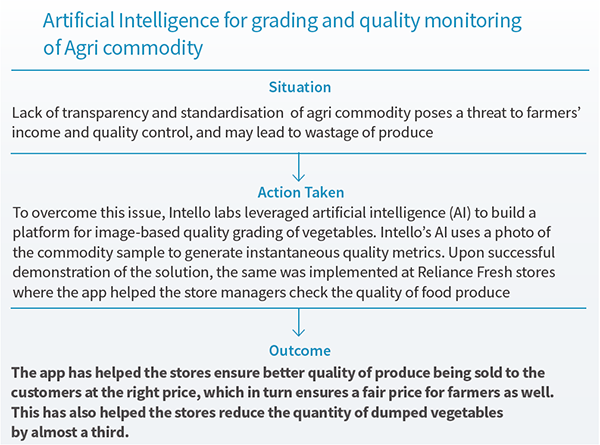
RESPONSIBILITY TOWARDS
SUPPLIERS
Suppliers are an integral part of the RIL’s
business performance. They are the key
drivers for development, manufacturing
and reliability of products, helping
the Company meet evolving customer
expectations. The Company’s supplier
base includes top performing engineering/
supervision companies, construction
companies, installation and commissioning
service providers, joint ventures and
consortia. Most of them have their own
sustainability programmes and disclose
their sustainability initiatives publicly.
In order to strengthen its relationship with suppliers, RIL has a board approved Supplier Code of Conduct and takes a formal acceptance from them for abiding by this Code of Conduct during the vendor registration process. It reflects RIL’s belief in its suppliers to achieve and adhere to its core values, and comply with labour, human rights, health and safety, environmental protection, business integrity and confidentiality laws and standards. Consequently, Reliance conducts a comprehensive sustainability assessment and rigorous screening process for registration and evaluation of all suppliers. The procurement team also conducts regular surveillance audits at suppliers’ sites to assess performance.
Supporting local economy has always been one the focus areas for RIL. The Company is continuously exploring the potential for development of suppliers hailing from socially and economically backward communities. The Company has procured goods and services (noncrude/ non feedstock) worth over `18,566 crore from indigenous suppliers. As the Company continues to grow its operations, it encourages suppliers to indigenise and expand their capabilities and increase their economic value.
RIL regularly engages with local villagers and small businesses around its areas of operation in productive employment, especially through vehicle hiring, material handling, housekeeping waste-handling and horticulture contracts, thus expanding its direct and indirect economic impacts. Through sustained investment in mega projects and operations, RIL has developed India’s chemicals and engineering supplier base and majority of the suppliers and contractors are based in India.
SUSTAINABLE SOURCING
The five focus areas of RIL’s sustainable
sourcing strategy are aimed at social
progress, economic development and
mitigation of environmental impacts.
The focus areas are:
- Energy management
- Environmental responsibility
- Product stewardship
- Occupational health and safety
- Social institution building
RIL’s sustainable sourcing ethos focuses on nine key parameters:
- Green packaging
- Environmental protection
- Regeneration/Safe disposal
- Contract worker care
- Community support
- Supplier collaboration
- Make in India and development of India’s engineering talent
- Learning through P&C academy
- Digitally stitched Procedure to Pay (P2P)
All of RIL’s suppliers and contractors operate in compliance to applicable laws and regulations, and labour laws. In order to effectively manage activities like manufacturing, distribution and the use of chemicals in the products, RIL has adopted RC-14001, an international environmental management system. The Company has sourced REACH (Registration, Evaluation, Authorisation and Restriction of Chemicals) compliant materials for improving human health impacts and the protection of environment. As part of this, even Tier 1 suppliers of the Company are required to procure REACH-compliant materials.
Apart from this, local vendor engagement, digital invoicing, contractor care and supplier query redressal are some of the Company’s other sustainable sourcing practices. RIL’s determination to reinforce local manufacturing, will help bridge the gap between robust domestic consumption and constrained supply, thereby leading India to become self-sufficient.
CUSTOMER ENGAGEMENT
Reliance drives customer value through
its product innovation for customers,
application and service levels, ability
to deliver a consistently high consumer
experience and its overall reputation and
brand promise in the markets it operates
in. To achieve this goal, Reliance has
undertaken various engagement strategies
to understand the voice of the customer.
RIL Petrochemical business is shifting from
traditional B2B business model to a B2B2C
model. R|Elan™ and Recron® Certified are
the brands that solely function on the
B2B2C model. By engaging directly with
brands and retailers who are well aware of
their target consumers, RIL is able to offer
unique and specialised solutions to cater
to the growing demand. This helps RIL
stay relevant in the fast-paced consumer
driven market. Retail business is leveraging
consumer insights through the use of
technology-enabled tools and enhancing
its core capabilities. Various channels
have been implemented across all store
concepts for capturing customer feedback.
These include feedback forms, customer
feedback registers, message services to
customers and online portals such as
ROMA, Litmus and Happy Calling. In Digital
Services business, customer engagement
begins right at the on boarding stage.
Customer feedback is taken at various
stages, including on-boarding, usage of
services and post resolution of customer
queries. Apart from this, calls from contact
centre, SMS and web links are also used as
feedback channels.
PARTNERSHIPS FOR CHANGE
GOVERNMENT AND OTHER GLOBAL
INSTITUTIONS
RIL is a member of several business and
industrial associations such as The World
Economic Forum, The American Chemistry
Council (ACC), Indian Chemical Council
(ICC), The Chemicals and Petroleum
Manufacturer’s Association (CPMA), Gulf
Petrochemicals and Chemicals Association
(GPCA), World Business Council for
Sustainable Development (WBCSD), European Petrochemicals Association
(EPCA), American Fuel and Petrochemical
Manufacturers (AFPM), Association of
Oil and Gas Operators in India (AOGO),
Federation of Indian Chambers of
Commerce and Industry (FICCI),
Confederation of Indian Industry (CII),
Associated Chambers of Commerce and
Industry of India (ASSOCHAM), Association
of Synthetic Fibre Industry (ASFI), Synthetic
and Rayon Export Promotion Council
(SRTEPC), and The Synthetic and Art Silk
Mill’s Research Association (SASM IRA).
The Company is cognisant of the importance of stakeholder interaction for preserving and protecting the environment. In a unique partnership with the Ministry of Environment, Forests and Climate Change (MoEFCC), the Government of India (Gol) and the Gujarat Ecological Commission (GEC), the Company actively contributed to the setup of India’s first Centre of Excellence (CoE) for the study of the coastal biodiversity of Jamnagar. This centre is known as the National Centre for Marine Biodiversity (NCMB).
Business Partnerships
Hydrocarbon
RIL has forged an strategic partnership
with BP that aims to combine Reliance’s
exceptional project management and
operations expertise with BP’s deep-water
exploration and development capabilities
in the Krishna-Godavari Basin. With a
focus on US shale oil, RIL has two joint
ventures with Pioneer Natural Resources
and Chevron for drilling and completion
activities. With a focus on Industrial
Internet of Things (IIoT) strategy and
the digital manufacturing platform, RIL
is exploring partnerships with industry
leaders such as GE, Honeywell, Siemens,
Emerson, Schneider Electric, among others.
Retail
Reliance Retail is setting up long term
exclusive partnerships with reputed
retailers from across the globe.
In categories such as food, fashion, toys and
much more, Reliance retail has partnered
with Disney to develop and market
co-brand SKU’s. In the premium denim
segment, Reliance Brands has ventured
with Replay jeans. To bring popular retail concepts like Pottery Barn, Pottery Barn
Kids and West Elm to India, Reliance
Brands has announced partnership with
Williams-Sonoma. The company has further
extended its presence by acquiring stakes in
Mothercare, British kids-wear brand
and Salvatore Ferragamo, an Italian
luxury brand.
Digital Services
With a focus on customer service and
engagement, Digital Services has entered
into a series of partnerships with a number
of organisations. Reliance has made
strategic investments in Hathway Cables,
Datacom Limited and Den networks in
order to provide global standard wireline
infrastructure and services in India.
Through group affiliates, the Company has
invested in Grab-a-grub (logistics), C-Square
(software), Netradyne (AI, logistics),
Reverie (language as a service platform),
Tech Media (new age journalism), SkyTran
(transportation technology), Radisys (5G,
IoT), EasyGov (e-governance), Sankhyasutra
(simulation services) and Haptik (chatbot
solution). In the sports category, Reliance
Jio has entered into an agreement with Star
India for the telecast of all cricket matches
on the JioTV platform. Jio has also tied up
with Zee to make available 37 TV Channels
to Jio subscribers on the JioTV platform.
To contribute to the education sector in
India, Reliance has acquired a majority
equity stake in Indiavidual Learning Pvt
Ltd. (Embibe), a leading AI-based education
platform leveraging data analytics to
deliver personalised learning outcomes to
students.
Academic partnership
To build and attract a pool of fresh talent
and next generation engineers in the
organisation, Reliance has collaborated
with various universities and colleges
across India and the globe. Some such
universities with academic partnerships
are Indian Institute of Science, Bangalore;
Indian Institute of Technology (IIT) –
Mumbai, Delhi, Kharagpur, Kanpur, Madras;
Institute of Chemical Technology (ICT),
Mumbai; Tata Institute of Fundamental
Research (TIFR), Mumbai; Florida State
University; Massachusetts Institute of
Technology and Washington University in
St. Louis Louisiana State University.
Social Stewardship
Jio has reached 306.7 million subscribers
and provides transformative, quality and
affordable access of end-to-end digital
services for every Indian. Impacts of
Reliance's products, services and community
investment activities on society at large is
mentioned under the Human capital, Natural
capital, CSR report and case studies sections
of the Report. Reliance's strategy is driven by
employee and societal value, which aims to
foster inclusive growth through job creation
and community development. Reliance
seeks to focus strategically on discrete
social problems, all aimed at enabling
lives and livelihoods. The Company is in
the process of conducting evaluation of its
social aspects using the Social and Human
Capital Protocol published by the Social and
Human Capital Coalition. Reliance adopts
rigorous processes to identify the impact
of its social initiatives created on primary
stakeholders. It establishes baseline values
of key indicators that describe the status
of stakeholders at the beginning of the
intervention and periodically assesses the
status of stakeholders with reference to the
baseline.
RESPONSIBILITY TOWARDS
COMMUNITIES
DISASTER RESPONSE
As a responsible business, Reliance swiftly
and effectively responds to disasters that
endanger human lives and livelihoods by
directly engaging with affected communities.
During FY 2018-19, the Company promptly
helped communities affected by floods and
cyclone in Andhra Pradesh, Kerala, Gujarat,
Odisha, Uttar Pradesh and Tamil Nadu.
For more details, please refer Report on
Corporate Social Responsibility on
page no. 182.
CLEANLINESS DRIVE - PROJECT
VERSOWAH!
Reliance worked extensively with Mr. Afroz
Shah and team for the clean up of Versova
beach in Mumbai and sponsored BobCat for
easy retrieval of solid waste off the beaches.
For more details, please refer Management
Discussion and Analysis on page no. 117.
Enabling the Fourth Industrial Revolution
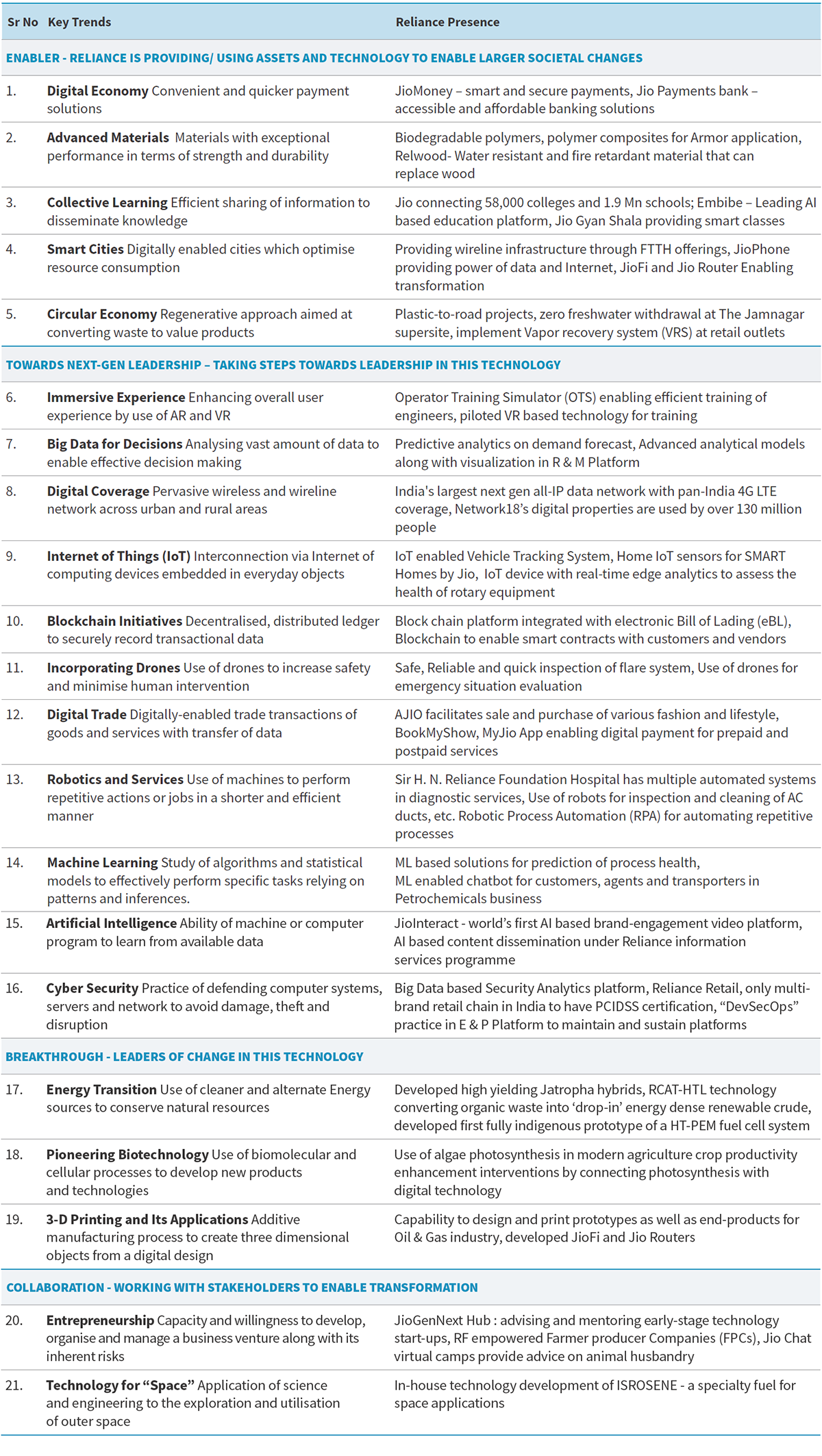
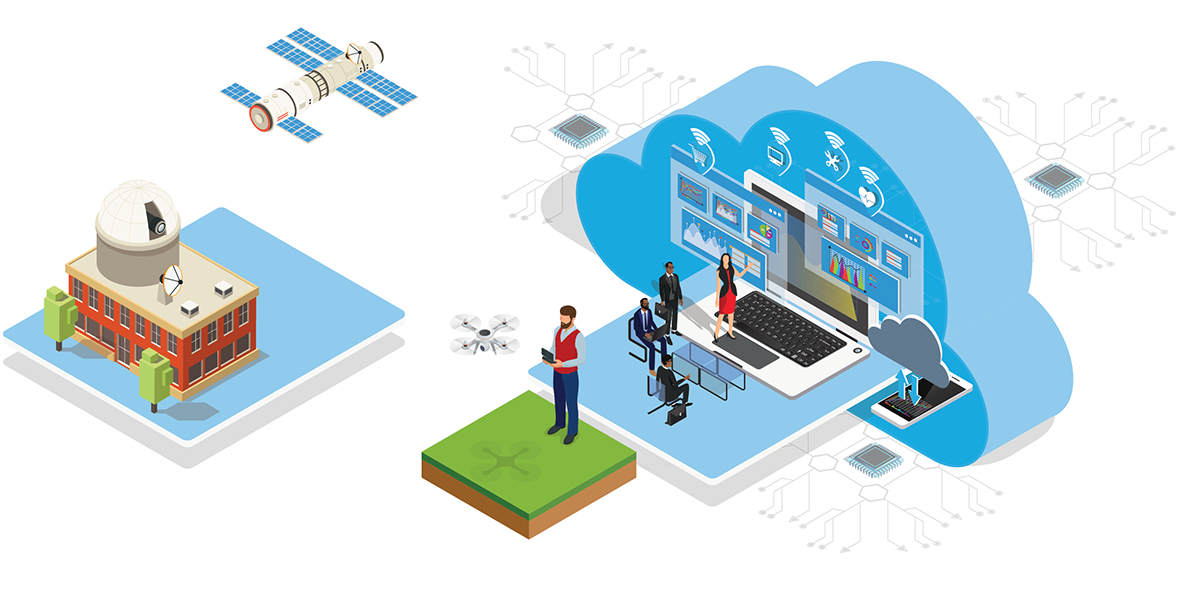
Reliance’s Sustainability Reporting Journey
RIL has been publishing sustainability reports annually since FY 2004-05 based on the Global Reporting Initiative’s (GRI) reporting guidelines. Reports published until FY 2013-14 have been GRI checked with an ‘A+’ application level. RIL was among the first companies to adopt the G4 guidelines and subsequently the GRI Standards. The Sustainability Report for FY 2017-18 was prepared in accordance with the “Comprehensive” option of the new Standards (including the Oil and Gas sector disclosures). The reports are externally assured as per the reasonable assurance requirements of the ISAE 3000 standard and Type II High level assurance using AA1000AS standards. RIL is also a member of World Business Council of Sustainable Development (WBCSD) and Global Reporting Initiative (GRI). WBCSD’s “Reporting matters” 2015 and 2017 have recognized RIL’s sustainability report as a leading example of the best practices. The reports are available at http://www.ril.com/ Sustainability/CorporateSustainability.aspx
In addition to the GRI Standards, the Report also refers to a large number of nationally and globally adopted frameworks including:
1) International Integrated Reporting
Council’s
2) Global Reporting Initiative (GRI)
3) United Nation’s Sustainable
Development Goals (UN SDGs)
4) American Petroleum Institute / The
International Petroleum Industry
Environmental Conservation
Association (API/IPIECA)
5) United Nations Global Compact (UNGC)
Principles
6) Business Responsibility Framework
based on the principles of National
Voluntary Guidelines on Social,
Environmental and Economic
Responsibilities of Business (NVG–SEE)
7) National Guidelines on Responsible
Business Conduct (NGRBC)
8) World Business Council for Sustainable
Development’s (WBCSD’s) focus areas,
9) Greenhouse Gas (GHG) Protocol
10) Task Force on Climate-related Financial
Disclosures (TCFD) recommendations
11) Natural Capital Protocol (NCP)
12) Social and Human Capital Protocol
13) United Nations Guiding Principles on
Business and Human Rights (UNGP)
14) The Global Recycle Standards (GRS)
Version 3.0 for traceability of fibre
15) Social return on investment (SROI),
16) Prime Minister’s Office (PMO) initiatives
for India / NITI Aayog.
The Report has been externally assured by KPMG India for selected sustainability related disclosures in the report as per Reasonable Assurance requirements of the ISAE 3000 (Revised) Assurance Standard. Please refer Page No 204-205.
As a key strategic focus area, sustainability is crucial to the delivery of the Group’s strategy and is integrated across all areas of business. The scope of sustainability reporting was extended to Reliance Retail and Digital Services since FY 2017-18. Until then the scope of reporting was limited to RIL and Reliance Foundation.
RIL conducts a formal materiality assessment in accordance with GRI Standards to identify and prioritise the most significant sustainability topics, set KPIs and targets for improvement that guide the content of the Sustainability Report. The KPIs and management approach for identified material topics undergo a monthly review through the sustainability council, which advises on improvement measures and action plans. Additionally, an annual review is conducted by the Board-level CSR and Governance committee.
MATERIALITY ASSESSMENT
RIL’s materiality assessment involves
the process of identifying and assessing
numerous potential economic,
environmental and social topics that could
affect its business and stakeholders and
prioritise them into key material topics.
The identification of material issues has
been largely aligned to the Company’s
risk management framework and its
strategic approach based on the four areas:
Strategic and Commercial risks; Safety and
Operations; Compliance and Control; and
Financial risks.
Reliance aims to build strong and longlasting relationships with its stakeholders through structured dialogues. For more information on Materiality refer to the Sustainability Report 2017-18.`
Link: https://www.ril.com/DownloadFiles/ SustainiabilityReports/RILs%20 Sustainability%20Report%202017-18.pdf
CAPITAL AND MATERIAL TOPICS
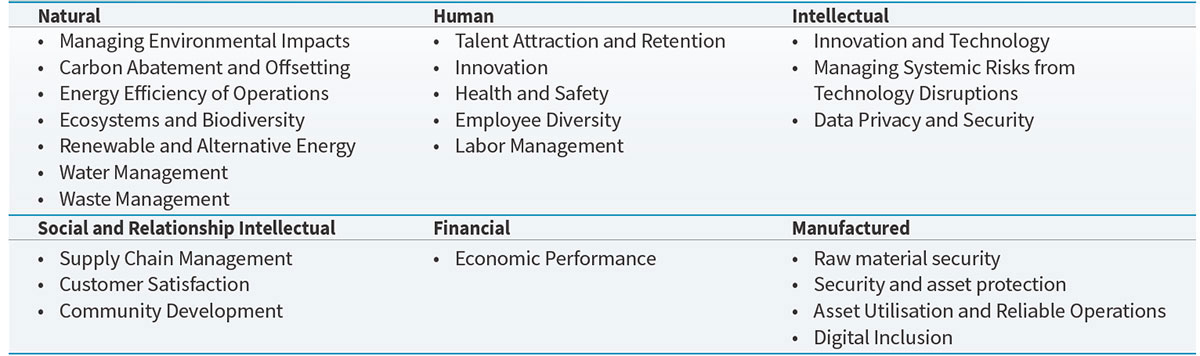
TASK FORCE ON CLIMATE RELATED FINANCIAL DISCLOSURES (TCFD)
TCFD was established by the Financial Stability Board with the aim of improving the reporting of climate-related risks and opportunities.
These recommendations guide the organisation on how to conduct business and drive commitment in the transition towards a low carbon
global economy.
Reliance has recognised the TCFD recommendations with a commitment to enhance its climate-related disclosures, and improve the management and reporting of climate-related risks. Reliance acknowledges the efforts around the world aiming to limit global temperature rise to two degrees Celsius above pre-industrial levels. The principles laid out in the TCFD recommendations are an important step which help move forward together to improve transparency and build better understanding of potential climate-related risks and opportunities.
CORE ELEMENTS OF RECOMMENDED CLIMATE-RELATED FINANCIAL DISCLOSURES
Governance
Strategy
Risk Management
Metric and Targets
Reliance’s governance structure includes avenues to exercise the oversight responsibilities with respect to climate change risks at multiple levels ranging from operations to Board of Directors:
1. Oversight and Governance:
a. Board of Directors
b. Board level CSR&G
Committee
2. Identification and
prioritisation
a. Business Risk and
Assurance Committee
b. Functional Risk and
Assurance Committee
c. Business leaders
3. Implementation and
Monitoring
a. Sustainability council
b. Governance and
integration
For more details please refer:
Risk and Governance -
Sustainability Report -
1. Analysis and description of all business segments of Reliance covering strategic advantages and competitive strength
2. Structured materiality assessment process in accordance with the GRI Standards
For more details please refer:
Management Discussion and Analysis -
Business Model -
1. Reliance has adopted a Three Lines of Defense model to enable continuous and real time assessment of risks:
a. Verification by functional leaders regarding risk management procedures.
b. Network of functional and business risk and assurance committees providing guidance on mitigation of identified risks to businesses.
c. Group Audit function providing assurance and advisory support on the management systems
2. Climate related risks leading to business opportunities–Our approach to circularity in operations including ROGC and gasification operations at Jamnagar
3. Changing the nature of doing business via new models such as B2B2C–Plastic recycling “Value out of Waste” – Integrated collection and processing
For more details please refer:
Risk and Governance -
1. Reliance has been reporting annually on its carbon footprint as a part of Annual and Sustainability Report.
2. In FY 2018-19 the GHG emissions decrease by 5.18% as compared to last year because of change in fuel mix. The energy efficiency improvement initiatives resulted in saving energy of 2.65 million GJ.
3. RIL’s manafucaturing plants have been allocated energy efficiency and renewable energy targets under the PAT and RPO schemes
4. RIL is committed to reduce the carbon intensity of its energy mix
For more details please refer:
Natural Capital -
Sustainability Report 2017-18 -
Board's report Annexure V -
Nikhil R. Meswani
Harish Shah
Laxmidas V. Merchant
A disciplined approach to risk is important in a diversified organisation like Reliance to enable the achievement of Reliance’s strategic objectives and to ensure that Reliance only accepts risk for which Reliance is adequately compensated. Reliance’s Enterprise Risk Management framework drives a consistent and systematic approach for identifying and managing risk, both at the strategic and operational levels. Reliance’s integrated risk management framework provides the capability for timely and informed response to address risks and to capture opportunities.
Reliance has a comprehensive Reliance Management System, a holistic set of management systems, organisational structures, processes, policies and governance framework. During the year, further progress has been made with driving a risk aware culture through continuous self-assessment processes based on clear accountabilities for risk and control ownership and ongoing oversight by designated Committees. Furthermore, Reliance is building on the investments in continuous controls monitoring capabilities across the Three Lines Of Defense, enabled by analytics technology, covering all key risk areas.
ENTERPRISE RISK MANAGEMENT
1. INTRODUCTION
Reliance actively stimulates entrepreneurship throughout the organisation and encourages its people to identify and seize opportunities. The current economic environment in combination with significant growth ambitions of the Reliance Group carries with it an evolving set of risks. Reliance recognises that these risks need to be managed to protect its customers, employees, shareholders and other stakeholders in the society to achieve its business objectives and enable sustainable growth. Risk and opportunity management is therefore a key element of the overall Reliance strategy. This section provides Reliance’s view on risk and the key risk factors for Reliance as well as how Reliance manages risks through Reliance’s Risk Management Framework.
2. RELIANCE’S VIEW ON RISK
2.1 Risk Appetite
Reliance’s risk appetite is linked to its strategic approach and is based on the stance it has taken across four areas:
- Strategic and Commercial: Reliance manages strategic risk in the pursuit of profitable growth in both mature and emerging markets. Given the volatile markets and economic climate in which it operates, the adaptability of its people, its service offerings and its infrastructure are key.
- Safety and Operations: Reliance is committed to conduct all its activities in a manner appropriate to avoid harm to employees and the community. Reliance strives to deliver safe, reliable and compliant operations.
- Compliance and Control: Compliance with laws and regulations is fundamental to maintaining its license to operate in the various industries that it operates in. Reliance also believes that accurate and reliable information provides a competitive advantage and is key to effective management of its business. It therefore accepts minimal risk in relation to reporting risks.
- Financial: Reliance manages financial risk to maintain a prudent financing strategy, even when undertaking major investment and therefore taking controlled risks in this area.
In Reliance, risk appetite is formally articulated through specific policies related to common risks, business decisions or activities. For example, policies such as financing and deal limits, vendor selection criteria, HSE, customer credit and new country entry describe the level of risk Reliance is willing to take, including the specific tolerances, limits and other boundaries within which decisions shall be taken or activities shall be carried out. These policies are then enforced through controls integrated in Reliance’s business processes and governance architecture.
2.2 Risk Factors
Reliance emphasises risks that threaten the achievement of the Group’s business objectives over the short to medium-term. As part of its annual planning process, Reliance reviews plan related risks, opportunities and uncertainties. It identifies those as having a high priority for particular oversight by the Board and its various committees and by Executive Committees. An overview of these risks is provided hereafter, including the actions taken to mitigate these risks and any related opportunities.
 STRATEGIC AND COMMERCIAL RISKS
Commodity Prices and markets:
Reliance’s financial performance is subject to the fluctuating prices of crude oil, natural gas and downstream petroleum products. Prices of oil, gas and products are affected by supply and demand, both globally and regionally. Factors that influence fluctuations in crude prices and crude availability include operational issues, natural disasters, political instability including geopolitical risks, economic conditions and Government pricing policy of petroleum products among others.
Mitigation: Since Reliance operates an integrated hydrocarbon business, some of these risks can be offset by gains in other parts of the Group. To mitigate the risks resulting from non-availability of crude and feedstock, Reliance has a diversified crude sourcing strategy from multiple geographies (Asia, the Middle East, West Africa, Latin/ South America, North America and North Africa) under both short-term and long-term arrangements. In addition, Reliance has put in place commodity risk management policies, which provide the framework for hedging of exposures from commodity trading positions.
Changes since last year:
There have been no significant changes in the nature of the risk exposures over the last 12 months.
Cybersecurity risk
As Reliance continues its journey with digital transformation, it faces an increased exposure to cyber risks. A digital security breach or disruption to digital infrastructure, due to intentional or unintentional actions, such as cyber- attacks, data breaches or human error could lead to serious business impact. These include revenue loss, loss of process control, impact on business continuity or damage to assets and services, harm to the environment, the loss of sensitive data or information, legal and regulatory non-compliance and reputational damage.
Mitigation: Reliance continues to strengthen its Cyber Security Posture through next generation Cyber Security Architecture to meet the demands of the digital transformation and protection against emerging cyber threats. Next generation architecture includes enhancement of the technical safeguards for prevention and detection of threats, situational awareness and automated security response.
Changes since last year:
Reliance’s industry continues to witness a growth in cybersecurity breaches, both in their prevalence and in their disruptive potential. Data Fraud/
Theft and Cyber Attacks have been identified in the top 5 global risks by the World Economic Forum (WEF) in its latest Global Risk Report (2019)
owing to rising cyber dependency with the increase in digital interconnection of people, things and organisations.
Considering the large digital footprint of Reliance, ongoing efforts are required to combat these evolving threats.
Some of the notable measures are:
- A Continuous Improvement Program (CIP) for cyber security that was instituted across Hydrocarbon, to keep pace with ever increasing threats and improve the security posture of the company, has now been extended to cover the other group companies of Reliance
- Innovative Cyber Security Initiatives including simulated phishing programmes were launched to spread awareness on Cyber Security
- Several businesses of Reliance are now benchmarked against ISO 27001, the global standard for ISMS (Information Security Management System)
- Reliance’s retail business operations (Reliance Retail and Petro Retail) process that involves payment card transaction processing is now certified to the global PCI DSS 3.2 (Payment Card Industry Data Security Standard)
- Big Data based Security Analytics platform has set up for proactive detection and remediation of threats with efficient detection techniques and improved incident response capabilities
Data Privacy Risk
New Data privacy laws are increasing the imperatives to protect personal information of individuals. The endless series of data scandals and breaches in the last year have transformed the way that citizens, governments and organisations think about data privacy globally. Currently in India, the Data Privacy requirements are governed by the Information Technology Act 2000, amendment 2008. Reliance is evolving its own Data Protection Policy based on Indian and global best practices.
Mitigation: At Reliance, Data Privacy is taken up as one of the top priorities. Reliance is committed to safeguard the privacy of individuals and ensures that they continue to trust RIL with their personal data or information. RIL has adopted the 'Privacy by default' principles in its approach to Data Privacy i.e., privacy of data and information is upheld first by default.
Changes since last year:
A group wide Data Privacy Framework has been established, which includes the following elements:
- A Data Privacy Policy has been published to all employees and is hosted on all RIL public facing applications
- A Privacy Impact Assessment has been conducted for all group companies
- As required by the existing privacy legal requirement, employees’ consent was taken to deal with the personal data as per employment contract
- Awareness Campaigns have been deployed across Reliance to promote awareness on Data Privacy
- Major businesses of RIL are ISO 27001 certified, which is a reasonable security compliance as per Information Technology Act 2000, amendment 2008
Jio Customer Experience and Retention
Reliance Jio has now more than 307 million customers on the back of an innovative customer acquisition strategy. Along with expansion of its current customer base, customer retention and experience are of utmost importance for Jio to generate sustainable business performance and return on its investments. Jio is committed to deliver on a differentiated customer experience and constant endeavor is to proactively mitigate any such risks that may weaken Jio’s value propositions, brand and customer loyalty.
Mitigation: To successfully capitalise on Pan-India all IP network, backed by extensive fiber and tower infrastructure to deliver next generation digital services and for ensuring sustained customer value proposition, Jio’s strategic and risk framework encapsulates the following mitigations/ plans:
- Leverage Jio’s Pan-India network foot print and digital ecosystem to expand Jio’s product offerings to diversify revenue sources and customer base.
- Ongoing investments and operational excellence in the network infrastructure contribute to delivering on full population coverage with superior customer experience.
- Jio Prime Membership Programme: A loyalty programme that not only offers most competitive monthly tariff plans in the industry, but also many other attractive deals and offers from both Jio and its partners to ensure retention and loyalty.
- Jio pricing and tariff strategy focuses on continuous innovation on products/service offerings keeping various customer segment needs, requirements and affordability. The offerings are always benchmarked with best value and quality service assurance vis-à-vis competition.
Changes since last year:
There have been no significant changes in the nature of the risk exposures over the last 12 months.
 SAFETY AND OPERATIONAL RISKS
Health, Safety and Environmental (HSE) risks in Operations
Reliance operates a wide spectrum of businesses in the hydrocarbon sector, which poses HSE risks that are managed through various embedded controls at multiple levels in the processes in the hydrocarbon value chain. The exploration & production of oil and gas and their further refining and processing is regulated by various HSE related regulations across the geographies where Reliance operates. A major HSE incident, such as fire, oil spill and security breach, can result in loss of life, environmental degradation and overall disruption in business activities. Risk management in Reliance’s hazardous operations involves technical risk analysis by competent and experienced teams. The risk assessments involve identifying the potential hazardous situations and the corresponding controls, including engineered controls and administrative controls that enable the risks to be within the organisation’s risk policy.
Mitigation: The Reliance HSE policy requires that ‘Safety of persons overrides all production targets’. This is underpinned with the HSE Management principle 'Reliance believes that all injuries, occupational illnesses as well as safety and environmental incidents are preventable.' This ensures that all employees strive for excellence in their own personal safety and the safety of others including employees, contractors, customers and the communities within which Reliance operates. In the consistent pursuit to achieve safe, reliable and compliant operations at Reliance, risk management is the fulcrum to achieve the goals. A separate Safety and Operational Risk (S&OR) function which is independent of the line, along with its embedded HSE function, provides oversight on safety and operating exposures and periodically conducts assessments and reviews to provide independent assurance on the conformance to the Operating Management System.
Changes since last year:
Reliance’s operating entities progressed risk management by reviewing risk registers and keeping them ‘Live’. There have been focused risk
mitigation discussion and actions that encompass strengthening existing controls and including new risk mitigation actions where appropriate. The
annual risk process sets objectives and timelines for each level of the organisation to enable smooth functioning of the safety and operational risk
management process.
Reliance’s cascaded governance structure has matured in driving holistic risk management and engages the line management actively. The key risks
in each facility are discussed in the various risk committee meetings and periodic assurance is provided for the effective control of the risks. The
three lines of defense for risk management enables managing the availability and adequacy of the controls.
In addition to the risk management process, a robust risk culture has been a focus, which included enhancing risk management competency among
the leadership and the asset facing personnel.
Reliance believes that conforming to the requirements of Reliance’s Operating Management System (OMS) will lead to long-term sustenance of
operating excellence and support Reliance’s goal of no accident, no harm to people and no damage to environment.
Safety and environmental risks during Transportation
Technical integrity failure, natural disasters, extreme weather, human
error and other adverse events or conditions could lead to loss of
containment of hydrocarbons or other hazardous materials, as well as
fires, explosions or other personal and process safety incidents during
transportation by road, sea or pipeline.
Reliance is exposed to a complex and diverse range of marine risks,
including exploration vessels, oil tankers, chemical tankers, gas tankers,
dry cargo vessels, and Reliance is operating a fleet of tugs port service
vessels and operations of port and terminal infrastructure. With most
crude being supplied to Reliance by vessel and the overwhelming
majority of refined products being exported by vessels, it is essential that
these activities are actively managed to avoid HSE incidents, oil spills or
disruption to business activities and processes.
Mitigation: An augmented ship vetting programme ensures that all vessels contracted to carry Reliance cargoes are screened based on risk prior to its induction. For incident response in shipping, formal documentation and cascading have been completed. Reliance is further improving the controls framework for road transportation working hand in hand with Reliance’s contractors. Reliance has supported the contractors in accessing quality training for their drivers and risk mitigation measures during the journey. Reliance has supported capacity building in the key areas impacting transportation safety, viz defensive driving training, route hazard mapping and real time tracking. Reliance’s contractors can use these in an integrated way to deliver safe operations while on contract with Reliance.
Changes since last year:
Additional road transport contractors have been utilising the services for improving safety in their operations. The emergency response
communication facility has been enhanced through a dedicated emergency response centre for road transportation in the country so that
contractors can immediately respond to any emergency.
Physical Security and Natural Calamity risks
Hostile acts such as terrorism or piracy could harm the Company’s people and disrupt its operations. Some of Reliance’s sites are also subject to natural calamities such as floods, cyclones, lightning and earthquakes. If the Company does not respond, or is perceived to not respond, in an appropriate manner to either an external or internal crisis, its business and operations could be severely disrupted. Inability to restore or replace critical capacity to the required level within an agreed timeframe would prolong the impact of any disruption and could severely affect Reliance’s business and operations.
Mitigation: Reliance maintains a proactive posture by continuously
monitoring and assessing emerging threats, vulnerabilities and risks to
manage its physical security. Global Corporate Security (GCS) is a distinct
function of Reliance mandated to de-risk, safeguard and secure the
Company by harnessing expertise from across the spectrum. The group
security function and embedded security teams provide assurance to
businesses at all levels with respect to the management of security risks
affecting its people, assets and operations. It actively monitors the threat
landscape to prevent / mitigate risks using a ‘de-risking’ framework,
ensuring safe operations and business continuity.
To respond to natural calamities, any disruption or incident, Reliance
maintains disaster recovery, crisis and business continuity management
plans.
Changes since last year:
There have been no significant changes in the security risk exposure over the last 12 months. Cyber threats, insider threats and terrorism risks
continue to be causes for concern globally. Continuous application of pre-emptive mitigation measures, proactive engagement with concerned
stakeholders and sustained relationships with sovereign agencies continue.
 COMPLIANCE AND CONTROL RISKS
Regulatory compliance risks
The evolution of the global regulatory environment and at home, the Government of India's ambition for reforms and transparency have resulted in increased regulatory scrutiny that has raised the bar with regards to regulatory compliance. This requires the alignment of corporate performance objectives, while ensuring compliance with regulatory requirements.
Mitigation: Reliance recognises that meeting all applicable regulatory requirements can be challenging. A comprehensive and digitally enabled compliance management framework has been deployed which is designed to:
- Understand changes to regulatory standards in a timely manner and assess their impact to strengthen decision making processes and integrate these in the business strategy of each of the industries in which it operates
- Convergence of risk, compliance processes and controls mechanisms to ensure continued operational efficiency and effectiveness of business processes
- Assign single point of accountability with appropriate responsibility matrix cascading till the lowest level of organisation
 FINANCIAL RISKS
Treasury risks
Treasury risks include, among others, exposure to movements in interest rates and foreign exchange rates. Reliance also maintains sufficient liquidity, so that it is able to meet its financial commitments on due dates and is not forced to obtain funds at higher interest rates. It has access to markets worldwide and uses a range of products and currencies to ensure that its funding is efficient and well diversified across markets and investor types.
Interest Rate risk
Reliance borrows funds from domestic and international markets to
meet its long-term and short-term funding requirements. It is subject to
risks arising from fluctuations in interest rates.
Mitigation: The interest rate risk is managed through financial instruments available to convert floating rate liabilities into fixed rate liabilities or vice versa, and is aimed at reducing the cost of borrowings.
Foreign Exchange risk
Reliance prepares its financial statements in Indian Rupee (`), but most of
the payables and receivables of hydrocarbon business are in US Dollars,
minimising the cash flow risk on account of fluctuations in foreign
exchange rates. Reliance avails long-term foreign currency liabilities
(primarily in USD, EURO and JPY) to fund its capital investments. Reliance
also avails short-term foreign currency liabilities to fund its working
capital.
Mitigation: Foreign exchange risk arising from mismatch of Foreign
Currency Assets, Liabilities and Earnings is tracked and managed within
the risk management framework.
The foreign exchange market is highly regulated and Reliance ensures
compliance with all the regulations.
Changes since last year:
There have been no significant changes in the nature of the risk exposures over the last 12 months. Monitoring mechanisms within the Treasury
function have been enhanced to further strengthen the control framework.
3. HOW RELIANCE MANAGES RISK
Reliance manages, monitors and reports on the principal risks and uncertainties that can impact its ability to achieve its strategic objectives. The Company’s risk management framework encompasses internal control in an integrated manner and is tailored to the specific Reliance segments, businesses and functions. It takes into account various factors such as the size and nature of the inherent risks and the regulatory environment of the individual business segment or operating company.
The Reliance management systems, organisational structures, processes, standards, code of conduct and values and behaviours together govern how Reliance conducts its business and manages associated risks.
Reliance’s risk management framework is designed to be a simple, consistent and clear framework for managing and reporting risks from the Group’s operations to the Board. The framework and related processes seek to avoid incidents and maximise business outcomes by allowing the management to:
- Understand the risk environment and assess the specific risks and potential exposure for Reliance
- Determine how to deal best with these risks to manage overall potential exposure
- Manage the identified risks in appropriate ways
- Monitor and seek assurance of the effectiveness of the management of these risks and intervene for improvement where necessary
- Report up the management chain to the Board on a periodic basis about how risks are being managed, monitored, assured and the improvements that are being made
3.1 Group Risk Management Framework
The Group Risk Management Framework is designed to help ensure risk management is an integral part of the way that Reliance works everywhere to enable risks to be identified, assessed and managed appropriately. The Group Risk Management Framework comprises three levels:
- Oversight and Governance– Reliance’s Board, along with executive and functional leadership, has articulated an absolute commitment of the Group to effective risk management and provides oversight to identify and understand significant risks, both long term and short-term. They also put in place systems of risk management, compliance and control to mitigate these risks. Dedicated Executive subcommittees review and monitor group risks throughout the year depending on the criticality and impact with the respective risk owners to drive a risk management culture.
- Business and Strategic Risk Management–Through Business Risk and Assurance Committees (BRAC), Reliance businesses and functions manage risk as part of key business processes such as strategy, planning, operations, performance management, resource and capital allocation and project appraisal. The BRAC’s do this by collating risk data, assessing risk management activities, reviewing near misses and incidents through root cause analysis followed by implementation of required improvements.
- Day-to-day Risk Management– Management and staff at Reliance’s facilities, assets and functions identify and manage risk, promoting safe, compliant and reliable operations. For example, Reliance’s Group-wide Operating Management System (OMS) integrates Reliance requirements on health, safety, security, environment, social responsibility, operational reliability and related issues. These Reliance requirements, along with business needs and the applicable legal and regulatory requirements, underpin the practical plans developed to help reduce risk and deliver strong, sustainable performance.
3.2 Continuous Assurance Through The Three Lines Of Defense
Reliance has adopted a Three Lines of Defense model to enable continuous and real time assurance on key risk exposures and the ongoing effectiveness of controls.
First Line of Defense
Business and Functional Leaders
continuously verify for themselves that
risk management activities they have
in place are effective. In conjunction
with the risk management activities
themselves, this monitoring activity
provides the first line of defense.
Second Line of Defense
A network of functional experts
provides Functional Assurance to the
Businesses in their area of expertise by:
- Providing a view, independent of the line, of risks within their area of functional expertise
- Setting standards for the management of risks and provide guidance on mitigations to relevant Businesses in their area of expertise
- Monitoring or verifying the effectiveness of controls and other risk management activities completed by the Business
Third Line of Defense–Group Audit
Reliance has established an
independent Group Audit function,
reporting to the Chairman of the Board
and the Audit Committee. The Group
Audit function is mandated to provide
assurance and advisory support on the
management systems that manage the
key group risks across all subsidiaries
and investments by the Reliance
Group. Group Audit function is aligned
to the key business segments in order
to deliver Group Wide assurance
coverage as part of the third line of
defense.
The Group Audit function has been set up as a multi-disciplinary teams that deliver assurance across all areas of risk including strategic & commercial, safety & operational, compliance & control and financial risks across all business segments. Specialised resources, real time assurance technologies, data mining, analytic techniques and external benchmarking of best practices are leveraged extensively to achieve Group wide assurance coverage and deliver audits in an efficient and effective manner. The Group Audit function operates in line with international auditing standards and continuously improves its functional capabilities to achieve world class assurance best practices.
| 1) | Downstream | The downstream commonly refers to the refining of petroleum crude oil and the processing and purifying of raw natural gas, as well as the marketing and distribution of products derived from crude oil and natural gas. |
| 2) | Upstream | The upstream includes searching for potential underground or underwater crude oil and natural gas fields, drilling exploratory wells, and subsequently drilling and operating the wells that recover and bring the crude oil and/or raw natural gas to the surface. |
| 3) | Complexity Index | The Complexity Index (CI) is a measure to compare the secondary conversion capacity of a petroleum refinery with the primary distillation capacity. The index provides an easy metric for quantifying and ranking the complexity of various refineries and units. |
| 4) | Gross Refining Margin (GRM) | GRM is the difference between crude oil price and total value of petroleum products produced by the refinery. |
| 5) | Crude throughput | Crude throughput is the total amount of crude that is processed in the refinery. |
| 6) | Crack spreads | Crack spreads are differences between wholesale petroleum product prices and crude oil prices. |
| 7) | Refinery Off gas Cracker | A refinery off-gas cracker is a petrochemical unit that uses the gas generated as a byproduct of refining operations. |
| 8) | Pet Coke Gasification | The gasifier converts petroleum coke, the lowest value refinery residue, into high value syngas. |
| 9) | Coal Bed Methane (CBM) | CBM is a form of natural gas extracted from coal beds. |
| 10) | LTE Technology | Long Term Evolution (LTE) is often referred to as the next generation wireless network beyond 3G, with the capacity to support a high demand for connectivity and supporting fast moving. |
| 11) | Additives | Specialty chemicals incorporated into fuels and lubricants that enhance the performance of the finished products. |
| 12) | Condensate | Hydrocarbons that are in a gaseous state at reservoir conditions, but condense into liquid as they travel up the wellbore and reach surface conditions. |
| 13) | Greenhouse Gas | Gases that trap heat in Earth’s atmosphere (e.g., water vapor, ozone, carbon dioxide, methane, nitrous oxide, hydrofluorocarbons, perfluorocarbons and sulfur hexafluoride). |
| 14) | Liquefied Natural Gas | Natural gas that is liquefied under extremely cold temperatures to facilitate storage or transportation in specially designed vessels. |
| 15) | SDG | Sustainable Development Goals - set of 17 goals declared by the United Nations |